Friday, July 21, 2006

Penultimate post on Küng’s Der Anfang

Concluding remarks on Der Anfang Aller Dinge Pt 2 of 3

Words of criticism and praise.

Throughout this journey across such a wide scope of subject matter, Küng’s argumentation has consistently been a tour de force of erudition, boldness, and immense learning and familiarity with the most recent developments in numerous branches of scientific study and theology. Particularly helpful for me was Küng’s comparison of the dynamic between evolution as chance, and God’s activity within it, with the tension between human works as truly human, yet also the outworking of God’s grace (cf. e.g. 1 Cor 15:10: ‘But by the grace of God I am what I am, and his grace toward me has not been in vain. On the contrary, I worked harder than any of them - though it was not I, but the grace of God that is with me’).

However, his work will not convince all, especially dyed-in-the-wool atheists and fundamentalists who have little time for the complimentary model Küng has pursued throughout. Nevertheless, even those sympathetic with Küng’s overall project will perhaps stumble on a number of (usually minor) issues, even though almost all of them are not original to or the focus of this monograph. Those points of contention that are not original to, but nevertheless occasionally voiced in Der Anfang aller Dinge, and which were hardly central to the argument of the book, but which will rightly continue to generate critical debate, include


  • his pessimism regarding the existence of extraterrestrial life (cf. this light hearted post)
  • his confidence in the relevance of an Ur-Ethos for interreligious ethical discussion,
  • his thesis concerning miracles, especially as compared to his less problematic treatment in On Being a Christian (discussed here, here and here)
  • his precise understanding of salvation in the world religions,
  • his assessment of the meaning of the resurrection of Christ,
  • and his ‘spirit’ theology which some will dismiss as simply heterodox.
Whatever disagreements some may have with Küng on such matters, Der Anfang aller Dinge is a work that all interested in the relationship between science and religion will be obliged to engage with.

Thursday, July 20, 2006

A huge thanks to Jim West, again!

Once again, a huge thanks to Jim West for sending me his copy of the Evangelische Theologie Zweimonatsschrift (the red book on the left), dedicated to the 70th birthday of Jürgen Moltmann!

There are articles, among others, by Wolfgang Huber, Miroslav Volf, Jürgen’s wife, and a real interesting sounding one: ‘Zum Stichwort “Augenblick”. Eine Theologische und kulturkritische Skizze’, by G M Martin.

Thanks a bunch, Jim! I should start a Jim West Fan Club, and produce badges with his smiling face impressed on them ... (and mine!, while clutching all my Jim-given books!)

The book on the right (Die Sache mit Gott, by Heinz Zahrnt [Piper, München, 1966]) comes with my highest possible recommendations. It is absolutely un-put-downable! For those who want to learn a little more about Barth, Bultmann, Brunner, Tillich etc., and their contributions, this look at protestant theology in the twentieth century (up till the 60s) is written as smoothly as silk, and I’ve learnt a great deal already. It is literally keeping me up at night; I just can’t get enough.

For those of you who don’t read German, then let me recommend this little volume to you to improve your language skills. It is well written (he even pokes fun at Barth’s long sentences!), and the language is manageable for those who may not know too much German. A good book, in other words, to help get you interacting with theological German, without having to jump in at the deep end – and a superb read, all at the same time! Get it! Read it! You won’t regret it!

Oh, and be sure to read Exiled Preacher’s review of Tom Holland’s Contours of Pauline Theology.

Wednesday, July 19, 2006

Existence of heaven proved!

‘Hoffentlich bist du, lieber Leser, nicht durch diese meine beißende Ironie verletzt’ (Zwingli)

WorldNetDaily reports: New ‘scientific evidence’ that heaven is real

‘Until now’, they observantly point out, ‘heaven has been just a matter of faith’.

But not any more, oh no. No more silly faith when we can prove it:

They continue: ‘a new documentary, “The Evidence for Heaven,” available exclusively through WND’s ShopNetDaily online store, offers scientific evidence for the afterlife’.
----
Here is a typical stream of thoughts in my brain when confronted with such silly, even if well intentioned, claims:

*aware of my stunned, blank face*

*faith in humanity wilts*

*thinks about becoming an atheist*

*But then remembers Jesus. Feels foolish for atheism thought. Repents*
----

That’s not all. They also serve a nice helping of dualism to top it off:

‘Is there something beyond this life’, they ask, ‘a spiritual realm of some kind where the soul resides when we lay this body down?’

AHHHHHHHHHHHHHHHHhhhhhhhhhhhhhhhgghh. NOOOooooooooo! Bad theology, consumerism, naïve epistemology, anti-intellectualism and platonic notions of the soul and heaven - all for the price of one article.

When will the torture end? When will people stop leading me to webpages that DRIVE ME NUTS? You know who you are, and you know it makes me mad. Just the other day, a ‘friend’ told me of a lovely discussion page where one fundamentalist chap had decided to caution the author of the blog for quoting C S. Lewis, ‘for he is not a Christian’, and all because Lewis didn’t fit his own wack-job frigging messed up pile of theological wackiness. I read this ‘scientific proof’ and I want to gouge my eyes out, hide under a bed, swing on a noose, drown in cynicism.

Tuesday, July 18, 2006

Concluding remarks on Küng's Der Anfang

Concluding remarks on Der Anfang Aller Dinge Pt 1 of 3

Now I’ve reached the end of my review of Küng’s book (and thank you for all who have read my posts and made many thought-provoking and helpful comments), I have just a few posts to put on the blog that will summarise some of my thoughts, and look back on the whole series.

The skeleton upon which the meat of the whole book hung can be summarised as follows:
Küng’s reliance on Kantian epistemology, the biblical narratives, existentialism, and an interreligious ecumenism, all surfaced at numerous points, and came to explicit expression in his repeated attempts to encourage epistemological humility from both those in the scientific as well as in the theological communities, while at the same time pointing towards a free and existential trust in an Urgrund. However, especially in relation to his eschatological arguments, the theology of God as Spirit, and his discussion concerning miracles, the influence of Hegel and his correlationist tendencies were also felt. This was all married to a strong, yet not uncritical, confidence in the proposals of modern science, and out of this dynamic his arguments found their form.

Some of the critical matters will be overviewed in the next post in this series.

Monday, July 17, 2006

A sin-filled podcast

Jim’s recent, impassioned and tear-jerking attempt promoted me, perhaps, but I spontaneously decided to do a podcast tonight, on a subject that we all hate to love ...

SIN! (Pronounced Siiiiiiiiiiiiin, if your are called Cardinal Spin. Or if you’re puritanical. Or just plain odd.)

Yep. Sin has been on my thoughts much recently. If you know what I mean.

In my thesis, I’ve just moved on to my exegesis of 2 Cor, and my friend, Volker, recently delivered a paper on 2 Cor 3:18 in Tübingen, and so I’ve worked some of my own thoughts about that verse around my ponderings on the nature of sin in Paul.

I won’t go ahead and say what I said cos that would be stupid, so I’ll just write:

click HERE to download my latest podcast (it’s only 2MB and just over 10 minutes long – crikey, 10 minutes! What did I say that took so long?!)

I’m afraid that I’ve been having real problems with the audio recording due to a faulty microphone, so the quality is almost as bad as my preparation, but I hope you find some of the thoughts interesting, and perhaps even helpful.

By the way, I forgot to mention Berger’s work on the nature of sin in relation to Rom 7. He claimed, in Identity and Experience in the New Testament, that desire is the means by which sin rules over a person.

Sunday, July 16, 2006

Approaching the end of this 7 month review of Küng's Der Anfang aller Dinge!

We are fast approaching my final post on Küng's Der Anfang aller Dinge. There shall follow a couple of posts in summary of the whole thing, but this posts ends the commentary on the text as such.

Review of Hans Küng’s, Der Anfang aller Dinge, Epilogue, Pt. 2 of 2.

In short, Küng answers this question (cf. the end of part 1 of my review of Küng's Epilogue) in the negative. The end-time stories in the bible are not chronological revelations, satisfying our curiosity with mere information concerning the last days, and to read the bible in such a way is to misunderstand it. Rather:

‘The haunting visions of the Apocalypse are an urgent warning to humanity, and individual humans, to recognise the seriousness of the situation ... The bible doesn’t, therefore, speak in the language of scientific facts, but in a metaphorical picture language’ (223).

And this language, with its actual meaning, is to be translated into the horizon of modern people, and not to be taken literally. And what is the actual meaning? These pictures stand for the hopped for and feared, and particularly represent a faith confession about the completion of the work of God in his creation. ‘Therefore, theologians have no motivation to prefer one or the other of the scientific world-models over the other, though truly they have an interest to portray God as Origin and Perfecter of the world, understandable to humans’ (224). For if God exists and one accepts this, not in light of certain ‘proofs’ but in enlightened trust, then God is surely not only God for here and now, but also at the very end.

Ending on a personal note, Küng writes: ‘Personally, I have accepted Blaise Pascal’s bet, and set myself on – not on the grounds of probability calculations or mathematical logic, but on the basis of a reasonable trust – God and the Endless, over against nil and nothing’ (225). Though Küng doesn’t believe in what he dismisses as the later legendary NT resurrection stories, he accepts their original core, that Jesus didn’t die into nothing, but into God. So die we, into God. And even if Küng’s Pascalian ‘bet’ proves to have failed, ‘I didn’t loose anything in my life. No, I lived a better, happier and more meaningful life than if I had lived with no hope’ (225).

The end of all things, then, is the hope to ultimately die into the light: ‘And there will be no more night; they need no light of lamp or sun, for the Lord God will be their light, and they will reign forever and ever’ (Rev 22:5)

Saturday, July 15, 2006

Christ as crucified, and Christ as risen

‘Viewed “according to the flesh” (kata sarka), Jesus is “Christ crucified”, an image of weakness and degradation; viewed by faith he is the “Lord Messiah” (1 Cor 12:3), the place where God’s transforming power breaks into the perishing world’
(An Introduction to the NT, David deSilva, 587).

A nice quote, with just a couple of qualifications necessary that I’m sure David wouldn’t grumble with.

First, it is precisely as Christ crucified, that Jesus is the Lord Messiah (cf. 1 Cor 2:2). Christ can only be proclaimed as the crucified, but when he is, he becomes present as the risen One!

Second, Jesus isn’t a place, but understood primarily by Paul in personal terms, as a risen and glorious Person. The relational connection believers have with the risen Lord may well be described in spatial terms, as Paul hints at with the ‘in Christ’ language, but this spatial metaphor is bound to the relational, thus I would prefer an interruption in the above sentence.

Oh yes indeedy, I feel very pernicious today!

But as I read this yesterday, the words literally gripped me and drew my thoughts to the debates surrounding ‘natural theology’ and the nature of faith.

Only in faith can we recognise the crucified one as Christ, a perception that cannot be reduced to a logically compelling deduction from the evidence for the resurrection. But when, in faith, we grasp the activity and love of God in the crucified Christ, the very power and presence of God mediates the risen One to us.

Küng on the end of all things

Review of Hans Küng’s, Der Anfang aller Dinge, Epilogue, Pt. 1 of 2.

Epilogue. The End of all Things

Rather appropriately for the end of a book dealing with the ‘beginning of all things’, Küng concludes by asking: What will happen to the universe in the future? What is its end fate?

Scientists have made two suggestions. First, the universe will continue to expand until it stops, and becomes still. Then it will start to contract until it collapses back in on itself into a ‘big crunch’, one which could lead to another ‘big bang’. Second, the majority opinion among astrophysicians, is that the universe will continue to expand without ever stopping. Slowly, over millions of years, coldness will grip the whole universe until all that is left is death, absolute night (cf. 220).

The apocalyptic visions of the end of the world are common among conservative Christians. Indeed, they have also grabbed the imagination of the wider public in light of the Atom Bomb and the looming threat of ecological breakdown, and are expressed in numerous Hollywood films (e.g. Armageddon) and works of popular literature (e.g. the Left Behind series). In light of this, Küng laments that such works of fiction, and others like Dan Brown’s novels, could be taken as historically credible.

However, also in the bible, passages lend to the notion of a catastrophic end of the world (e.g. Mat 24:6-8, 29). But do they mean what many conservatives Christians think they do? We turn to address this question in the next post.

Friday, July 14, 2006

Küng and the origins of the World-Ethos

Review of Hans Küng’s, Der Anfang aller Dinge, section E, Pt. 4 of 4.

5. Beginnings of the human ethos

The development of human ethical behaviour is linked to evolutionary and socio-cultural factors. They belong together. Indeed, there has never been a people group, Küng asserts, without a religion or an ethos. Even in the earliest cultures there has been a sense of justice, respect of life etc., and notably so the world over. This means that ‘Today’s living in space “World-Ethos” is based ultimately upon a biological-evolutionary pre-given, in the time tested “Original-Ethos” (Ur-Ethos)’ (213).

How does an Ur-Ethos relate to biblical ethics? First, those found in the bible are not necessarily original in and of themselves. The accounts of the giving of the law are original, not so much in the content of the morality commanded, but in the fact that it is a covenant command, involving exclusive allegiance to Yahweh. What about Christian ethics? Is there a specifically Christian ethic? Actually, the only thing unique to Christianity, Küng insists, is not morality, an abstract idea, or anything else, but the concrete and crucified Jesus as the living Christ’ (cf. 215). This Jesus, this Person, possess a realisability, clearness and audibility, more than any idea or abstract principle. He becomes orientation for an ethically floundering, meaningless, drugged up and violent society. He is, after all, called ‘the light of the world’ (Joh 8:12). However, this is not, Küng goes on, to deny the presence of ‘other lights’, as indeed Islam, Confucius, Hinduism etc. is for millions of other people in the world.

And what does a World-Ethos have to do with the religions? Küng answers:
‘The instructions of the World-Ethos can be for this world-responsibility, a ground-orientation, and one that in no way excludes the special orientation in ones religion or philosophy. Quite the opposite, each can contribute, in their own way, to a World-Ethos’ (217).

Thursday, July 13, 2006

Küng and the reality of human freedom

Review of Hans Küng’s, Der Anfang aller Dinge, section E, Pt. 3 of 4.

4. The limits of brain science

The most recent research has shown that the closer neuroscientists analyse the functions of the brain, the less they actually understand, in light of the usual models, central aspects of the consciousness. So, the prophesied explanation of the relation between brain and consciousness is not, now many claim, to be expected at all (cf. 200-201). Indeed, ‘Brain research offers, at this time, no empirically provable theory about the coherence of spirit and brain, of consciousness and nervous system’ (202).

In terms of the ‘freedom’ debate, in certain situations the decision process of our whole brain enables one to even resist limbic reflexes. And in that, Küng insists, is freedom of will made clear: to set goals and values, and to follow them through, independently of external or internal foreign influences (cf. 204)

But does an ‘I’ exists to make these goals and follow them through?

Citing the words of the neuroscientist, Wolfgang Prinz, Küng maintains: ‘Biologists can explain how the chemistry and physics of the brain functions. But no one knows, up till now, how this becomes an “I” experience, nor how the brain creates meaning at all’ (204). Besides, the ‘spirit’ of a human hardly resides simply in the brain, but in the entire bodily life of a human. The ‘I’ is certainly a social construction, but precisely therefore it is no illusion.

Furthermore, freedom is complex. One could probe around in a brain and never find ‘freedom’. And this is freedom comes to us as an experience. However conditioned I am by my environment and the processes in my brain, whether I sit or stand, speak or remain silent, the person is always conscious that responsibility for such decisions lays in his or her hands. This is, then, an understanding of freedom that doesn’t simply focus on this or that brain function, but on the whole bodily life of the human, and in this context makes a good deal of sense.

Küng on freedom and neuroscience

Review of Hans Küng’s, Der Anfang aller Dinge, section E, Pt. 2 of 4.

2. Turning from physical development, Küng addresses the question of ‘freedom’.

The question of ‘freedom’ Küng calls a ‘problem’, one that shall concern him for much of the rest of the section. Having declared the traditional body/spirit dualism of Plato-Augustine-Descartes futile, Küng observes that ‘soul’ is hardly the commonly used label these days anyway. Today, one speaks of the psyche, thus resisting dualism. Agreeing with the general theses of Pannenberg’s extensive study, Küng concludes:

  • the Person, the ‘I’, is neither the ‘soul’ nor the brain, but the entire living, feeling, thinking, suffering, acting person – a line of reasoning that shall be of value for his later discussions on the nature of freedom in relation to the brain.
  • body and psyche are a unity, and ‘soul’ should only be understood metaphorically, poetically, liturgically etc., but never literally.
  • ‘Consciousness’ is a psycho-pyshcical process, not a spiritual ability outside neural substratum.
But does this mean that ‘spirit’ is just a secondary effect of brain functions? And does this not imply that any notion of human freedom is constrained by the neural workings of the brain? Indeed, recent studies in human sociality would emphasise that restrictions on human freedom are even more pronounced from without, not just in relation to patterns of neural synapses and the like.

Nevertheless, Küng affirms, the human is precisely within these constrains, free. Yes, the human is environmentally conditioned, but surely humans shape the environment. Yes, the human is genetically pre-programmed. But even here, the human is not entirely ‘pre-programmed’. However, Küng will devote considerable space in the following in expanding on how one can understand human freedom in light of modern science.

3. Brain and spirit

Discussions concerning ‘freedom’ have come particularly to the fore recently in light of the latest brain research. Surely the soul didn’t fall from heaven; it is a product of evolution. Hence, one may be correct to assert that the ‘I’ is entirely determined by physical-chemical brain processes. Thus ends the ‘freedom’ debate? Indeed, no theologian should ever, Küng insists, simply bring ‘God’ into this debate, and too quickly seek a theological resolution, as such language would simply speak past the scientist. Küng, on the other hand, wants to build bridges between theology and science and will do so by focusing his analysis upon the question: ‘Is freedom of will an illusion?’ In answer to this question, Küng simply insists upon more scientific humility. Physicists, Chemists and neuroscientists cannot answer such philosophical questions in their studies. They are focused upon the empirical, the concrete structures of consciousness, but to answer questions of freedom is to immediately colour scientific research with (perhaps unintended) philosophical commitments. Especially in light of the impotence of brain research to answer responsibly to questions of responsibility and guilt, one must resist reductionism. This line of reasoning, Küng expands in the next subsection.

Wednesday, July 12, 2006

Making discoveries with God

I’ve just uploaded this post, on Jüngel’s sermons, on the relatively new group blog ‘God as the Mystery of Theology’, a theological forum for reading and discussing the work of Eberhard Jüngel.

Küng on the physical development of the human species, and their religiosity

(Note on the picture to those who know how hairy I am: This isn't a picture of me)

Review of Hans Küng’s, Der Anfang aller Dinge, section E, Pt. 1 of 4.

Are humans anything other than physical stuff, and is the person more than the firing of electronic synapses in the brain? What is a human? What is the ‘I’? To such questions, Küng now turns.

E. The beginning of the human race

1. The physical development of humans

Küng spends a while detailing the standard theory concerning the evolution of the human species (Homo habilis - erectus etc.), while at the same time dismissing some associated myths. During his overview, Küng points out the key role played, in this process, by the growth of the human brain, a subject that shall busy Küng later in the section. An important feature in this growth was the development of a complex syntactical speech, something that differentiates humans from their nearest relative, the Chimpanzee, and led to the human ability of strategic thinking and self-reflection.

Clearly reflecting something of Küng’s Welt-Ethos sensibility, he concludes the section with the words:
‘Never to forget: Aborigines, Bushmen, Asians, Europeans or Americans – these are not different kinds of humans, they all present one single kind of human, the same family of humans. And even if we are very different in our outward appearances, we probably all have, as molecular genetic analysis shows, one common origin. Under our skin we are all Africans’ (184)
In light of the evolutionary model expanded on in the previous section, Küng addresses the question: What are the earliest traces of religion?

In a nutshell, he argues that the two extreme theories concerning the development of religion (that use the Australian Aborigines as a test case) which purport, on the one hand, that magic was first then religion (e.g. Sir James G. Frazer), and on the other hand, that monotheism was first, followed by polytheism (cf. P. Wilhelm Schmidt), both lack empirical evidence. Indeed, an original religion (Urreligion) one can find nowhere. Nevertheless, following the recent presentation of Ina Wunn, Küng affirms that the earliest traces of religiosity are to be found in the Old and Middle Stone ages. Thus, even non-human extinct races of human relatives had religious tendencies, ‘upon which the religions of historical times built’.

Reviewing Küng

My review of section D of Küng’s Der Anfang aller Dinge, was rather lengthy, not least because of the discussion it generated but also because the contents fascinated me. It is not finished either, as I intend to write a series of posts on the question of panentheism, a matter thrown to the light in Küng’s treatment of God’s activity in the world as Spirit.

However, I actually want to finish my review on the whole book, first – I’ve been writing this review on and off for over 7 months, after all!!

Section E is the last (followed only by a short Epilogue), and I shall not spend as much time on it for the simple reason that it didn’t interest me as much. Nevertheless, there are some fascinating topics covered by Küng, so I hope it will be of interest to my readers still.

The following review of section E (cf. here to orientate yourself) shall be divided into 4 parts.

Tuesday, July 11, 2006

Bauckham's Eyewitnesses

Bauckham’s forthcoming book (Jesus and the Eyewitness) mentioned here is really quite a read with some claims that will make the jaws of most drop to the floor with a clatter. I wanted to wait until I finished my exegesis of 1 Cor before I started reading it, but now that I have, even after having read just the first chapter, my brain has already crashed and rebooted a couple of times. I may need new software.

While on the historical Jesus, do have a look at this excellent list of books (I love these sort of posts!) suggested by Chris Petersen of Resurrection Dogmatics. He says that James Dunn’s Jesus Remebered is the last book on the historical Jesus he plans to read for a while - but hang on, Chris, for Bauckham’s.

I wonder too, if many of my readers know of Rainer Riesner’s, Jesus als Lehrer: eine Untersuchung zum Ursprung der Evangelien-Überlieferung (Tübingen: Mohr, 1988). Rainer’s scholarship is always top-quality, and I mention him not only as his is a neighbour of mine.

‘But it’s written in German, Chris’, I hear you protest.

Well, not to worry. Last year, I translated from German (and I think cleaned up parts that were an attempt at English) a summary article of the book, written by Rainer himself, entitled: ‘From the Messianic Teacher to the Gospels of Jesus Christ’. It, of course, gets my highest recommendations (though I forget where it was published. If anyone wants to know, I’ll check it out).

Monday, July 10, 2006

My 'Opposite Blogging Day' contribution

OK, this might not be entirely what Rick Brannan had in mind when he suggested some attempt an ‘opposite blogging day’, but my creative juices weren’t driving me in any other direction, and my analytical energy levels certainly couldn’t manage anything even remotely serious.

So, I’m glad to introduce you, tonight, to Cardinal Spin. In the following, he shall be sharing his considered thoughts concerning that most sensitive of subjects: ‘Christian counselling’

-------------

Thanks for giving me this opportunity, Chris, to post on your blog. You come across a bit liberal sometimes though, so stop it and start using the KJV you freak.

I want to share my thoughts on my approach to ‘Christian counselling’, as so many get this wrong. To do this, I will give an example from my own ministry experience. No theological ‘theory’ crap here:

The situation: Recently, an old woman came to me – big fat lard she was – to discuss her ‘problems’. I was only visiting the church, but she saw my dog-collar and made a beeline for me as I walked into the back of the chapel from the car park. So I took her aside and she told me the awful story of her failed marriage and of her kids who recently left the church youth group to become Nazis.

But through all of this pain she still had her beloved poodle dog.

‘Smoochee’, she affectionately called it – even had a picture of it. Ugly bastard. But then she got all tearful as she told me how she’d run it over while reversing into the garage. Of course, I was fighting off a smirk when she told me that she’d managed to run Smoochee over twice during this episode, but funniest of all was when she broke down into tears as she detailed the business with the liposuction and her belly button. But I’ll leave out the details.

‘What should I do?’, she asked with pained eyes.

Sensitive counselling in action: Having heard her speak for a while I interrupted her before she could go on for too long. That’s the first principle. ‘Interrupt’ if you can’t be bothered to hear anymore crap. And how to do that? Well, I said ‘shut up and stop whining woman’, a suggestion that was successfully returned with stunned silence.

‘Right’, I continued, ‘I can see what your problem here is *waving a pointed finger*.

‘Clearly ... for such awful stuff to happen to you ... to have such a pitiful life ...

*imaginary drum roll*

... you obviously have siiiin in your life (I stressed the word ‘sin’ and made it sound about three syllables longer). Yes, that would be Iniquity, woman. Wick-ed-ness. Eeeevil’.

At this point her eyes started to fill with tears so I made the following deduction: She is clearly under conviction, ergo I am obviously operating under the anointing.

‘What?’, she quivered. But I had no time for sissy talk, so I got straight to the point: ‘Dear, you’re a disgusting sinner, and that’s why all of these things have happened’. Her face wrinkled into thought so I reassured her: ‘Listen, I do know what I’m talking about, OK? Cos I’m a priest. OK?

*I paused and glared to make sure she’d ‘received’ that*

I continued: ‘Good. Right, what you need to do is obvious’.

Then I looked long and hard at her and told her the age old wisdom that has gotten me through decades of counselling: ‘Old hag, what you need to do is simple:

One, Repent more *I glared at her for effect and looked for signs of conviction*.
Two, read your bible more.
Three, fast more *I jabbed her fat waist* (Here I also muttered something Zwingli said – cf. fn.* below).
Four, pray more *I grinned at her to make her feel more comfortable*.
And finally, five!. Just be generally more holy and excited about church *I waved my hands around to make clear everything I’d said was utterly self-evident*’.

She looked back at me. But I kept eye contact.

Eventually, I noticed that her face had slowly started to get a bit ‘hard’, and her eyes had narrowed.

Knowing that I’d hit the nail on the head with the ‘siiiiiiin’ speech, I’d expected this. And for those of us who have done this sort of thing before, I ‘discerned’ what was going on. Behind those pursed lips was none other than a religious Jezebel spirit. Without further ado, I grabbed her head and cried out in a loud voice ‘COME FORTH THOU JEZEBEL SPIRIT OF EVIL HARD HEARTEDNESS AND UTTER DOG-MURDERING WICKEDNESS’

She struggled to prise my hands away, so I slapped her and repeated my command with more gusto. I was starting to really enjoy myself.

At this moment the actual Priest, who had heard my authoritative commands, rushed to the scene and foolishly pushed me away. He threw his arms around the woman (who was now sobbing in uncontrollable tears), while I quietly but quickly made my way out of the side door back in to the car park.

So, to summarise this successful ministry moment: Interrupt. Be anointed. Speak the truth. Make the sicko who needs help feel comfortable. Take authority. Have fun!

Footnotes:
* ‘Einen Grund für das Fasten sieht er, ganz modern, darin, daß wir "damit den allzu schamlos vortretenden Wanst wieder in das alte Kleid hineinbringen’ (Zwinglis Sämtliche Werke, Vol III, p. 674, line 42)

Any ‘Opposite Blogger Day’ suggestions?

I wanted to write a post for this so-called ‘Opposite Blogger Day’, but I’ve run out of time before tonights Tübingen NT Colloquium - this time, my good friend Volker shall be presenting a paper. Besides, I didn’t have a good idea, and I’m exhausted after a Tübingen second hand book shop crawl (I picked up some WONDERFUL deals today: books by Küng [Menschwerdung Gottes, for €6!!!; Christentum und Weltreligionen, for € 5], Balthasar [Bernanos; Verbum Caro and Sponsa Verbi, i.e. Skizzen zur Theologie I and II, all for a very good price] and Becker’s, Paulus)

So, any suggestions as to what to ‘opposite blog’ about today? as I’m sure I can whip something up after I return from Volker’s paper. Hmmm, as I write an idea is surfacing actually ...

Sunday, July 09, 2006

Küng and God's presence in the world

Review of Küng’s Der Anfang aller Dinge, section D, part 10.

The Endless works within the temporary

God, understood as Spirit, works in the physical laws of nature, but is not identical with these laws. He acts, rather, as the absolute in the relative, as the endless in the temporary. He doesn’t work from above, or outside, as unmoved mover, Küng claims. He works and acts from within creation: in, with and under all things, whether humans or not, directly within the suffering and random processes of life. God is himself the origin, middle and goal of the world process.

This means, God doesn’t just work ‘every now and then’ at special points, like a ‘God of the gaps’ (what Borg, btw, would dismisses as ‘supernatural theism’), but continually. And to qualify, this doesn’t mean that God is the world (pantheism), but that God is in the world, and the world in God (ineinander).*

With this theological view in mind, and following John Polkinghorne, Küng denies it is possible to link God to this or that event within the evolutionary process in the causal network. The relation is more complex than that, one that can only be grasped by faith and is not ‘pin-downable’, scientifically, to this or that point-of-contact. Therefore, it is not possible to claim, Küng reasons, that the great plan of the creation of the universe ever existed as a formal blueprint, detailed to the last issue. Rather:

‘The actual balance that we accept between coincidence and necessity, contingence and possibility, appears to me to cohere well with the Will of a patient and subtle Creator, one who is satisfied to pursue and track his goals all the while he accepts, in the process he initiated, a measure of violability and precariousness, in such a way that always distinguishes the gift of his freedom and love’

Understanding the mystery of God’s activity in and with the world is however, at the end of the day, a mystery, much like the balance between grace and works which is likewise a problem the church has never managed to resolved.

*(A discussion concerning ‘Panentheism’ shall follow soon)

Saturday, July 08, 2006

Küng, evolution, and God as Spirit

Review of Küng’s Der Anfang aller Dinge, section D, part 9.

A spiritualised God

An understanding of God as ‘up there on a throne who controls everything’ doesn’t really gel well with Küng’s suggestions so far. Indeed, he points out that such a theology cannot answer why the developmental process has led to so many evolutionary ‘dead-ends’, nor can it give an answer to the endless suffering of terrestrial life and the presence of evil in the world.

Hence, Küng advocates, against all crude anthropomorphised images of God, an understanding of God, drawn from the scriptures, as ‘Spirit’. This will, Küng argues, enable one to helpfully focus discussion in terms of God’s relation to the world in light of the evolutionary process.

‘Palpable, yet also not palpable, invisible, yet mighty, important to life like the air we breath, loaded with energy like the wind of a storm – that is the Spirit’ (175).

He spends a little time qualifying what he means by ‘spirit’, and in so doing impressively avoids the many potential exegetical pitfalls. In particular, he was clear not to buy into the peculiar tradition of German exegesis that insists on a ‘substantial’ Spirit (cf. e.g. Friedrich Wilhelm Horn’s, Das Angeld des Geistes: Studien zur paulinischen Pneumatologie (Göttingen: Vandenhoeck & Ruprecht, 1992).

The last post on section D shall follow tomorrow.

Thinking with Küng about God's activity in world evolution

Review of Küng’s Der Anfang aller Dinge, section D, part 8.

The last section of this excellent chapter (D. Life in the Cosmos?) is the very best. It not only summarises the reasoning Küng has worked through in the chapter, but does so in explicit and fascinating reference to the question as to how one should understand God in the light of the evolutionary process. Not only that, Küng writes more personally than ever before, and one feels that the author really ‘comes through’ in this section, even ending his words with a hymn of praise.

Quite frankly, I would like to simply translate the whole section, but as this is out of the question I shall try my best to summarise.

The question Küng now addresses is:

6. Can you think after God’s activity? (Wie Gottes Wirken denken? – tricky German to translate!)

Küng has throughout the book steadily argued for a ‘yes’ to a reasonable trust in an ‘Alpha’, a ‘Ground’ for all things, one based not on an anthropic principle, but one that is simply the ‘other side of science’, where scientific research and knowledge cannot tread.

However, what Küng affirms is not the same thing as faith in a ‘supernatural intervention’ of God in the process of world evolution. Indeed, biology has demonstrated more and more that such a ‘divine intervention’ has become superfluous. However, the evolutionary process cannot either shut out (or in) an origin, an ‘Alpha’, nor a final meaning and goal in the evolutionary process.

But how should we understand God in the light of these points, and his relation to the world?

To be continued ...

Friday, July 07, 2006

Quote of the day

‘Jesus obviously regarded the loving and saving address of God to us, and particularly to the needy and the lost among us, as the purpose of his sending. He believed that by his own sending the Father himself was addressing the lost’

Pannenberg, Systematic Theology, 1.422

The Drama of Scripture

I started a book recently called The Drama of Scripture. I haven’t worked through much yet, but the first chapter on creation was hitting the mark. However, the second chapter, on the ‘fall’ disappointed me as it implied that the biblical account of the sin of Adam and Eve was an actual event. This might be important for conservatives, but it almost caused me to give up on the book entirely. Nevertheless, after having surrendered my snobbish prejudices, I determined to carry on anyway, sensing that I was going to hear God and learn as I read it. So far, I’m glad I did. Indeed, this historicity issue is admittedly a small blemish on what is turning out to be an inspiring and easy read. Actually, the book is something I would especially recommend for church groups as an introduction to theology and the bible that leaves traditional syllabus issues till later.

Anyway, I’m not writing this to review the book, but to point to two helpful webpages that are linked to the book. There are some useful resources on them, so check them out here and here.

I have really finished my chapter on 1 Cor now; it’s already sent off, so I intend to devote a little more time to finishing my Küng series here over the next few days, and perhaps get round to doing another podcast on a theme that has been bouncing around in my brain for a few weeks.

Thursday, July 06, 2006

Dedicated to Walter

I recently found this useful webpage dedicated to Walter Brueggemann.

It says of itself: ‘This website is an unofficial “fan” site collecting links to articles and lectures by and about Walter Brueggemann’, before nervously adding: ‘Walter Brueggemann has nothing to do with this site’. I know what the author means, but I suspect this last comment could do with some re-wording!

Still, the content looks great, be sure to have a look.

Guess the author

‘There was a certain madman named Carabbas, afflicted not with a wild, savage, and dangerous madness (for that comes on in fits without being expected either by the patient or by bystanders), but with an intermittent and more gentle kind; this man spent all this days and nights naked in the roads, minding neither cold nor heat, the sport of idle children and wanton youths’

Here is a clue:

ἦν τις μεμηνὼς ὄνομα Καραβᾶς οὐ τὴν ἀγρίαν καὶ θηριώδη μανίαν ἄσκηπτος γὰρ αὕτη γε καὶ τοῖς ἔχουσι καὶ τοῖς πλησιάζουσιν, ἀλλὰ τὴν ἀνειμένην καὶ μαλακωτέραν οὗτος διημέρευε καὶ διενυκτέρευε γυμνὸς ἐν ταῖς ὁδοῖς οὔτε θάλπος οὔτε κρυμὸν ἐκτρεπόμενος, ἄθυρμα νηπίων καὶ μειρακίων σχολαζόντω

Tuesday, July 04, 2006

Germany 0 - Italy 2

Germany are out of the World Football Championship.

I had drafted a post for this moment which went something like this:

HAHAHAH HA HA HHAHAAAH AHAHA HAHAHAHA HAHAHHA HAH HAHAAAHA HAHAH AHAHA HAHAHAH HAHAHH AHAAAH AHAHAHA HAHA AHAHAHA HAHA HAHAH AHAHA HAHAH AH HAHAHH AHAAAH AHAHAHA HAHA AHAHAHA HAHA
HAHAHAH HAHA ... etc.

... and something similar for a few more paragraphs.

However, I don’t feel like that tonight at all. I love Germany and the German people (especially one of them, of course), and I think it’s a real pity they are out. It has truly been a delightful experience to see the roads regularly swarming with German flag waving fans, watching them, in a symbolic way, feel proud about being German, instead of living in the shadow of the WWII for a change. I’m told this is the first time Germans have ever been so bold with their flag waving, so something changed in the nation during this tournament, and it felt good.

Liebe deutsche Leser, mein Herzliches Beileid – nächstes mal, vielleicht (wenn England es nicht schaffen, natürlich).

The Moscow World Religions Summit

The Moscow World Religions summit has started - see also here (and you’ll love some of the comments at the bottom of the page of the first link: ‘eine interreligiöse Organisation wäre der Anfang der Endzeit....’!)

For those of you who are, like me, praying sorts, then it will perhaps be worth remembering them as they proceed through their discussions.

Monday, July 03, 2006

Defining 'divine-Christology'

My Colloquium paper went well tonight, and the members appeared to agree with my major original contributions, which is always nice.

As it turns out, I was my worst critic, and I’ll admit, I’m still not happy with the paper. I feel this subsection of my chapter on 1 Cor has the potential to be something really good, and until I’ve chiselled that ideal out, everything else will look dull to me. For those who have asked to read a copy, I am sorry for not getting back to you – I’ve just been a been, well ... frankly, a lazy git.

My thesis concerns the present debate regarding Pauline divine-Christology.

But what is ‘divine-Christology’?

I like, at least as a provisional and working definition, that suggested by Bauckham: A divine-Christology places Christ, ‘on the divine side of the line which monotheism must draw between God and creatures’ (R. Bauckham, “The Worship of Jesus in Apocalyptic Christianity,” NTS 27 [1981]: 335).

How would you define ‘divine-Christology’?

Wise words

“It is prudent, methodologically, to hold back from too hasty a judgment on what is actually possible and what is not within the space-time universe. There are more things in heaven and earth than are dreamed of in post-enlightenment philosophy, as those who have lived and worked in areas of the world less affected by Hume, Lessing and Troeltsch know quite well. This is not to say that there are not such things as gullibility, credulity, culpable ignorance, and self-deception. Nor is it to deny, what is manifestly true, that the evangelists have written their stories of Jesus, not least their accounts of his extraordinary deeds, in such a way as to make particular theological points, by echoes of the Old Testament, juxtaposition with other stories, highlighting certain elements. Nor, we should stress, is this to say that, if we reject Hume’s stance on miracles, we are bound to embrace a non-Humean worldview in which a (normally absent?) god intervenes in the world in apparently arbitrary and irrational fashion. The appeal for suspension of judgement, then, cannot be used as a Trojan horse for smuggling in an old-fashioned ‘supernaturalist’ worldview under pretence of neutrality”
... are the wise words of who, written where?

Saturday, July 01, 2006

Black arm-band evening

Something terrible happened tonight, the sort of thing that can cause all kinds of difficult philosophical and existential questions to surface and shake a man’s faith.

Yes, the England football team were knocked out by Portugal.

I think the only appropriate response is a minute of silence, so perhaps you will join me. Stop what you are doing, and think about our lads, justice and the meaninglessness of everything with me:

----

*Looks at watch ... 60 seconds*

...

*stares around the room*

... 40 seconds left

*whistles - but then thinks of the national anthem and deep emotions start to well up*

*Hence diverts attention to dirt on the keyboard*

*Looks at watch ... 20 second left*

*Thinks of the ten most amusing ways to run over a Portugal football team fan in a glass-bottom Tractor*

*Feels guilty of thoughts and repents*

----

OK, time is up. If you can, try and get on with your normal life. Me, I’ll go and continue my sulk.

Thursday, June 29, 2006

Monday's paper

I’m presenting a paper on the Christology of 1 Cor 8-10 on Monday, and I thought I’d finished it, done and dusted, ready for a visit from friends from South Africa. However, on Tuesday afternoon, before our friends arrived, I thought I’d give the paper a quick proof-read for typos etc., and to my horror, I realised that I had written a pile of steaming dung, a sweating mound of putrefaction, a virus populated mass of inadequacy, a seweresque heap of laughability ...

Panic set in.

I was so stressed by the original state of the first part of my paper, I even gave someone who beeped me on the motorway, ‘the finger’ – to the shocked astonishment of my wife in the passenger seat. Shame welled up for a while, until I saw the funny side!

I’ve gone through things now and have, I hope, salvaged a decent argument, perhaps even a good one, but it was looking a bit shaky in places. Alas, the torture of being your own worst critic.
But, at least we all know what biblioblogging is all about: sound, serious, academic exchange between learned seekers of truth.

Tuesday, June 27, 2006

A friendly critique of Küng’s view vis-à-vis miracles Pt 2 of 2

3d) Whether Küng is correct in the historical doubt he casts upon certain biblical miracle stories is disputable - and readers will know that I actually admire and applaude Küng's openness to the results of biblical criticism. One or two of the examples Küng cites as ‘obviously legendary in character’ seem to presuppose a value judgment precisely according to modernist categories of closed and prescriptive (rather than descriptive) laws of nature. But one should perhaps be more careful in deciding what is legendary or not a priori (cf. Meyer, The Aims of Jesus). Furthermore, to claim that Küng's assertions are not made a priori but rather because of the results of biblical criticisms doesn't convince me.

3e) He uses that old chestnut of an argument: it’s the meaning that counts to the biblical authors, not whether something happened (‘Es geht ja der Bibel bei ihren Wundererzählungen ohnehin nicht primär um das erzählte Geschehen selbst, sondern um die Deutung des Erzählten’, p. 172). Although he sneaks in the word ‘primär’, it is doubtful that the flow of his argument justifies its inclusion. And surely sometimes the meaning of an event, the interpretation of an event, presupposes the occurrence of an event (cf. Jesus’ response to John the Baptist – though the interpretation was ambiguous, the happening of the miracles is presupposed – or the deck of cards has no table to stand on). Thus, to drive too firm a wedge between the event and its interpretation runs the risk of overstatement. Questions concerning the historicity of an event are an inadequate line of analysis, yes, but they are not ‘beside the point’ or irrelevant.

3f) I would suggest that it is one thing to claim as Küng does, and I think rightly, that miracles are not ‘proofs’ of God’s existence, but hints toward his activity in the world. However, it is quite another thing to assert that miracles are metaphors, and not about a ‘lifting of the laws of nature’ (whatever one is to make of such a phrase. It appears as a pejorative in modern scholarship in a way that brings less light than promised). These two issues are perhaps not distinguished firmly enough in Küng's rhetoric. To take a side-step out of the strict rules of academic debate for a moment: Try praying for a dying mum with cancer and tell her that she should not expect any miracle as (a hoped for) real event, but something only faith can seize in interpretation. This is not about proofs of the existence of God, but neither is it about simple metaphor.

A friendly critique of Küng’s view vis-à-vis miracles Pt 1 of 2

3) So, what are my difficulties with Küng’s presentation in Der Anfang Aller Dinge?

3a) I wonder if the ‘modern people’ he wishes to give ‘a helpful answer to’, are indeed modern? Modernist, yes, but modern? A generation raised on ‘Buffy the Vampire Slayer’, and such like, don’t, I think, have the slightest problem with miracles. The point: His claimed apologetic motives are, I suspect, simply out-of-date for many.

3b) Ben Myers quotes Küng’s Christ Sein in his comments to his first post on this subject: ‘[T]here is no question here of all or nothing, of everything being legendary or nothing being legendary. There is no need at all either to accept all miracle stories in an uncritical, fundamentalist spirit as historical facts..., or, on the other hand in a spirit of narrow-minded rationalism to refuse to take any miracle stories seriously. The hasty conclusion is a result of putting all miracle stories on the same plane’ (p. 229). This crucial comment, or something like it, is, however, missing in Der Anfang Aller Dinge.

3c) ‘In the Hebrew Bible and in the NT, nowhere does one differentiate between miracles that correspond to the laws of nature, and those that explode (sprengen) them’ (p. 171). This is, I suggest, an oversimplification of the epistemological Unterscheidungskraft of the ancients in the near east, who were quite aware of those things that normally happened, and those that didn’t. This is bordering, to use a C.S. Lewis phrase, on chronological snobbery.

Küng and Miracles - a response (preliminary waffle)

Here I am sitting in Tübingen library feeling guilty that I'm not working, but blogging. So I'll keep this short:

It has been fun to read the developing debate in blogdom after my initial post on Küng’s position on miralces. Ben Myers was the first to respond, criticised by Mike of Pontifications here, then Ben retorted, and lastly a fourth, by Mike, here.

1) What do I not want to challenge? First, I do not dispute Küng’s claim that certain biblical miracle stories are best understood as legend (i.e. didn’t happen). Second, I leave unchallenged the assertion that certain miracle stories in the scriptures are simple faith interpretations of events that one could describe today as ‘natural events’ (I have in mind, for example, the Exodus miracles).

2) I will restrict myself to a critique of Küng’s views as presented in Der Anfang Aller Dinge, the source of my real quibble, and not get involved in his more lengthy (and less problematic) treatment in Christ Sein.

Sunday, June 25, 2006

England - Ecuador, here I come

What a busy weekend I’m having.

And now I’m off to watch the England football match in Stuttgart against Ecuador, along with roughly 70,000 other English fans! No, we have no tickets, but a couple of big screens in the city centre and plenty of grub! If I get near a TV camera, I’ll be sure to give you all a wave (I’ll be the fat git in the background with an England flag painted on his face trying to cause trouble)

You see, I live in South Germany about three-quarters of an hour drive away from Stuttgart (‘Schtoo-g’rt’ as the Swabian natives say), so I thought this one ought not be missed. In fact, this will be the last game to be played in Stuttgart apart from the match for 3rd place. Beneath is a link to Joe Cole’s awesome goal against Sweden.

(P.S. Moltmann didn't even make it to the final Symposium slot at which he was alloted to speak. I suspect that he's simply getting too old for too much activity. His mind obviously remains sharp, though)

Friday, June 23, 2006

Name dropping

I’m very tired – it was a long day. The symposium offered a number of thought provoking presentations by Bernd Janowski, Jörg Barthel and H-J Eckstein (I missed Christiane Tietz’s), but I won’t go into details now as I’ve got almost no energy left.

Moltmann kicked off in typical style, suggesting, among other things, that talk of the centre of the canon is not as appropriate as talk of its fulfilment. Tomorrow, he will wrap things up hopefully in more detail.

Jüngel was in line to preach in a few weeks in the Stiftskirche, but I hear it has been cancelled.

:-(

Küng response to follow Moltmann Symposium

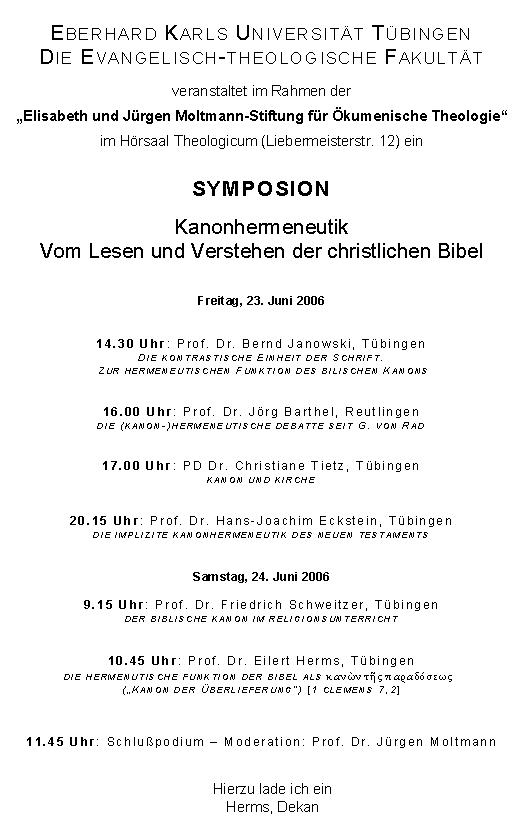
I will get around to responding to your comments, and posting my (of course, utterly devastating) friendly critique of Küng’s position on miracles. I’ve simply been enjoying the company of friends, and today – thanks to a tip from my dear friend, Volker – I shall be visiting a Symposium moderated by none other than Prof. Dr. Jürgen Moltmann. It promises to be a fascinating mini-conference, especially as the subject is one that personally interests me very much: The meaning and hermeneutical function of the biblical canon (Kanonhermeneutik. Vom Lesen und Verstehen der christlichen Bibel)

Here is some more information, if you really want to start salivating with jealousy ...

Until my Küng-rejoinder, I would point my readers to an excellent response to my initial post on Küng by Ben Myers, here (be sure to read the discussion on this one as well).

(Click to enlarge)

Wednesday, June 21, 2006

Küng on miracles

Review of Küng’s Der Anfang aller Dinge, section D, part 7.

5. Miracles

Küng, now turns, briefly, to the question of the intellectual credibility of miracles – a matter he has treated at more length elsewhere (Christ Sein II, 2).

He prefaces his argument with the following:
‘I don’t want to hurt the religious feelings of anyone who finds a literal interpretation of the biblical miracles important. Rather, I want to give a helpful answer to those modern people for whom miracles are a hindrance to faith in God’ (171, italics mine).
It is necessary, claims Küng, to distinguish between the biblical and the modern understanding of reality. In the scriptures, he argues, no one distinguished between miracles that broke the laws of nature, and those that didn’t. Indeed, the idea that miracles ‘break the laws of nature’, is a modernist conception only.

As I pointed out in my ‘Why I love Küng’ post in Ben’s series, Küng’s sensitivity to the results of biblical criticism is something I appreciate. And to biblical criticism Küng turns in order to demonstrate that one should not take the biblical miracles stories literally.

Based on the different ways biblical writers saw the world, and the results of biblical criticism, Küng argues that biblical miracle stories are best understood as metaphors. What is important is not whether the miracles actually happened but what they mean.

I don’t find myself in disagreement with anything particularly noteworthy in Der Anfang aller Dinge, except, that is, for his arguments above.

An appreciative critique follows tomorrow.

Finished 1 Cor

I’ve just finished my exegesis of my-thesis-significant passages in Paul’s first letter to the Corinthians tonight, (I’ll be joining you in 2 Cor soon Volker!) and it feels so good to have it behind me. It has ended up a little longer than I planned, which means I’ll be correspondingly changing my thesis outline. In fact, at over 30,000 words, I have enough material for all the presentations I plan to give this year, whether it be at the LST NT conference, or at the Tübingen postgrad seminar thingy. My exegesis of Paul’s discourse concerning idol food is alone 16 pages long.

Nevertheless, I’m pleased with most of what I’ve written, and that’s a nice feeling.

Tuesday, June 20, 2006

JC - it's in the initials


Righty, I’m no homosexual – ask the wife – but Joe Cole, I love you. I want to nibble your ears and peck your rosy cheeks.

What a guy! What a goal! Ronaldinho eat your heart out!

Monday, June 19, 2006

How can one explain cosmic evolution?

Review of Küng’s Der Anfang aller Dinge, section D, part 6.

4. Why a life friendly cosmos? (WARNING, THIS SECTION IS FASCINATING)

In looking at the astonishing fact that 13.7 million years of cosmic evolution has led to incredibly developed and complex life, even ‘life with spirit’, Küng asks: ‘Is everything really chance? Is pure chance an explanation?’ (165)

What about science? Could this discipline one day clarify how human life came to be on this planet as it is? ‘Perhaps one day’, says Küng, it would be difficult to principally exclude any such possibility. But what of Kurt Gödel’s Incompleteness Theorem (‘a finite system of axioms always contains formulas that within this system can neither be proven nor disproved`, 33)? Surely that makes things more than just a little problematic!

So, if science doesn’t give us a final explanation (and Küng isn’t holding his breath for the day it may do) what does explain the development of life on earth?

What about an anthropic principle? Well, possibly, says Küng, if the principle is understood in its weak sense. But how could a meta-nature law be proven?

In fact, Küng has already laid the epistemological foundations of his thinking in section A (cf. his reliance on Kant), and this excludes the possibility that science could one day provide a ‘final solution’ in the language of meta-empirical law. Rather, for such meta-matters as this, philosophy and religion is responsible, not science.

Now this brings one back to the question: While the development of life cannot be scientifically demonstrated to be ‘goal-orientated’ or more than chance, our view of reality can inspire philosophical/religious thoughts in a direction – namely that it is difficult to believe that ‘the great cosmic development is only a meaningless drama played before empty seats’ (169).

What does all of this reasoning suggest?
  • Religion can interpret evolution as creation.
  • Science can make the creation a concrete evolutionary process.
  • Religion can give evolution a meaning which science cannot. Science cannot read meaning off of (or into) the evolutionary process, and at best can only suggest it.
Thus, any such meta-interpretation of reality is then a matter of faith, or, better: trust.

Sunday, June 18, 2006

The Great Pillsbury's 100th Death Day

My last post reminds me of a famous saying by one of the worlds greatest ever chess champions, the late Emanuel Lasker:

‘Chess is a fight’

Which brings me to my next subject.

Harry Nelson Pillsbury was one of the greatest chess talents of his time. He died exactly 100 years ago yesterday, but his chess games continue to inspire me. Chess is not only a fight, but an art, and Pillsbury was a master of this art.

‘Pillsbury would play up to 22 simultaneous games of chess and draughts blindfold while also taking part in a game of whist. ‘Before the display he would ask the audience for lists of words or objects, and repeat them at the end of the display. On one famous occasion in London two professors came up with the following curious list of words:

Antiphlogistine, micrococcus, Etchenberg, Bangmanvate, periosteum, plasmodium, American, Schlechter's Nek, taka diastasi, Mississippi, Russian, Manzinyama, plasmon, Freiheit, philosophy, theosophy, ambrosia, Philadelphia, Piet Potgelter's, catechism, Threlkeld, Cincinnati, Rost, Madjesoomalops, Streptococcus, athletics, Salamagundi, staphylococcus, no war, and Oomisellecootsi

Pillsbury looked at the list, repeated the words, and then again in reverse order. The next day he recited them again’ (The Complete Chess Addict, Fox and James, p. 99)

In honour of his memory, I’ve uploaded one of his games and lightly annotated it. However, bear in mind that this game was played blindfold simultaneous with twelve other chess and four other draughts games - plus a game of whist on the side!

Click here to play through the game.

Here is another superb article celebrating the occasion.

Saturday, June 17, 2006

Quote of the day

‘If one is afraid to fight, one shouldn’t pretend to be interested in the truth’
- Jim West (but see the context here)

Friday, June 16, 2006

Crazymatics pt 3 of 3

5) While on the Zionist subject, what about a touch more nationalism while we are at it - it's a Christian store remember. Here you can buy a T-Shirt: ‘United we stand’ with a flag of America next to a flag of Israel. Again, nothing against either flag of course, it is the theological baggage that goes along with it.

6) But I finish off with my absolute favourite. This is utterly wacked out, so be prepared to either laugh or cry, depending on your temperament.

Now, ever felt like you needed a ‘Portals to Cleanings Property Dedication Kit’?

I know you have.

Ever had the sensation that there are swarms of demons brooding over your lounge, bedroom, fridge, toaster ... Frank Peretti style?

Of course you have.

Well, you obviously need to cleanse your home. Buy this little pile of nonsense, and you have, they claim: ‘A unique kit with instructions, scriptures, oil and stakes to dedicate your property to the Lord’.

The ‘Portals to Cleansing’ refers to a book that the ‘kit’ supplements, one recommended by truly delightfully godly Christian souls such as John Loren Sandford, John Paul Jackson and Beth Alves.

The book blurb asks:


‘Is there another spiritual dimension operating all around us? Can the spirits of the dead really haunt houses? Are specific geographical areas portals of spiritual power? Can an heirloom possess the spirit of its deceased owner? Does the blood of the murdered cry out for justice? Can animals be possessed by demonic spirits? What can be done to cleanse land, possessions and animals of spiritual darkness?
It continues:

“Portals to Cleansing” is a spiritual journey into the realm of the supernatural. Page after page you’ll discover how spiritual ground is taken and how it is released. ... You'll learn keys to reclaiming your land, home, possessions, and animals from the power of satan and his demonic forces. You’ll experience the peace that comes from the cleansing of all you possess. And you'll walk into a portal of God's presence that will take you deeper into the realm of the Spirit and change your life forever.’
Steve Schultz, the man who runs this webpage - a wonderful Christian man, of that I’m sure - writes:

‘In the last six years, at least on 3 or 4 occasions, I've had my house and the land it sits on cleansed. My house is on 20 acres. There is history with land. But there is also “current” history, as visitors come and go and people who don't like you send curses your way. If you don't believe those curses have power, you'd be hard pressed to explain certain sicknesses and disease and even death that comes upon very anointed and pure-hearted people you know (not that I would claim pure-heartedness nor anointing as something I possess). Nevertheless, each time the property is cleansed, I see a noticeable change in the atmosphere and circumstances.’
What?!?!?!?!?!

AAAAahhhhhhhhhgh!

In my opinion, there is so much wrong with all of this strange rigid mechanistic 'spiritual priciple' thinking, I'm ... I, ....

AAaaaaaaaaaaaaahhhhhhhhggh!

Crazymatics pt 2 of 3

The webpage I had in mind is the following: The Elijah List Webstore.

Some of my best loved examples follow, though my favourite will have to wait till the next post:

1) Click here for ‘Third Heaven Vision Anointing oil’ – made from ‘six ingredients from around the world: Calamus, Cassia, Frankincense, Myrrh, Rose of Sharon, and Spikenard - in a base of virgin olive oil’. At 10$ for ½ Oz!!!

Perhaps I should try coughing up and selling Chris Tilling Really Very Holy Ministry phlegm, and call it ‘Gnostic Heavenly Visions Ointment’. BTW, I know someone in Berlin is trying to sell and ship Football World Cup air in plastic bags!

2) Here is a book that makes the following claim:
‘Is everything you do a struggle? Does a dark cloud seem to hang over your life? Are you trapped by feelings of abandonment and betrayal? ... You may be cursed! ... Dennis Cramer details his 13-year battle with a “Christian” curse’
The theology of this book would appear - though I haven’t read it - to be full of so much crap it’s unbelievable. Sorry, if I’ve offended anyone, I’m just telling you as I think it is. It’s, in my opinion, a bizarre mix of magic, Christianity, and an odd and totally inappropriate handling of the bible. I personally know people who are caught up in all of this, and it makes me livid that we Christians can be so easily duped by poor teaching.

Nevertheless, some of these people whom I personally know I would definitely want praying for me, were I ill or in need, as they can be filled with a delightful and expectant faith in God. They know and love God, and God is with them. But their theology is not at all thereby justified.

3) Ever fancied a Shofars from Afar New Covenant Messianic Prayer Shawl and Matching Talis Bag? Well, here is your chance.

40$. Nuff said.

4) In a similar vein, what about a Joyful Life Ministries Hebrew Scarf? Notice in the notes: ‘Our ultimate joy will be when the L-rd makes us His Bride!’. Yep: ‘L-rd’.

Praise the L-rd!

The Zionist edge of this webpage drives me up the wall, but I'll be careful now, as living in Germany one is surrounded by quasi-theological and evangelical Zionism. But it remains, in my opinion, poor theology, and one that deals with scripture in a highly oddball and selective way promoting all kinds of weird activity. It freaks me out, if I'm honest. I'm not a violent person at all, but if anyone, given all of the theological connotations here, runs past me in a Christian worship service enthusiastically waving an Israel flag, I have an urge to stick my foot out. This is certainly not meant as an anti-semitic statement, I want to add. Anti-semitism was and is pure evil. This rather expresses my frustration with evangelical Zionism.

To be continued ...

Crazymatics pt 1 of 3

I start this mini-series by saying the following: I love Charismatics, and I remain unapologetically, though slightly ambiguously, ‘charismatic’, albeit with a small ‘c’.

Indeed, in the formative years of my faith, I was heavily influenced by the late and great John Wimber and the Vineyard Church, but also by Jack Deere.

Though I’ve been moving away from some of the charismatic way of doing things for some time now, I am, unlike many people I respect, by no means a cessationist, nor, exegetically speaking, could I justify that movement. Actually, my own extremely able supervisor has written a fantastic work on this very subject: The Holy Spirit and Spiritual Gifts, Then and Now - the best, to my mind, on the topic.

However, some things that swim around in charismatic culture and some of the 'teaching' nark me off big time.

And there is one webpage that I'll mention in the following posts that tends to rub me up completely the wrong way. Completely. It is based on an e-mail list that daily publishes ‘prophecies’ made by most of the big names in the charismatic world. Don’t get me wrong, I am quite sure that the webpage is run be extremely godly and well-meaning Christians, and sometimes they have some good things to say, but some of the stuff they sell is either silly or downright preposterous. In the following posts, I will give some of my favourite examples.

Warning! Achtung!

Our roaming reporters have notified me that me own wife has been crawling biblioblogdom, and even left a cheeky comment!

That’s right, so you’d better say nice things about me, lay off of the swearing, a definitely give the heresy a break till the hazard-time is over ... And yes, her English is very good, so she doesn’t tend to zwrite zlike zis.

If the beautiful face of my wife turns up in any of your comments, be sure to be nice to her!

Thursday, June 15, 2006

Reading Hauerwas

‘Theology becomes a burden only when we take our unbelief seriously’
– Stanley Hauerwas

I’ve been intending to read Hauerwas’ The Peaceable Kingdom for some time now (hat tip to Dan). But after Kim Fabricius’ post in Ben Myers ‘Why I love theologian X’ series, I just couldn’t wait anymore. Has anyone read The Peaceable Kingdom? What is the big deal?

Wednesday, June 14, 2006

Eulogy

In light of my symptoms and my recent posts, my ‘friend’ Simon had already gone to the trouble of formulating my eulogy: ‘Chris: A fine friend, bad personal hygiene, but a sharp, if heretical mind’.

At times like this you learn who your friends are, hey Si.

Yes, he was being a git, but it does make me think – what will be written on my tomb?

‘Chris: everything he touched went tits-up’.

‘Chris: Died of smoking, but he’s definitely not smoking anymore’.

‘Chris: He thought he was a theologian’

‘Chris: Died after being attacked by territorial male squirrels’

‘Chris: He meant well’

Anyway, before I get carried away, just one more ‘death quote’:

‘When we die, we do not die into nothingness; we die into God ... We are known by God already. In that lies our hope, for God’s knowing is forever’
But do you know who said it?

If anyone guesses correctly, I’ll be seriously impressed. A clue: he is primarily a NT scholar.

Rumours of my death are greatly exaggerated

Firstly, a big ‘thank you’ to all of you who have prayed, well-wished, sent e-mails, shown concern, and said nice things! It has really meant an awful lot to me, as the last week hasn’t been much fun.

Yes, my posts on my health and the ‘death thoughts’ were related, but not because I’m terminal. I did, however, have some rather ominous, worrying and painful symptoms for something that could have been more than just a bit nasty.

Nevertheless, I was back at the doctors today, and I’m VERY glad to report that after, among other things, some rummaging around ‘where the sun don’t shine’, the doctor has confirmed: I don’t have a tumour.

I get to live!

As for the actual cause of whatever is going on, the results will be in on Monday. But it isn’t cancer. Praise God!

Nevertheless, this scare has somehow been a healthy experience for me. In light of all my morbidity, I think I’ll give up my theological bookshop ram-raiding sprees, and my regular de-heathenising drive-by baptism evenings.

Also, of course, this means my usual prattling will continue unabated, especially as my energy appears to be returning.

‘Tell me, what’s going on, GOD? How long do I have to live? Give me the bad news! You’ve kept me on pretty short rations; my life is string too short to be saved. Oh! We’re all puffs of air. Oh! We’re all shadows in a campfire. Oh! We’re just spit in the wind. We make our pile, and then we leave it. What am I doing in the meantime, Lord? Hoping, that’s what I’m doing – hoping’ (Psalm 39:4-7, The Message)

Tuesday, June 13, 2006

Thoughts about death

Freud said that the ego doesn’t really believe in its own death. He may be right. But I’ve been doing rather a lot of morbid thinking about that great enemy (1 Cor 15:26) called death recently. Was Sartre right to insist that death robs life of all meaning? And is there anything after you die?

I know this is a massive topic involving such issues as our worldviews, ‘body and spirit’, Platonism and resurrection, intermediary state, purgatory etc., but I wanted to simply list a few comments by theologians that have stuck in my mind.

Küng says a lot of things about this (cf. Ewiges Leben?), but one memorable passage speaks of us ‘dying into the light’.

Moltmann also says many things (cf. The Coming of God ). However, in one passage he memorably spoke of hope ‘that God will find us in death’ (p.66).

Pannenberg writes: ‘Christian theology views us as creatures in both body and soul, destined indeed for immortality in fellowship with God, yet not possessing it of ourselves, nor able to secure it for ourselves, but receiving it only as a gift of grace from God’ (Systematic theology, 3.571)

Barth, eloquently wrote: ‘Resurrection means not the continuation of this life, but life’s completion. To this man a “Yes” is spoken which the shadow of death cannot touch’ (Dogmatics in Outline, 154)

The greatest theologian of them all says:
‘For to me, living is Christ and dying is gain ... my desire is to depart and be with Christ, for that is far better’ (Phil 1:21-23. Cf. also 2 Cor 5:8)

In facing questions about death, and my inevitable death, I can find my true hope only in Christ.

Monday, June 12, 2006

Not well

Some of you will perhaps have noticed that I’ve been posting less the last couple of days. Well, I’ve been a little ill, and things aren’t cleared up yet. I won’t go into any details, but I would appreciate your prayers, if you are the praying sort, as the problem isn’t resolved yet – and this particular problem isn’t any fun. Many thanks.

Saturday, June 10, 2006

Your oldest book

What’s the oldest book you own?

I mean published date, not 1st edition, obviously - so an internet printout of The Diamond Sutra doesn’t count!

My oldest book is a copy of the Scots Worthies (1835), or with its more extensive title: A Brief Historical Account of the Most Eminent Scots Worthies, Noblemen, Gentlemen, Ministers, and Others, Who Testified or Suffered for the Reformation in Scotland, During the Sixteenth and Seventeenth Century.

Do you own an older book?

A Volx Bibel offering

England are going to play their first WC match today, so I’m getting a tad excited. And it is a BEAUTIFUL day for it.

But for you Saturday afternoon, I give you an offering from the Volx Bibel which I introduced here.

But can you guess the passage it is very ‘dynamically’ translating (translation engines are allowed)?
‚Wer nun zu Jesus Christus gehört, wird von Gott nie fertig gemacht werden. Denn für ihn stimmt das Programm nicht mehr, auch wenn du Mist gebaut hast und verdient hättest zu sterben. Ab jetzt läuft ein Update, eine neue Software, das Programm von Gottes Geist, das dir durch Jesus Christus hilft zu leben. Denn die alte Software, das Gesetz, konnte uns nicht dazu bringen, so zu leben, wie Gott es geil findet. Sie war von einem Virus befallen worden, der uns unbewusst dazu zwang, Mist zu bauen. Deswegen schickte Gott seinen Sohn vorbei, der das alte Programm hackte und es umschrieb, indem er den ganzen Dreck auf sich nahm und auch die Strafe dafür bezahlte. Jetzt läuft das neue Programm Gottes in uns und nicht mehr die alte menschliche schlechte Software. Deshalb können wir unserem Leben eine völlig neue Richtung geben.’

Friday, June 09, 2006

An evenining by the Necker

I was in Tübingen tonight, for a lazy evening with friends, a pipe, and some wine. We thought we’d trot down to the river Necker for a quiet evening ...

But somehow we’d forgotten that Germany were playing the opening game of the World Cup tonight, and our appointment by the river bank coincided with the end of the game!

But what a sight met us! Crowds of semi-drunk flag waving Germans, dozens upon dozens of tooting cars, also with flags – it was as if the Germans had already won the cup! Quite an experience.

So we spent a quiet evening in the gardens of the Theologicum instead!

Thursday, June 08, 2006

How can religion and science work together?

Not like this.

Rather, as Küng argues, desirable is:

* No confrontation model between science and religion: whether one of a fundamentalist-premodern origin, which ignores or suppresses the results of science or historical-critical biblical exegesis; or whether a type of rationalistic-modernism which right from the start declares religion as irrelevant

* Also no integration model of harmonising tendency

* but rather a complimentary model of critical-constructive interaction of religion and science in which their own spheres of specialisation are maintained, all illegitimate transitions avoided, and all one-dimensional totalising rejected.

(cf. Der Anfang Aller Dinge, p. 57)

The Fatal Flaw

In the main library here in Tübingen, there is a small trolley just outside the main entrance that carries old or unwanted books the library has decided to throw out. There is usually nothing of interest, but last time I picked up a book (they are all 1 euro) by a certain Peter de Rosa. It was given the wonderfully balanced title: The Fatal Flaw of Christianity: He did not rise from the dead, and the dogma of Original Sin is pure invention! A quick read through some of it confirmed that this is not the most insightful book I have on my shelf, but has anyone ever heard of this Peter de Rosa? The blurb on the back made him sound papal in grandeur, but I’ve never come across him before.

Soon, my Küng post will be going up on Ben’s Faith and Theology, and as shall become clear (to my shame), I couldn’t find the quote I wanted to use. But here is one below that says something similar.
‘if we analyse the profile of the personalities of so many pious “believers” – not just in Christianity – we cannot dispute Ludwig Feuerbach’s view that belief in God can alienate people from themselves and warp them because they have adorned God with treasures of their own inner depths. These believers are not human enough, not human beings enough, for the godless to be infected by their belief in God’ (Hans Küng, Credo, 12, italics mine)

Wednesday, June 07, 2006

The end of an important section

Ahhhhhh! Quite a few glorious Illy espressos later, and I’m finished with a major section in my ‘final’ draft of my exegesis of 1 Cor. What is more, I’m really pleased with the product. It was an important section too: 1 Cor 8:1-11:1 (Paul’s ‘idol food’ discussion).

That's just wrong


Sean the Baptist has the darn cheek to disagree with me, and my post on ‘Did Pentecost Happen?’!

*Chrisendom readers the world over shake their solemn heads and pray for his mortal soul*

He shall therefore be know hereafter as Evil Sean the Baby Eating Baptist.

Tuesday, June 06, 2006

Mike Bird on justification

I’ve been reading the drafts of Mike Bird’s forthcoming book on Paul, justification etc. recently, and let me tell you, it is quite simply a load of total and utter rubbishy tripe. Still, it made me laugh. Its like a cross between a Mr Men book, and the Idiots Guide to Idiots. Give a rabid blind chimpanzee a keyboard with three letters, and you’ll have a more convincing thesis.

... well, not really. It’s actually an exciting, highly readable, and, to my mind – and I mean this honestly – important book that makes a bundle load of sense. I’m really looking forward to seeing how his argument is received. It could mean serious cross-fire from both sides, Mike – I hope you’ve got a trench helmet spare.

His last chapter attempted to contend that ‘the “traditional” reformed view and the NPP are indispensable to attaining a proper understanding of Paul’s articulation of justification’. In other words, he argues that ‘Paul’s notion of God’s saving righteousness includes both a declaration that those who profess faith in Christ have been graciously granted a right-standing in a right relationship with God, and also that they are thereby constituted as full and equal members of God’s covenant people’ (p. 73). Well, Amen to that, not simply because it’s ecumenical, but also because the texts, to my mind, seem to justify exactly this. You’ve got me convinced. And this means Tom Wright isn’t going to hell after all, I guess.

666

This annoyed me. A VERY MUCH LOT.

What they are doing is about as Christian as Beelzebub’s backside on a bad potty day. I had to drive the streets and run over a few cats to calm down after watching it. Click on the link at your own risk.

Monday, June 05, 2006

Did Pentecost happen?

Did Pentecost happen?

A scattering of opinions:

Gerd Lüdemann says: ‘Certainly the report of Acts about the events of Pentecost is, in the present form, unhistorical’ (Das frühe Christentum, 54)

Hans Küng says: ‘Did such a Pentecostal assembly take place historically? Given our sources, that can no longer be decided, but it is quite possible’ (Credo, 128)

Ben Witherington III says: ‘It is not convincing to argue that Luke invented the notion of the coming of the Spirit at Pentecost’ (The Acts of the Apostles, 130, fn. 5)

Wolfhart Pannenberg says: ‘Defining the historical core of the event is difficult in view of the many layers that seem to have been imposed in the process of handing down and in Luke’s editing. Most exegetes are inclined to assume that at the first Jewish Pentecost after Jesus’ resurrection the disciples could have had an experience of collective enthusiasm that came to expression in ecstatic speech. But it is hard to say anything more precise ... It is appropriate, then, to evaluate the Lukan story of Pentecost above all as a theological statement about the relation between the church and the Spirit that has found expression in Luke’s reworking of the older tradition’ (Systematic theology, 13-14, 15)

I H Marshall is of the opinion: ‘It all happened, guv, right down to the last details’ (not an exact quote)

R. F. Zehnle: ‘Happened? Naah, none of it’ (not an exact quote)

Chris Tilling personally thinks that a couple of Germans have recently put the ball in the court of those who fundamentally distrust Acts as credible history, namely Rainer Riesner (Paul’s Early Period) and Eckhard Schnabel (Early Christian Mission). Besides, a methodological scepticism, as some would have it, that must have every detail independently verified for it to be history is hardly fair. Nevertheless, aspects of the narrative, the dating scheme, and Peter’s speech, are likely not entirely historical.

What do you think?

Sunday, June 04, 2006

When exegetes only read exegetes

Anything Richard Bauckham writes is worth taking very seriously. His NT Christology lectures and seminars in St Andrews made a big impact on me in my undergrad years, and were a major factor that drove me further in my own thinking. His enormous breadth of knowledge, spanning church history, modern systematic theology and biblical exegesis in Paul, Peter, the Gospels, Revelation etc etc. should command the respect of anyone – see here for his list of publications.

This is what Moltmann had to say about Richard’s critical engagement with The Coming of God in God will be All in All (1999):

‘I am grateful to Richard Bauckham for reading my theological exposition exegetically too. In doing so he is a rare example of his discipline. Otherwise exegetes only read exegetes, and theologians only theologians. For the full multiplicity of standpoints we need more cross-readings; for after all both he and I still believe in the unity of theology in its diverse disciplines.’ (232)

Friday, June 02, 2006

Volx Bibel

Thankfully I’m done with that post on Küng to go up on Ben’s blog for his ‘Why I love theologian X’ series.

I’ve been putting that off that for days, so I finally decided to just write it. But honestly, reading the jaw dropping contributions of the likes of Cynthia and Kim Fabricius was like throwing logs on the fire of my procrastination – they really sounded convincing!

Poor Küng! Sorry matey that it was me that had to put in a good word for you; no doubt the aformentioned could have randomly headbutted a keyboard and done a better job.

Enough wallowing, as today I received my Volx Bibel in the post. It’s a new German translation in the language of the youth, and the vision behind it can be downloaded here.

It is a mixed bag, with some questionable ‘dynamic translation’ choices, but it can also be most insightful and helpful. Apart from that, it can also be a real hoot! For example:

‘Wir haben keinen Bock mehr auf die Sachen, die uns diese Welt anbietet, und leben stattdessen so, wie Gott es geil findet’ (Titus 2:12)!

And how is dikaiosu,nh translated? ‘für Gott okay werden können’ (e.g. Rom 3:21)!

The parable of the lost sheep becomes the parable of the lost cat, and there is a liberal sprinkingly of ‘krass’, ‘geil’, ‘cool’ etc, all over the place! It is similar to but even more radical than the Message. Get it, cos it's great, and will help the person learning German too.

Truth hurts

Sean the Baptist tells it as it is!

Thursday, June 01, 2006

The alien poll

Thank you for the 77 of you who voted regarding the question of the existence of intelligent extraterrestrial life.

Attending to voting polls like this just goes to prove that we have too much time on our hands.

Getting to the results:

5% of you voted ‘don’t know’, despite my pleas that you choose another option. I know who you are.

For me, the gap between ‘yes’ and ‘probably’ is quite the significant fissure. Nevertheless, an astonishing 10% voted a confident I-can-channel-the-mother-ship ‘yes’ - which perhaps just goes to show that too much TV does rot the synapses.

Equally absolute was the 20% of you who voted a clear ‘no’. Are you sure? I would, of course, love to be there and see your face if ET landed tomorrow, to make sure my grinning ‘told you so’ face is the last thing you see before we get ray-gunned into smoke. But apart from that, how do you explain the missing socks?

Of course, the big tug of war was going to be between the ‘probablies’, and the ‘probably nots’.
However, only 26% of you voted a ‘probably’, which makes the clear favourite ‘probably not’ with 40%.

I must admit, I selected ‘probably not’, but I hope I’m wrong. It was just the ‘intelligent’ clause that stopped me jumping on ‘probably’ in a flash. After all, *puts on cynical head for a moment* there isn’t too much evidence of ‘intelligent’ life even on planet earth ...