Monday, June 18, 2007

Chris VanLandingham interview Part 1 of 3

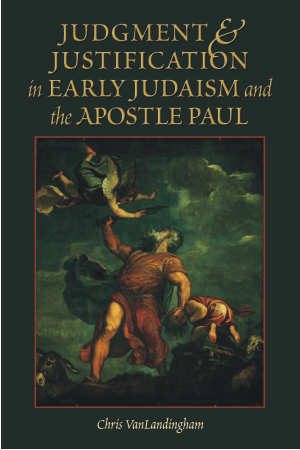
In three posts I will share Chris VanLandingham's response to a number of questions I sent him last week about his book, Judgment and Justification in Early Judaism and the Apostle Paul. In part 1 I will share his answer to my questions. I attempted to be more general in my questions, as the really interesting questions of substance were best posed by Mike Bird, I thought, especially as he has just written a book on Paul and justification, and written a lengthy review article of Chris' book. Chris' response to Mike's questions will appear in part 3. In part 2, Chris responds to a couple who left comments on my blog review of his book.

Chris VanL: First of all, Chris, I am delighted that you have found my book worthy of some attention.  It is a pleasure to answer a few questions about it.  

Chris Tilling: 1) What or who was the biggest influence in the development of your thesis? Was there any passage of scripture that promoted an 'ah ha!' moment for you?

Chris VanL: As you probably know, Judgment and Justification is simply the published form of a dissertation I wrote at the University of Iowa under the supervision of George Nickelsburg. For years I intended to write a dissertation in the area of Christology, but just as I was preparing a proposal, I discovered a recently published book by Larry Hurtado that already stated everything I was thinking.  Feeling pressured to find another dissertation subject so that I could take my comprehensive exams on schedule, I decided almost by default to do something along the lines of what E.P. Sanders did in Paul and Palestinian Judaism.  For some time I had been troubled by Sanders's reading of the post-biblical Jewish texts as well as his approach to the earlier Second Temple texts from the vantage point of later Rabbinic texts.  As I recall, I decided to include a treatment of Paul simply because this is what Sanders did in his book.  In this regard, I was troubled by how easily Romans 2 was ignored by interpreters of Paul, and so decided to treat the Pauline judgment texts in light of similar Jewish texts.

Chris Tilling: 2) What do you hope your thesis will achieve?  

Chris VanL: When I sent the manuscript to Hendrickson four years ago, I had hoped that a book-length publication on my résumé would lead to an interview for a tenure-track position teaching in my field of early Judaism and Christian origins.  By this time I had applied for over 250 such positions, but had not been invited to a single interview.  I am still waiting for that first interview.  So, my hopes are actually quite mundane.  Otherwise, my book is one of 100,000 published this year, so in reality I don't expect my thesis to achieve anything of significance.  Personally, though, it sure feels good getting one's thoughts down on paper.

Chris Tilling: 3) How has your thesis affected your own religious and theological life?

Chris VanL: Although my studies have affected my religious/theological life a great deal, the research and writing of this book has not changed it at all.  My approach is entirely secular; I write as an historian, not a theologian.  Nevertheless, I don't think my conclusions are anti-Jewish or anti-Christian at all.  But, and this is an important point, if my conclusions happened to be anti-Jewish or anti-Christian, I would still be willing to let the chips fall where they may.  I do exegesis as if nothing is at stake.  If I can't do this, then I need to find another occupation.  I intend to seek the truth despite the consequences of what that truth may hold.  Such intent doesn't mean I will find the truth, but my chances of finding the truth are better than those who think they already know the truth before they seek to find it.  By analogy, the archaeologist who a priori is unwilling to admit that the bones he or she may find belong to Jesus is not really an archaeologist, but a blind apologist.  I am aware that many who read my book cannot do history or exegesis as if nothing is at stake because they are being paid by a church or religiously-oriented university that mandates certain theological positions.  Thus when a professor signs a "statement of faith" as a precondition for employment, one wonders how credible that person's research is that always supports that signed "statement of faith."  When our livelihoods depend on us not seeing the moons of Jupiter through Galileo's telescope, how can we expect to have 20/20 vision?

Chris Tilling: 4) Are there any issues you would like to address in response to the second part of my blog review of your book? (It was posted here)

Chris VanL: As you suggest, allow me to respond to the points you make in Part 2 of the review of my book. First, the theses in Chapters 1 and 2 are about post-biblical Judaism, not the Hebrew Bible.  As I state on page 65 where I admit Ezekiel 16 may be an exception, the purpose of discussing the Hebrew Bible is to establish a pattern, that is, the Deuteronomic formula as I put it.  Elsewhere I cite the Hebrew Bible in order to compare it to later Jewish texts, as for example what I do when I show what post-biblical texts do with the call of Abraham.  (Chris, you also mention 1 Esdras, but don't explain how this text is problematic for my thesis.  Perhaps after I read Michael Bird's review, I can respond.  For now, I should state that even though 1 Esdras is a post-biblical text, I treated in depth only those texts that deal with the Last Judgment or the assigning of a certain eternal destiny in the afterlife.  The compiler of 1 Esdras doesn't show a belief in the afterlife or the Last Judgment.)  Second, "being made righteous" in response to faith is a gift from God based on Jesus's sacrificial death.  It is not that Paul disagrees with the Jewish milieu, but that Paul treats Jesus's death as a sacrifice on behalf of others.  Let's be clear: good deeds are a rewarded with eternal life at the Last Judgment—good deeds are not rewarded with righteousness at the time of faith. On this point, Chris, I think you misread my argument.  Alas, I wish that Paul was clearer on the difference between "works of the law" that don't lead to righteousness and good deeds that do lead to righteousness, but he wasn't.  Third, after this, Chris, you have quite a bit of theological reflection to which I'm at a loss as to how to respond without going on for pages.  Obviously, however, I find being made righteous (i.e., "justification," which I find is a gross mistranslation) by faith and judgment by works impossible to reconcile if "justification" refers to an acquittal at the Last Judgment (as most scholars assert) and if the purpose of judgment by works is to assign an eternal destiny (which I think Paul believes).  Fourth, you question whether I really explain the fierce nature of Paul's rhetoric against 'works of the law' in Galatians (Gal. 2.6; 3:2, 5, 10, 12). For Paul, the issue with regard to 'works of the law' was a de facto way of negating the purpose of Jesus's death.  Jesus died to make people righteous.  If it is possible to be made righteous by 'works of the law' as some asserted, then why did Jesus die?  Paul's fierce rhetoric is explained because he does not believe Jesus died in vain (Gal 2:21).  Last, with regard to 1 Cor 5:5, you will need to explain your point further.

Forthcoming posts

In the next post I will post Chris VanLandingham's response to questions I sent him last week. He has done a magnificent job engaging with the issues, and I think almost all of my visitors will really enjoy reading his offering. In it he responds to a number of questions posed by myself, Mike Bird and a few others who have commented in my blog review of his book. To remind you, my review of his book, Judgment and Justification in Early Judaism and the Apostle Paul,
was posted in two parts: the first here and the second here.

Second, I will have a stab at answering why I think the 'Tilling Statement' (!) is really about inerrancy, and I would love to hear what you think when the time comes. I have found your responses to my previous two posts extremely helpful. Thank you.

Sunday, June 17, 2007

Yet more ad hominem

The blessed faithful one at Triablog shares his extremely critical opinions about my recent posts on inerrancy, calling me in the process, among other nasty things, a 'faithless demagogue'!

I found his acidic rant really quite sad, actually, but I won't reply in like manner as that would be sinking to his level.

Friday, June 15, 2007

A new statement of biblical inerrancy – part 2

As I mentioned, I would love to hear any thoughts about this approach - it's only my first draft but you'll get the general idea of what I want to do. And very important, this statement must be read in light of the first post, or misunderstandings will inevitably result.

----

This statement of biblical inerrancy is a faith confession not simply about the precise nature of God’s inspiration of the scriptures (and even less when squeezed through a deductive logical wringer, through which the stricter versions are forced), but also a statement about our daily practices and posture as we read and study scripture.

The confessions below are not to be understood as statements about the entire canon all of the time (to confess something about the prophets doesn’t necessarily include all of the Proverbs, or Ecclesiastes, for example). The confessions in their original contexts did not refer to the different Christian canons as we now know them. However, these confessions provide an orientation (or trajectory) in our confession and provoke the practices and posture aimed at in the second part of the statement.

Until I’ve thought of a better name ... here is The Tilling Statement of Inerrancy!

Part 1.
I believe
that all scripture[1] is inspired by God and is useful for teaching, for reproof, for correction, and for training in righteousness, so that everyone who belongs to God may be proficient, equipped for every good work.[2]
I believe that the prophets were moved by the Holy Spirit and Spoke from God.
I believe that God speaks in many and various ways,[3] and most definitively he speaks about God’s Son.[4]
I believe that as we read scripture, we are invited to approach Christ,[5] and hear the final and definitive Word God speak to us in his Son.[6]
I believe that as we read and study scripture seeking Christ, we are addressed by God, that through scripture God speaks to us.
I believe the word of God is living and active, sharper than any two-edged sword, piercing until it divides soul from spirit, joints from marrow; it is able to judge the thoughts and intentions of the heart.[7]
I believe that humans do not live on bread alone, but on every word that comes from the mouth of God.[8]
I believe that the words of the LORD are flawless, like silver refined in a furnace of clay, purified seven times.[9]
I believe scripture is trustworthy and precious, deserving of my study, love, time and energy.

A bridge to part 2.
I believe scripture is true.
What do you mean ‘scripture is true’?
This question cannot always be precisely answered at a propositional level. But we rejoice in the truth,[10] the gospel,[11] and the truth of scripture will be honoured in our practices and posture towards scripture. I seek to explain what I mean by inerrancy through my daily practices and inner and communal posture towards scripture.

Part 2.
Because of the above confessions of faith, and to make this confession meaningful, I purpose my heart for the following:
I purpose to call out to God’s Spirit for insight and understanding as I seek to understand the words of scripture.
I purpose to look for wisdom therein as one would for that which is the most precious, as a poor man would for hidden treasure
I purpose to apply various creative means of impressing scripture to my heart[12]
I purpose to regularly meditate upon and memorise scripture,[13] and hide God’s word in my heart,[14] expectant that God will speak a gracious word to me.
I purpose to divide scripture wisely, and to seek to understand scripture in its variety of levels of reference.
I purpose to be a discerning doer of God’s word, not just a hearer.[15]
To do this I purpose to seek the help of others in every way possible, and I pledge all of my intellectual, creative, emotional and physical faculties to the process, and offer them today to God’s sanctifying Spirit.[16] Amen.

[1] Again, these confessions do not specify the extent of the canon. [2] 2 Tim 3:16-17
[3] Heb 1:1 [4] John 5:39
[5] John 5:40 [6] Heb 1:2
[7] Heb 4:12 [8] Matt 4:4
[9] Psalm 12:6 [10] 1 Cor 13:6
[11] Col 1:5 [12] Deut 6:6-9
[13] Josh 1:8; Ps 1:2; 77:12; 119:15 [14] Ps 119:11
[15] Jam 1:22 [16] Prov 2:1-4

Thursday, June 14, 2007

A new statement of biblical inerrancy – part 1

At the risk of more personal abuse from certain conservative quarters, in two posts I want to suggest a new statement of inerrancy. I am thinking of writing an essay about this, actually, and would appreciate your feedback as I test my thoughts here. In this post I will give my introductory blurb and reasoning. In the second post, things will get really interesting! This first post is a little negative, I admit, but the second is so positive that I'm sure I'll be forgiven. Besides, it's a first draft ...


The following statement assumes that the church has a long tradition of affirming inerrancy, and that it is a valuable tradition. However, it also asserts that modern – and especially stricter – formulations are either misleading, ineffective or both. Furthermore, one model for scripture, one title, whether it be 'Word of God', 'Witness', 'Inerrant', 'Infallible', or whatever, cannot capture or adequately signify the variety and importance of God's gift of scripture to us. It is beyond any simple definition, and must be titled by the churches practices, posture, and through a variety of different faith confessions. By inerrancy we mean to say something about scripture itself, but at the moment it simply identifies a high view of scripture, one that is manifested in healthy practices and an expectant faith-filled posture towards scripture.


Why a new statement?

  1. Stricter formulations of inerrancy do not necessarily foster appropriate and healthy practices and an expectant posture towards scripture.
    • Believing the flood 'actually happened', for example, as posited in the Chicago Statement, doesn't guarantee orthodoxy, or an appropriate posture towards scripture, nor healthy scripture reading habits. Believing that inerrancy simply affirms all in scripture necessary for salvation is without error also doesn't guarantee orthodoxy, or an appropriate posture towards scripture, nor healthy scripture reading habits.
    • The proclamation of a strict definition of inerrancy – such as the Chicago Statement – is meaningless if one does not live life in such a way that reflects a high view of scripture, by which it is meant that one doesn't maintain and pursue certain practices, nor come with expectancy and faith that God will speak in scripture.
    • If you confess the Chicago Statement of inerrancy, this is no promise that you actually have a high view of scripture. It may simply mean that one is wallowing in self-righteous anti-intellectualism, and loveless, close-minded, aggressive, needlessly defensive dogmatism. It must not mean this at all, and doesn't for the majority that confess the Chicago Statement (I hope), but the point is that such a definition doesn't affirm the important and the worthwhile, that which inerrancy does at its best, namely encouraging a daily practice and an internal and communal posture that treats scripture as if God speaks through it.
    • What is lacking in many doctrinal formulations of scripture, as well as in the various formulations of inerrancy, is a practical fostering of meaningful practices and faith-filled expectancy in one's posture as scripture is read.

  2. Stricter formulations of inerrancy tend not to acknowledge the limitations of naked propositional formulations.
    • While propositional statements are important, an obsession with precise and strict formulations of inerrancy can simply foster the playing of meaningless metaphysical word games. One can no more define, for example, 'childhood' in a proposition than 'inerrancy'; it needs to be lived and experienced or it is meaningless. Inerrancy cannot be boiled down to propositional truth claims without violence being done.
    • Propositional statements are important and should be formulated so as to 1) facilitate the establishing of concrete meaning in one's practices and posture towards scripture, 2) correspond to witness of scripture, and resists the temptation to employ a deductive wringer.
  3. Stricter formulations of inerrancy do not necessarily facilitate healthy interpretation. It is a hermeneutical stance without facilitating a hermeneutical skill and healthy hermeneutical habit. It may even hinder healthy, responsible interpretation with its harmonisation tendencies.

  4. Stricter formulations of inerrancy do not correspond with reality and are demonstratably false on the basis of nothing but scripture.

  5. Stricter formulations of inerrancy go beyond scriptures witness
    • The stricter versions of inerrancy take the worthwhile and valuable tradition of inerrancy formulations beyond scripture's own witness.
    • For more on this cf. my earlier series.

What is needed is a statement of inerrancy that makes clear propositional statements (that nevertheless avoids deductive logical wringers) to provide an orientation for appropriate church practices and posture towards scripture. It the following post it will thus be formulated as a varied faith confession (in part 1), and a statement of purpose (in part 2).

Wednesday, June 13, 2007

The JWFC

(Sorry about this one, Jim. It will no doubt embarrass you so just skip it)

Last week, Jim West was much discussed and I wanted to simply point something out (honestly not intended as a polemic against anybody - just to make that clear):

There are few people who give as much time and effort to furthering and facilitating biblically related academic exchange, debate and development in the World Wide Web as Jim West. No, I don't agree with his cessationist position, and I thoroughly discredited his Bultmann business here, but not only did he create the biblical studies discussion list which now serves 760 members in biblically related discussion as well as hosting various colloquiums with top scholars about their works, but he also maintains the extremely helpful biblical studies resources page. On top of that there is his blog. I don't mean this as a sideswipe at anybody, just to say 'gratitude where it's due'.

Tilling’s Fame

The Tilling Society?! There's even a 'Tilling Pig' for crying out loud.

Don't ask. I have no idea.

Monday, June 11, 2007

Piper and Race

While I don't agree with all he says, I cannot help but respect the preacher John Piper.

In a recent sermon he argues:


"1. Evolutionary theory of human origins encourages racist thinking about human groups.

Evolutionary theory: Humans came from lower life forms.

Why does this tend toward racism? It can cause you to think that other groups of humans can be explained by saying they are less evolved".

However, I've got to disagree with this reasoning.

I quoted Hans Küng, during my review of his Der Anfang aller Dinge a while back, the following:

"Never to forget: Aborigines, Bushmen, Asians, Europeans or Americans – these are not different kinds of humans, they all present one single kind of human, the same family of humans. And even if we are very different in our outward appearances, we probably all have, as molecular genetic analysis shows, one common origin. Under our skin we are all Africans" (184)

Indeed, surely much of the biblical narrative implies sinfulness at a corporate, racial level. Hence nations suffer under judgment for persecuting God's chosen people (cf. Joel 3:2 for example). Of course, for Paul all are sinners, but some may want to suggest that some are more sinners than others - as 'Paul' appears on first reading to do in Titus (Titus 1:13-13). Given Küng's point above, I think evolution may help prevent racism actually. Besides, the summary: "Evolutionary theory: Humans came from lower life forms" perhaps forgets the following: "Biblical narrative: Humans came from the dust". Besides, what's this 'less evolved' business? Evolution says that we are all part of the same family of humans.

Friday, June 08, 2007

Still more ad hominem

A Tribute to the Poet

Oh Chris, your verse is clear
as brass,

And sweet as music from my arse;

No one else rhymes
quite like you,

Nor reads such volumes on the loo.

So writes another antiChris here.

People were burnt at the stake for this sort of thing in the good old days.

Review: Judgment and Justification in Early Judaism and the Apostle Paul. Part 2 of 2

See the first part of this review here.

(Some of my points below have been informed by Michael Bird's helpful review article of VanL's book, forthcoming in BBR. I heartedly recommend it to all interested in this book. I will keep detail out of this reflection on the book as Mike has rather stolen my thunder!)

Having summarised VanL's argument we can now ask: What is one to make of his bold thesis? To be honest, I cannot really give a final definitive statement about my reaction to his thesis for quite a while; it will need to sink in and then be tested over a longer period of time together with a close examination of the primary material. Indeed, whatever one finally makes of VanL's reading of the second Temple Jewish texts and Paul, his thesis drives one back to the primary material, and this is always a good thing. Furthermore, his argumentation throughout has been one of clarity and focus and it impressively covers a wide range of material. This is a book that one will not be able to simply quickly dismiss, and it is one to which I will return to on a regular basis as I seek to understand Paul. Indeed, I admire VanL's courage and the sweep of his paradigm disrupting vision. May his clan increase!

Having said that, I have some misgivings which at the moment I can really only formulate as questions I need to take back to the primary material. But let me try to spell them out anyway.

First, one wonders if he rather neglects to seriously deal with texts that would appear to fly in the face of his of view of the Jewish literature. Off of the top of my head, not only Ezekiel 16, but also Deut 7:7, a passage I suspect he doesn't entirely convincingly 'explain away'. Following Bird's review article, I also note 1 Esdras. There is also the significance of the broader scriptural narrative (the Exodus comes before the giving of the law, i.e. grace comes before the law), a matter that the focus of his study perhaps wasn't best suited to encompass. While it may be responded that these few 'problem texts' are just blips compared to the rather consistent picture VanL paints, it may be wise to hold these other texts in play and not force all second Temple Judaism in one direction. Hence 'variegated nomism' has been pursued by Carson and co in response to Sanders' 'covenantal nomism'. Besides, I'm not yet persuaded that VanL's thesis best explains the nature and variety of Jewish material, so these 'problem texts' may well not just be infrequent blips. As I said: I need to sit on this for a while!

Second, a reason to keep a more variegated notion in view is that Paul arguably embodies a different type of Judaism to the one described by VanL. For example, my present reading of Rom 4 and Abraham has Paul making a point that would very much set him at odds with his Jewish milieu, if VanL's reading is to be believed. There it speaks of the 'one who without works trusts him who justifies the ungodly' (4:5). Besides, Paul's rhetoric in Rom 1-3 is largely to demonstrate that all have sinned; yet it is these sinners who are now dikaioed by God's grace as a gift (3:23-24). Quid pro quo?

Certainly VanL's focus on the 'day of the Lord' texts and the 'Two-Ways, Two-Spirits ideology' in Gal 5-6 are important points, yet my feeling at the moment is that VanL dissolves the texts in only one direction. I tend to see these matters as part of the logic of the content of the new covenant and the promise of the Spirit (and the shape of Rom and Gal and the point of 2 Cor 3), and so would want to posit a logical coherence between these matters and a covenantally framed justification. This means that I presently see no need pit an eschatological and forensic justification by faith against judgment according to works in the sense urged by VanL.

Naturally VanL's reading is in strong variance not only with all Reformation theology, but also present day Catholic scholarship which by and large accepts a forensic meaning of the dikai- terms. He is well aware of the boldness of his thesis at this point, but it is also the one that may prove to be the most unsuccessful. I refer people to Mike Bird's review article for more on this point.

While VanL's thesis explains much of the evidence well, one needs to be able to answer all of the pertinent questions to understand Paul. For example, earlier reformed exegesis could explain certain passages in Paul rather well with their more anthropological focus. However, where they lacked explanatory power was with the concrete social Jew-Gentile relationships in relation to the matter of justification in Paul's letters, a matter the 'New Perspective' has done a fine job of thrusting back onto stage. Could it be that VanL's thesis explains only some of the Pauline material leaving big questions unaccounted for? In this respect it could be asked if VanL's thesis can really explain the fierce nature of Paul's rhetoric against 'works of the law' in Galatians (Gal. 2:16; 3:2, 5, 10, 12). I suspect VanL's thesis cannot, and this causes me to wonder if the whole thesis is problematic, despite its explanatory power with regards other matters.

Furthermore, but without going into exegetical detail, it is likely that Paul's words in 1 Cor 5:5, that 'you are to hand this man over to Satan for the destruction of the flesh, so that his spirit may be saved in the day of the Lord', would cohere more plausibly with an understanding of justification with direct eschatological implications. To that one could make mention of Rom 10:10.

VanL's thesis leaves me with numerous unanswered questions, a desire to get back to the primary material and a fresh enthusiasm to grapple with Paul's teaching concerning righteousness. While many of my points above are critical, I do not pretend to have grasped the issues as profoundly as VanL. I write these issues down in order to think aloud through VanL's bold and challenging thesis. This is one of the most exciting and stimulating books on Paul and justification I have had the pleasure to work through in a long time.


Thursday, June 07, 2007

Guest post: James Mendelsohn

Since I started my Christian Zionism series, James and I have kept in touch and he has kindly sent me all kinds of links, book recommendations and material about that subject. And now he has decided to start his own blog which I asked him to introduce with a few words here:

AND NOW FOR SOMETHING SLIGHTLY DIFFERENT

Have you ever asked...

... why Jewish Christians/ Messianic Jews can't just call themselves Christians like everybody else?

... what happened to the Jewish remnant in the church after the New Testament was written?

... whether or not today's Messianic Jews are theologically kosher (so to speak)?

... what God is doing in Israel, behind the headlines?

... what indigenous Israeli congregations look like?

... what implications the chilling resurgence of antisemitism around the world has for evangelicals?

... whether it's possible to be pro-Israel without being a loopy American Christian Zionist? What a genuinely Christian approach to the Middle East conflict might look like?

If so, my nascent blog may be of interest. I'm a 30-year old conservative evangelical, non-dispensationalist, British Messianic Jew (yes, such people do exist!). I'm hoping to bring something slightly different to the world of Christian blogs. All comments gratefully received!

http://largebluefootballs.blogspot.com/

Quote of the day

"The evangelical tradition at its best encourages critique from within. It sends us back to the Scripture which stands over against all traditions, our own included"

- NT Wright (here)

Wednesday, June 06, 2007

Forthcoming interview with Chris VanLandingham

I'm thrilled to announce that Chris VanLandingham has kindly agreed to an interview, here on Chrisendom, about his exciting book, Judgment and Justification in Early Judaism and the Apostle Paul!

I will be sending him some questions within the next few days, soon after I have completed my two part review of the book. As Mike Bird has written an extremely helpful review article of VanLandingham's work (forthcoming in BBR), I will give particular space to a few questions Mike has already suggested I pose. However, if you have any burning questions you think I should ask Chris V, then please let me know in the comments (though I can't promise I will send all to him - I'll do the moderator thing and make a selection in a few days).

A Huge Thanks

I opened my letter box yesterday to find a package from Amazon. I knew I hadn't ordered anything so I was clueless as to what was inside. I opened the box and found a book I've been wanting for ages, one I had put right at the top of my Amazon Wish List, namely Thomas Talbott's The Inescapable Love of God! As I looked into things it became clear that someone purchased this book for me from my Amazon Wish List! Amazing!


From the receipt that came with the book, I know your name and address in London. I tried to find out your phone number to give you a call to say thanks but you appear to be ex-directory. So if you read this blog then I wanted to say a sincere thanks for your generosity! What a delightful surprise, and I'm loving the book already. Many thanks!

Tuesday, June 05, 2007

Review: Judgment and Justification in Early Judaism and the Apostle Paul. Part 1 of 2

My thanks to the kind folk at Hendrickson for a review copy of Chris VanLandingham's Judgment and Justification in Early Judaism and the Apostle Paul
(Peabody, Mass: Hendrickson, 2006)
.

I've been harping on about VanLandingham's (hereafter VanL) book for some time now, and I have noticed with little surprise the high level of interest the book has provoked. Why am I not surprised? Quite simply because of the breathtaking boldness of VanL's claims! It is not without ground that A. Das reviews VanL's thesis as 'stunningly provocative' noting that VanL calls for 'a complete overhaul in our understanding of both Second Temple Judaism and Paul'. This is indeed a uniquely thought-provoking, daring and challenging book – but is it convincing? It is difficult to offer a worthwhile response in so few words, but before I submit my answer to this question (in the second part of this review), his arguments first need to be overviewed. Buckle up, as this will be quite a ride.

Besides the introduction and conclusion, the book consists of four long chapters consisting of extensive engagement with the primary material. While noting the difficulties involved in this study, the problem the book addresses is the 'relationship between divine grace and human reward as these two concepts relate to an individual's eternal destiny within the writings of Early Judaism and the Apostle Paul' (1). Indeed, anyone with only a basic familiarity with Paul's letters will notice the apparent tension between such topics as grace, mercy, predestination and justification by faith, on the one hand, and Paul's clear statements of judgment according to works, on the other. For example, in 2 Cor 5:10 Paul writes: 'For all of us must appear before the judgment seat of Christ, so that each may receive recompense for what has been done in the body, whether good or evil.' After reviewing the scholarly responses to this problem, VanL maintains that their suggestions 'still have not come to terms with how a forensic justification by faith can be reconciled with a judgment according to deeds' (15). Instead, VanL has his own very original thesis to propose as a solution to this supposed problem, one which he pursues is in critical dialogue with E. P. Sanders and his notion of covenantal nomism, and particularly Sanders' notion 'that in Palestinian and Diasporic Judaism obedience does not earn God's grace, election, or "salvation"' (15).

In chapter one, VanL takes to task Sanders' thesis that 'salvation is given graciously by God in his establishing the covenant with the fathers ... [that] salvation cannot be earned ... [and that one] can never be righteous enough to be worthy in God's sight' (cf. the citation from Sanders on pp. 15-16). Against this, VanL argues that election 'is not a gift of God's grace, but a reward for proper behaviour' (18). Indeed, he finds the concept of 'divine grace remarkably absent in Jewish accounts of Abraham's election' (16). God elected Abraham because of his righteousness. It will of course be responded that the election of Abram in Gen 12 doesn't supply any reason for God's promise. However, in the post-biblical texts, this election was understood as a response to Abraham's righteousness.

This leads to a discussion concerning the nature of the other covenants God made with people. In each case, VanL argues, human obedience is the cause and the covenant the result. VanL's thesis is not simply about finding the odd verse in support of this argument, but rather to determine the general thrust of the entire literary evidence. So he can dismiss the odd verse or chapter (e.g. Ezek 16 – noted on p. 65) that seems to contradict his view as simply a minority view and not representative of the general nature of these texts. Furthermore, unlike earlier works, VanL doesn't thus understand second Temple Judaism negatively, but he rather sees himself as an apologist of the fairness of the justice inherent in these views (cf. e.g. 35-36, 64). God's mercy is thus vindicated from the charge of arbitrariness.

In chapter two, VanL turns from the beginning of the process leading to eternal life (election) to the end of the process, namely judgment. He argues that the Deuteronomic blessings and curses and the associated promises of life and death are, in the Jewish texts of the Greek and early Roman periods, taken to refer to eternal life / damnation. This leads to the straightforward conclusion that one's eternal destiny depends upon obedience; 'God never shows mercy toward the wicked or unrepentant' (77). This is consistent throughout a large variety of texts and 'the extent that God's mercy is discussed, it simply refers to God's salvation, not the reason for it' (17). Eternal destiny has nothing to do with being a simple member of God's covenant people, but rather obedience. VanL further argues that covenantal nomism further flounders on the rocks of the rather extensive pessimistic anthropology and widespread notion that most Jews will be damned, in these Jewish texts.

Turning to Paul's letters, chapter three extends the discussion of chapter two concerning the criterion for receiving eternal life. VanL maintains that Paul's letters evidence the same burden of the previously examined Jewish material, namely that eternal destiny hinges on nothing other than obedience. Because '[e]ternal destiny is the primary issue at the Last Judgment' (176), as in the material examined in the previous chapter, it is possible that God will reject believers (here believers in Christ) at the judgment if their works are not sufficient. If 'justification by faith refers to an acquittal at the Last Judgment, which one receives proleptically at the time of faith in Christ, then one should expect some hint of this idea in the Pauline judgment passages. This idea, however, remains absent in those very judgment passages where his notion of justification by faith should have some imprint' (176), at least if the forensic interpretations of justification are to be believed. VanL grounds his view primarily in Rom 2:5-16, but also upon the 'Two-Ways, Two-Spirits ideology in Gal 5-6 and Rom 6-8' (240). Furthermore, VanL contends his view is supported by paraenesis material in the context of the 'Day of the Lord'.

VanL argues that one must understand justification by faith 'in light of the judgment passages', and not the other way around. In the final chapter, VanL argues that justification by faith can only be reconciled to a judgment according to works if one resists the imposition of a forensic and eschatological verdict element to this justification. Indeed, 'justification' is a poor translation of the Greek and should be taken to simply mean '(1) forgiveness, cleaning, and purification of past sins and (2) an emancipation from sin as ruler over humanity' (245). There is thus no contradiction between the conclusions of the previous chapter, and Paul's notion of justification by faith. Justification is a 'concrete, objective reality of qualitative righteousness' (246). This justification happens at the start of a believer's Christian existence and does not necessarily carry definite implications for the final judgment at all. If it did, judgment wouldn't be according to works. In order to pursue this thesis, VanL studies the dikai- word group and supplies contextual reasons to reconsider the meaning of the terms. For example, he argues dikaiosunee, 'never means salvation, acquittal, absolution, or justification ... [but] refers to something one does' (252) and maintains that the dikai- terms are only rarely used in the context of the Last Judgment. Rather, they are ethical and qualitative (cf. e.g. 302). Furthermore, the phrase 'before God' in this context doesn't mean before God's tribunal (at least not God's last tribunal), an interpretation which would seek to emphasise the forensic nature of the terms. As 2 Cor 3, Rom 5 and 8 show, 'it is the one who is righteous, not acquitted, who is immune from condemnation' (332).

Before I share my reflections, what maketh you of this?

Monday, June 04, 2007

The return of the Twelve Tribes

A chap called David asks Brant Pitre, author of one of my two favourite books – together with Wright's – on the historical Jesus thus far (though I'm yet to work through Bird's offering – someone annoyingly ordered it back to the library before I could read it) a good question about the prophesied return of the Twelve Tribes and the supposed start of its fulfilment in Jesus and his ministry:

"If Jesus seeks to bring about the restoration of Israel, then what happens to God's promise to gather the lost tribes of Israel back to the land (cf. Isa 11; Ezek 37; Mic 4, etc.)? Is this promise simply abandoned? Or does the New Testament "over-spiritualize the gospel" (David's words) it by referring it to the heavenly Jerusalem (e.g., Heb 12)? As he said, "Doesn't there have to be a bit more to it than that?""

Brant's shot at an answer is really worth reading!

Sunday, June 03, 2007

A quick thought

Chris VanLandingham's Judgment and Justification in Early Judaism and the Apostle Paul is an extremely challenging and thought-provoking read. If he is right then, well, ... yikes! But I do wonder if his thesis, which I shall review here shortly, fails to really account for Paul's rhetoric against 'works of law' (Gal. 2:16; 3:2, 5, 10, 12).

Quote of the day

'[A]ccording to Rom 5.8 the death of Christ is just as much a demonstration of the divine character as is his resurrection: the one event reveals God's love, and the other (2 Cor 13.4) his power'

-M. E. Thrall, 2 Corinthians 1-7 (ICC) T & T Clark, 1994, p. 309

Saturday, June 02, 2007

Bird’s new book and a recent post

Michael Bird was kind enough to send me a copy of his exciting new book, The Saving Righteousness of God: Studies on Paul, Justification and the New Perspective. You can read the recommendations from James Dunn, Robert Gundry, I H Marshall and Scot McKnight here.

This is not the time for my official review, but I feel compelled to write a few words of praise, and I don't just say the following because he is a fellow blogger. Mike is a true example for many of us evangelicals not only because he puts so much hard work into his efforts, but also because of his balanced, gracious and skilful handling of the subject matter. That he works so hard is evident not only from this post (!), but also in his exegesis and in the quality of argumentation. This impressive book, from which I have learnt a good deal, is a delight to read and makes a bundle load of sense. Mike has done us all a service with this book. If you are at all interested in themes related to the NP or justification, this is definitely one for your book shelves.

Anyway, all of that was to point attention to his recent thought-provoking post titled 'The Pastoral Significance of Christian Origins and New Testament Theology'. In it, he writes:

"I find that many Christians operate with a default "myth of Christian origins" and skewed view of New Testament Theology. What is that myth and what is skewed?

1. Well, the myth goes something like this: In the beginning was "us" (i.e. me, since all the first Christians held the same beliefs that I did, they hated the same false teachings that I hate, my distinctives were their distincitives). Things went well for us until about 100 AD when it all turned to a schmozzle and we disappeared. But the good news is that "us" is back and we have brought with us a return to the pristine era of doctrinal purity. We are the gatekeepers of truth and righteousness and the boundary of the kingdom includes us and our friends. In the immediate sense, all before us and all apart from us are dogs and devils. (Note, this is a caricature and an exaggeration and I do not have any body or any group in mind)."

How true! Read the rest of it here.

Thursday, May 31, 2007

Link of the day

Guy has written a superb list comparing Fundamentalism and the Reformed Faith.

Famous Christians and their Celebrity Counterparts

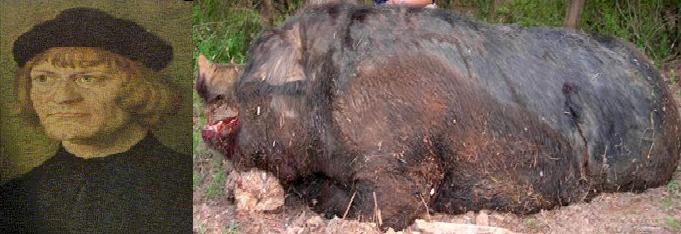
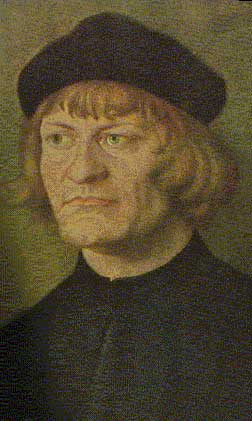
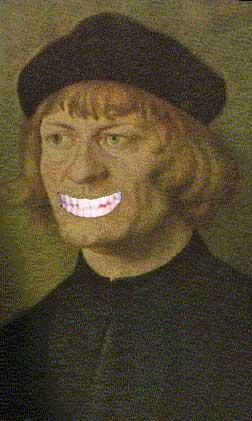
Jim West (who continues to call me Satan) has just posted about the striking resemblance between Professor Keith Whitelam, of the University of Sheffield, and Jimmy Carter! Amazingly, when looking at this picture of Zwlingli, and also this picture today, I too found a striking resemblance.


Here they are - side by side. You decide.

N T Wright causes crops to fail

I wish this guy would post more.

Wednesday, May 30, 2007

Quote of the day

'[If the young and foolish are] straining after beat music and pop culture and all this kind of garbage they ain't born again'

- This gentleman's comment on the emerging church!

Barth – a poem

Blue books fill my shelf, inviting to be devoured
But my lazy arse sometimes needs to be first overpowered

He did write an awful lot,
But at least it wasn’t a lot that was awful Schrott

Though my butt is not lazy all the time, mind you
As often I love to read the CD, especially while on the loo

Luther too did his best thinking on the pot,
As, according to the Apocryphal Liturgy of Moses, so did Lot.

Hang on, Chris, toilet humour is not appropriate for a man of such greatness
And I gotta tell you, not much rhymes with ‘greatness’ (nor ‘bollocks’ come to that).
Oh, actually ‘lateness’ does. Shit.

Don’t get me wrong, not all poetry needs to rhyme
Especially because drafting it takes up a bit more time

But this is all the more the case with Barth,
As his name sounds like the sound my bottom makes when I
Go to bed.

Oh yes, don’t make me a limp wristed poem writer, Oh Lord
That takes himself too seriously and gets everyone deathly bored.

Make me a Barth without the unfortunate rhyme,
Yea, Lord, make me a more of a Barthian,
For that’s not so easy to rhyme with a gastronomical functian.

Tuesday, May 29, 2007

Mother

of all headaches. Blogging hurts.

Bis morgen.

Monday, May 28, 2007

GodTube?

Have you ever bothered looking through the contents of Godtube? It's appears to be a Christian type of Youtube, and I'll be upfront: I much prefer the latter.

Though Godtube is filled with a mixture of material, as I expected it is dominated by conservative evangelical material. Why is this so? You may ask. Here is my answer: I know of one fundamentalist blog which enjoys many more readers then even the biggest biblioblogs entertain. All he has to do is write about his breakfast – I'm being serious – and multiple comments are left. Now, one day I wondered why this was the case and came to the simple conclusion that there are more conservatives in the west (where access to a computer is more possible), and they also tend to be more active on the media front (hence all of the various Christian TV channels)

Anyway, Godtube. One of the first things I stumbled upon was this number.

The speaker asks, does God love sinners?

And concludes God doesn't.

And anybody who thinks he is wrong is a deceived heretic evil scripture twisting liberal. Or more or less.

'Then what about John 3:16?', he asks.

Well, the Greek word for love is in the aorist, he notes, which basically means, after he's finished showing he doesn't know what the sexual-related-word-ing hell he's talking about, that God only hates sinners.

This kind of thing makes me angry, frustrated and sad.

And my belief in a straightforward understanding of the perspicuity of scripture is melting.

When I see upsetting things like this I realise afresh how badly the evangelical and fundamentalist churches need trained teachers who could recognise the significance of an aorist from a dancing grapefruit.

Ad Hominem for the day

My blog, Chrisendom, is getting into trouble again.

Thomas Ice, Executive Director of the Pre-Trib Research Center in Wash. D.C, slanders Chrisendom as 'anti-semitic'!

Sort of.

(Cf. the second major subheading on this page)

Film Review: Pirates of the Caribbean 3

It was alright I suppose.

Plot: * - - - -
Action: * * * - -
Tottyometer: * * - - - (for Keira Knightly)
Effects: * * * - -
Procreative related activities: - - - - -

Friday, May 25, 2007

The New Look

My thanks to Scott Bailey (http://scotteriology.wordpress.com/) for surprising me this morning with an e-mail with the above graphic attached! That man has skill!

Still, some explanation is in order. On the very left we have Calvin who is either

  1. Trying to pick Tom Wright's nose
  2. Pointing out to Wright the errors of the New Perspective on Paul
  3. Or he's saying 'Yea, return from exile, narrative, makes a good deal of sense to me'

The truth would perhaps involve something of all three.

Next to Tom Wright is none other than Barth who looks like he's just been told that Brunner accidently fell into a vat of chicken poo.

Coming next, and blasphemously appearing prominently covered with a glow of heavenly filling glory, is a grinning idiot.

To my right, and Jim, the following sentences are for your benefit, is Zwingers. As he turns to me, light is prophetically being cast on the bible as he reads it. He's whispering, 'please tell me more oh much wiser-than-me-one'. (He's also chewing on a protestant sausage).The grinning glory boy is thus appropriately standing and shining in authority over the wee got-all-his-ideas-from-Luther reformer. (I figure if Jim is gonna call me the devil anyway, I might as well earn it)

To the right of Zwingli is Luther looking like he's taking everything far too seriously. He's got his 'I'm not amused' face on and needs a good tickle. Rumour has it, he just read this before the painting was made.

To Luther's right is Bultmann who has the classic 'I didn't just fart (but I secretly know I just did)' look on his face.

You are an open book to me, Herr Bultmann.

That's why Bonheoffer, at the very right, is looking a bit pensive.

Thursday, May 24, 2007

Another Anti Chris Ad Hominem Quote for the Day

"As to that other wicked Brit living in Tübingen- well, he's on his own ... you too can be snatched from the flaming, fiery, Chris Tilling filled pits of hellish torment"

No need to mention out who wrote that.

Bauckham’s Response

As promised, here is Bauckham's response to my questions listed here. I will try to gather together all of the questions and all of Bauckham's responses at the end of the colloquium, marking those that were the most thought-provoking. Until then:

Bauckham's response to my first question

a) I should say that 'inherently memorable' doesn't only refer to miraculous events. Zacchaeus's meeting with Jesus must have been very memorable - it changed his life - but was not miraculous.

b) To go for common ground with historians who don't believe miracles possible, I would want to say that all historians should allow for inexplicable events. Very strange things do happen and are reliably witnessed. The historian should not wait for a scientific explanation before thinking that the evidence suggests an event he/she can't explain. I myself am not inclined to believe the events at Fatima a God-given miracle, but the evidence that something happened (mass hallucination?) cannot be dismissed. Of course some of the Gospel miracles - healings - may be explicable in psychosomatic terms, and almost everyone accepts that Jesus healed people.


c) But in the end I would say that as a historian open to the possibility of real miracles I should do my historical work on that basis, just as unbelieving historians would do it on their basis. What matters, of course, is to be upfront with one's presuppositions.

Bauckham's response to my second question

Someone has written something on Mark that does this (I can't now recall who where) - in the sense of arguing that Mark's Gospel is written so as to be memorable to oral performers by those means. He sees it as a feature of Mark's composition of his Gospel. It would be much more difficult to apply this to the oral sources behind the written Gospel, but it's worth considering.

Bauckham's response to my third question

On the actual quote (p 204) I do make it first of a list of three reasons, and a reader might put the three in a different order. So I don't think too much hangs on the degree of confidence one has in the inclusio at that point.

To those who don't find it plausible I would urge (and perhaps should have done this more clearly in the book) that (1) There are inclusios of many kinds all over the place in ancient literature. We're not used to noticing them but ancient readers were. (2) I think the first readers/hearers of the Gospels would have expected them to incorporate eyewitness testimony, and so they would be on the look-out for clues to whose eyewitness testimony is indicated. (3) The inclusio needs to be taken with the fact that Peter in Mark is not only first and last, but also named very frequently through the narrative. I take it that is part of this particular inclusion device. Even readers who didn't explicitly notice the inclusio device would have their impression of the Gospel strongly marked by the priority and frequency of reference to Peter, and at that point my arguments in chapter 7 also become important.

Someone has said that if Mark is based on Peter's testimony isn't it likely in any case that Peter would be the disciple named first and last. But this fails to take account of (a) the *emphatic* first reference, and (b) the fact that the last reference wouldn't necessarily be expected. But it also fails to account for Luke, who creates his own Petrine inclusio with material not taken from Mark.

The inclusio in Mark and Luke, especially, is important to my argument because I am arguing that the Gospels indicate their own eyewitness sources. A strong argument against eyewitness sources has been the Synoptic Gospels don't seem to be interested in eyewitness testimony. The argument could still be made without the inclusio, but the inclusio does make a major contribution to it.

Bauckham's response to my fourth question

Probably, but I'd need to consider this material carefully, as I haven't so far.

Bauckham's response to my fifth question

This is a big question, and relates to a couple of other questions I've answered. One of the problems of a project like Tom's is the coinherence of fact and meaning in testimony. This cannot really be carried over into an account of the historical Jesus of the usual kind. In Tom's case, I think what tends to happen is that it becomes very important to him to reconstruct Jesus' own self-understanding and views of what he was doing in his ministry, because these have to serve as the interpretative lens through which to construct a Jesus of significance. Jesus' self-understanding and intentions of course matter in the Gospels but the writers don't load them with all the burden of understanding what was going on.

There's a very interesting issue about historiography's dealing with testimony here. Think of events closer to our time for which historians have accounts in a variety of sources. E.g. an important battle, of which we have three or four accounts from different perspectives from participants on either side and in different relationships to what was going on. The standard modern historical way of dealing with this would be for the historian to extract from a critical study of the accounts some basic 'facts' and information that meets the particular interests he has in the battle, and then wrote his own account of the battle from a sort of heaven's eye view. But so much lost in this procedure! We miss understanding what it was really like for the involved participants. Their perspectives are dissipated and lost behind a historian's own reconstruction. Suppose, instead, the historian published the accounts themselves (or extracts, whatever might be appropriate) and used his expertise to help the readers really understand and enter into the several perspectives. This would be a much richer sort of history. The historian could add whatever he wanted by way of critical assessment and could also add ideas about how the accounts can help answer questions the historian has but they were not directly concerned with. But the key thing is that the witnesses accounts would not be superseded by the historian's construction. Another good example would be the life of Francis of Assisi, which resembles the Gospels case in that we have a variety of accounts that probably rely on different sources among the oral accounts of different disciples of Francis, accounts which also have their own slants on the significance of Francis. What does the hiostorian do with these?

I think we need to think more about the appropriate ways of dealing with historical material of the kind we have in the Gospels.

Wednesday, May 23, 2007

Award for Jesus and the Eyewitnesses

Congratulations to Richard Bauckham who has apparently won the biblical studies category of the Christianity Today 2007 Book Awards!

Jim West Podcast

Oh, I had totally forgotten to mention, here is a podcast interview with our own Jim West. Christian Brady does a really good job with the questions and appropriately asks, among other things, why Jim keeps calling me the devil!

Ad Hominem Quote of the Day

I recently left an innocent comment on a blog that mentioned Köstenberger's helpful review of Bauckham's book, Jesus and the Eyewitnesses. I wasn't to know that this would prompt a rather unsympathetic outburst against my series on inerrancy. The whole post, for your reading pleasure, can be found here, but these were my favourite bits:

"I see that Chris Tilling has graced our combox ... Is Tiling even aware of the history of the ETS? If he is, it doesn't show ... What he really means is that he finds certain parts of the Bible unbelievable. And so he wants to see the ETS allow a lower view of Scripture to accommodate the disbelief of theological liberals like himself ... Is Jesus illogical? Is Paul illogical? Is the author of Hebrews illogical? Perhaps a better question would be—is Tilling illogical? However, I'm too tactful to answer that question ... This is a good illustration of Tilling's alarming lack of intellectual sophistication ... Tilling is guilty of bifurcating the witness of Scripture ... Tilling has such an undisciplined mind ... Tilling has done a wonderful job of leaving his brain at the door. He is attacking inerrancy by raising one brainless objection after another ... What is Tilling's problem, exactly? Is it that he's not terribly bright? Is that why he contradicts himself so readily? ... No, the false expectation which illogical minds like Tilling, Funk, and Ehrman are suffering from is the assumption that if Scripture were inerrant and inspired, then there would be no obscurities in the record of Scripture".

Tilling, Funk and Ehrman!

But my absolute favourite bit was this last angry outburst towards the end:

"Actually, nothing is more flippant than the way in which Tilling rattles off one lame-brained objection after another. Tilling is one of these conceited individuals who prides himself on his intellectual attainments when, in fact, his actual performance is distinguished by its slipshod, anti-intellectualism"

Ah these guys, you gotta love em! Some of you may well be thinking what I've been thinking, but CTRVHM is making no official statement at this moment. I'm confident, however, that any who read my series on inerrancy (and the discussion in the comments) after his post can make up their own minds as to whether the position I'm promoting is really lame-brained or not!

You will notice that he wittily titled his post 'Tilling less than thrilling'. Even rhyming!

Of course, my poetic skills have already been abundantly demonstrated on my blog (here and here, for example), as so I felt obliged to respond in like manner. But I couldn't really get much to rhyme with 'Steve Hays'. 'Hays loves gays' couldn't be proved, and nothing else was funny enough, so I've landed with the poetic 'Hays writes a blog post'.

Tuesday, May 22, 2007

My biblical-studies colloquium questions to Bauckham

Below are my questions to Richard Bauckham about his book, Jesus and the Eyewitnesses. Having worked rather closely with the work, I have plenty more thoughts and questions, but I've chosen a few from my list that may also encourage further discussion with the other members of this discussion group.

You can find my post on the biblical-studies discussion list, and if Bauckham is kind enough to respond to my questions, you may find them also on the list in due time.

1) My first point relates to believing the miraculous. You speak of the 'inherently memorable' nature of much of the Jesus tradition, with a nod to the believed reality of the extraordinary and 'supernatural' events like the resurrection and the miracle stories. While I personally have no problem with this faith stance – it is one I share – many will, of course, protest that to speak of the 'inherently memorable' nature of these events as if they were reporting real miraculous events is to import a unverifiable faith judgment into a historical argument, a move that wouldn't be allowed in other historical disciplines. Many rationalists and naturalists will simply argue that we can no more trust the Gospel accounts of such supposed events any more than the bizarre stories in other premodern literature such as the Apostle Peter's resurrecting of the smoked fish in the apocryphal Acts of Peter or the piecing together of the torn-to-shreds St Aelhaiarn in mediaeval hagiography. While I understand that your book was not the place to justify your perspective on these matters in any depth, how would you respond to this line of reasoning?

2) While on the subject of remembering Jesus tradition, do you think there is more room to develop your argument in light of deliberate mnemonic techniques such as the loci system as mentioned in Pseudo-Cicero's Rhetorica ad Herennium?

3) Confidence in the inclusio. Probably not all will be convinced by the supposed presence of the inclusio. Some will no doubt protest that it is overly subtle to be plausible. While I am generally convinced by your arguments for the presence of this inclusio, I am a little uncomfortable when you employ the inclusio so confidently elsewhere in the book. For example, in providing reasons in support of Papias' statements concerning the origin of Mark's Gospel, you argue that the inclusio 'is probably the most important reason for reconsidering Papias' evidence' (204). But is the case you make for the inclusio strong enough to serve as the foundation for another hypothesis, especially as the inclusio lacks explanatory power for the material in Matthew's Gospel?

4) Do you think there is any significance for your argument in the related mixture of themes found in Hebrews? Namely: i)
the importance of eyewitness testimony and the implied chain of transmission in 2:3 ('It was declared at first through the Lord, and it was attested to us by those who heard him'), ii) the presence of 'Synoptic-like "historical Jesus" titbits (e.g. 2:18; 4:15; 5:7-9 – The Temptation and Gethsemane, the beginning and end of Jesus' public career?)' (I here cite Michael Pahl), and iii) the evidence of the 'testimony' theme within Hebrews (cf. Heb 2:4, 6; 3:5; 7:8; 10:15, 28).

5) You write on page 3: 'Among current historical Jesuses on offer there is the Jesus of Dominic Crossan, the Jesus of Marcus Borg, the Jesus of N. T. (Tom) Wright, the Jesus of Dale Allison, the Jesus of Gerd Theissen and many others. The historian's judgment of the historical value of the Gospels may be minimal, as in some of these cases, or maximal, as in others, but in all cases the result is a Jesus reconstructed by the historian, a Jesus attained by the attempt to go back behind the Gospels and, in effect, to provide an alternative to the Gospels' constructions of Jesus'.

What would research into the historical Jesus look like in light of your thesis, then, especially as you allow for a good deal of interpretive development in the Jesus traditions and you yourself deal with various testimonies, e.g. that of Papias, in a selective manner such that you accept parts and reject other elements of the testimony (practicing what you preach in relation to the dialectic of trust and critical assessment). And why do you think Tom Wright - who doesn't practice a comprehensive mistrust of the Gospels and is perhaps only as selective as you were with, say, Papias' statements - is 'attempting to go back behind the Gospels ... to provide an alternative to the Gospels' constructions of Jesus'?

I'd be interested to hear what Chrisendom readers think about the issues raised in these questions.

Eschatological mess of the day

--------
Russia, with its remaining nuclear arsenal, will soon invade Israel.

And this fulfils Ezekiel 38-39.

You may add to this cocktail, if you so wish, a nice serving of Muslimophobia conspiracy by suggesting that Russia will, in the above, also ally with Iran, and that both will then invade Israel.

Again, all cos the Bible says so.

Obviously.

Oh yes, and Israel had better not disarm and seek peace, that would only fulfil the strategy of the antichrist (the latter of course to be linked with the UN)
--------

*Bangs head against a brick wall until it really hurts*

*Feels a bit better*

Monday, May 21, 2007

B. B. Warfield on evolution

"I do not think that there is any general statement in the Bible or any part of the account of creation, either as given in Genesis 1 and 2 or elsewhere alluded to, that need be opposed to evolution"

(I was surprised to read this, too!)

Online Colloquium with Richard Bauckham

I've finally returned from my 'church retreat', rather exhausted and in need of peace and quiet, but immensely holy and incredibly anointed.

*Holds up hand in charismatic prayer posture and blows at screen*

*Readers of Chrisendom the world over start shaking and fall on the floor. Gold fillings fill thousands of mouths and their household pets manifest while their keyboards run to the nearest stream to be baptised*

Apart from imparting the unction to function, I've returned to the biblical-studies online colloquium with Richard Bauckham. It started on Sunday, and if you would like to join in the discussion or lurk in the background then now is the time to join up.

I need to get to my job of moderating the questions now.

Oh, and my apologies to those of you who have been waiting for e-mail responses from me, I shall try to attend to that today.

Tuesday, May 15, 2007

Church Retreat

I'll be gone for a few days on a church retreat. So, while all of you are busy being aimlessly unholy, I'll be locked away with a bunch of Christians veritably glowing with holiness.

Mostly.

Well, ok. Sometimes.

Until then, here's a video for your viewing pleasure. In it, conservative Christian, Greg Koukl, debates with self-help/new age guru, Deepak Chopra. Now this sort of thing doesn't usually turn me on, but I actually think it is a good example of courteous and thoughtful conservative Christian apologetics, and I though Koukl tended to generally have the upper hand. I liked his manner. However, Chopra started shinning towards the end in his insistence that he can embrace uncertainty. Koukl apparently didn't feel he could agree here, but I am strongly of the opinion that Christian's too can, nay must, embrace uncertainty. Anything else is an over-realised eschatology. Actually, the ability to accept and be comfortable with uncertainty is, I believe, a sign of spiritual maturity. Uncertainty indicates that one is closer to the truth.

As this question is engaging me at the moment, and if any are bothered, I would be interested to read your top few reasons why I should or shouldn't believe penal substitutionary atonement theory.

I wish you all a good few days!

Monday, May 14, 2007

Ortlund

NOT the best book to buy your wife for Christmas/her birthday.

John Webster podcast

Jordan Barrett sent a couple of us a link, today, of a presentation given by John Webster. He explains:

"Here's a podcast I just uploaded of a presentation I tried to record from John Webster. The audio isn't the greatest. You have to turn it up fairly loud to make out what he's saying, and yet any sounds much closer to my computer can get pretty loud at times (so beware!) ... The topic he spoke on was "mercy." At any rate, let me know if the quality is too poor to put the link up publicly (Webster gave me permission). Otherwise, I don't have a blog, so feel free to post it on your blog if you think your readers would enjoy/benefit from it.

I think my readers will certainly enjoy this! I can hear it OK, but you will need to amplify the audio, for sure.

The presentation was given on the 28th March, 2007 at Garrett Evangelical Theological Seminary.

Thanks, Jordan!

UPDATE: Note Jordan's comment to this post!

Thursday, May 10, 2007

Mastering New Testament Greek by Thomas Robinson

My thanks to the kind folk at Hendrickson for a review copy of Thomas A. Robinson's Mastering New Testament Greek: Essential Tools for Students (Peabody, Mass: Hendrickson, 2007).

Those of us concerned to improve our NT Greek are extremely grateful for any help we may get on the way, so I am delighted to point my readers to Robinson's new and well-priced book, Mastering New Testament Greek. This third edition provides the student with numerous new tools to aid one on the path to NT Greek proficiency.

The basic concept of the book is as follows. Some other Greek vocabulary books/lists will give the Greek words according to frequency, such that the most common words are to be learnt first. This is a good pedagogical principle and helps students gain a basic grasp of NT Greek faster. Robinson does the same only according to the frequency of cognate roots. The idea is simple: 'by learning the most frequent roots, one can gain a solid working vocabulary even more quickly than by memorizing only the most frequent individual words' (1). Additional to this, Robinson provides many mnemonic aids for helping the student in the memorisation process. I would note that during my undergraduate studies, mnemonic devices helped me tremendously. I applied them with a good deal of success to Greek, Hebrew and Aramaic, gaining perfect grades in my Greek test, and highest of the year grades in my Hebrew class (which also landed me with a money prize!) - and I can say this as one to whom languages do not come altogether naturally or easily.

Robinson also breaks down the vocabulary lists according to their roots, prefixes and suffixes. The third section of the book, 'Explanation of Greek Prefixes and Suffixes', is a very helpful introductory summary of the various ways Greek prefixes and suffixes are commonly used to contribute to the meaning of a given word. I think an obvious advantage of this approach is that it helps the student to more quickly gain a grasp of the ways in which Greek words inflect. This section, as with all the lists, is supplemented with mnemonic helps.

Also provided is an index of Greek word endings given in reverse alphabetical order, i.e. so that the last letter of the word is the first level of sorting. This will be helpful for many beginners who are at a loss as to how to decipher many endings.

But there are a myriad of other tools to hand, including a few helpful diagrams and pictures to demonstrate the meaning of the prepositions and cases. This is aimed to develop the spatial sense of prepositions, providing a ground upon which to build the necessary nuances one must later learn. There is also a short Greek-English cognate dictionary, again filled with helpful mnemonic notes.

If all of this wasn't enough, there is an accompanying CD (both Mac and PC compatible) with numerous software tools including a pronunciation guide (Erasmus style), a programme for parsing difficult grammatical forms, a review of verbs, and vocabulary quizzes suitable for teachers to give their students.

It needs to be pointed out that the often used mnemonic devices tend to focus upon logical connections rather than the purely creative. This was perhaps a little overdone, and creative associations could perhaps have been encouraged, as for example suggested in numerous 'learn foreign language quickly' books, as well as employed in the older Roman Loci mnemonic systems.

While some of the pages may appear rather daunting on first glance, filled as many are with codes and lists, Robinson provides a brief three page chapter supplying instructions for using the manual. These pages are a must if the student is to get the most from this helpful NT Greek learning aid.

Finally, while the book is not sufficient in and of itself to make possible a mastery of NT Greek, that is not its task. It seeks to enable the student to grasp NT Greek vocabulary with more speed and to facilitate a better intuitive grasp of the meaning of prepositions and declensions, as well as the meaning of word inflections. In this is admirably succeeds. This is a helpful tool for all who are starting NT Greek, and the index of Greek word endings will be useful also for more advanced students. I suspect that the book will also be of use for more experienced readers, for all of us can profit from the occasional recital of the basics. Indeed, given the basic idea behind the book, even more advanced readers may find themselves noticing links and patterns that had previously escaped their attention.

Click here to view the table of contents, here to view the small chapter listing identical Greek/English words, and here to read the introduction.

Wednesday, May 09, 2007

The Humour of Zwingli

I'm delighted to announce that at last you can access information about Jim West's forthcoming book, The Humor of Huldrych Zwingli: The Lighter Side of the Protestant Reformation.

Jim is to be thanked for the time he has spent working on this excellent English translation of Fritz Schmidt-Clausing's original, Zwinglis Humor. And I can confirm that the translation is good as my own beautiful wife also spent a considerable amount of time working through the whole text, helping out with numerous translation issues.

I wrote a review of the book for the back cover which I'll simply reproduce here:

" If any had imagined Zwingli as a straight-faced, humanist dogmatician and dull producer of theological fossils, this is the book to set things straight; it reconnects us with the real Reformer, with a man of deep theological energy and pastoral concern often delivered in the shape of biting wit, creative puns and a variety of other hilarious forms. In other words, this is a man we can identify with, making him appear all the more as someone worthy of out study and interest. Dr. West has done us all a service in not only producing a long-needed republication of the Schmidt-Clausing text, but his translation helps make the sometimes complex idiomatic German word-plays accessible to English-language readers."

It really is a lot of fun to read, and I suspect that many will discover a whole new side to Zwingli. And you'll like what you see.

None other than Dr. Emidio Campi and Dr. Peter Opitz have also written glowing reports on the backcover, all of which can be read by following the link above. Big names in Zwlingli studies for sure: Campi, Opitz, and, er, *cough* Tilling. Actually, I consciously wrote my review in light of the fact that I am a non-specialist in Zwinglian studies, and I found this book created far more interest in Zwingli than any other I have read.

Tuesday, May 08, 2007

What a name

Not much time tonight, but I wanted to point out another page that shows my fame is spreading, this time into the world of genomics. Tilling is simply getting everywhere.

Flippin 'Targeting Induced Local Lesions IN Genomes'! Ouch!

The fame of Tilling hits Wikipedia

Sort of.

The Seven Seals of the Apocalypse

A useful month by month time line to plot your eschatological fate!

Under the first point: "A radical government comes to power in the US, severs ties with Israel and creates a socialist state, persecuting Evangelicals and religious Jews" followed by "The city of Rome rises to world prominence once again"!

Seems only us evangelicals are in trouble, so it looks like the rest of you are safe enough. Except Frank Beckwith and clan, who, it seems, may well be the cause ...

;-)

Monday, May 07, 2007

Disagreeable Quotes of the day

I'm writing my doctorate to show why I think this first one is way off:

'The praises and homage offered to Christ [in the NT] then seem to take their place naturally in the series of Jewish royal messianic praises'

(William Horbury, Jewish Messianism and the Cult of Christ, London, SCM: 1998, p 140)

--------

All I want to say about the following is "what about 1 Cor 16:22?".

'What does Paul love? ... [I]n contrast to many modern believers, Paul cannot say, "I love Jesus" ... the relationship to this lord and king could not be any closer, but it is not called love. Paul loves heaven.'

(Klaus Berger, Paulus. München: C. H. Beck, 2002, p 35)

Of course, were either of these two to skim through my work, I would come out far worse!

Amazing archeological find

Reports are coming in that Herod's tomb and grave have been found at Herodium! Do give this haaretz.com article a read

HT Jim West.

Sunday, May 06, 2007

Quick link

Dan has written some superb and concise book reviews here, on authors and subjects ranging from Crossan, Barth, Hauerwas, Wittgenstein, and, er, Batman. Do give them a read.

The spawn of the whore of Babylon

So, the rumours are confirmed. Frank Beckwith, President of the ETS, has returned to Roman Catholicism, and he tells us all about it in his own words here.

Some may remember that I spoke about my own temporary conversion to Roman Catholicism here. To quote myself:

"Oh, and another thing. I decided to become a Catholic today. Yep. A big papal 'thumbs up', a nice dollop of Pope-loving, and I'm a red robed, hat wearing, ground-kissing, staff swinging counter-reformation papist. Admittedly, in about half an hour I'm back to being protestant. This was only a short-lived jaunt into the realms of Romism; but it was the only way I could justify taking a break from my work on All Saints Day (a Catholic holiday). Some may call this intellectual dishonesty. I call it pragmatic intellectual flexibility"

Yea baby! Bad taste, terrible timing Tilling is back on form.

Actually, I am a bit of a scholar on Catholic dress fashion, as this post ably demonstrated.

And there aren't many in biblioblogdom that have sought to include Catholics in their own worship songs. But if you remember, I did - in my immortal song, Holy and you Know it (© 2006, CTRVM)

And if all of this wasn't enough, I've even given my readers a peek into one the most beautiful moments in the entire history of Catholic-Protestant ecumenical dialogue in this post.

Oh, and I'm loving the Popes new book on Jesus as I've recently mentioned, and I wrote a lengthy blog series on another Catholic's work on science and Christianity (Küng's Der Anfang aller Dinge). It should be no secret, then, that I have a small soft spot for Catholicism. I admit it. Not enough to stop me gladly being an evangelical, but a soft spot nonetheless. So send me to the Evangelical Inquisition: I plead guilty (unless I'm offered enough money, of course, in which case I deny everything and I'll get back to cursing the spawn of the whore of Babylon, and pronto).

Of course, I disagree with some things implied by Beckwith in his leaving statement. Jim West commented about that here (though in the process he managed to call me the antichrist. Again). And I will disagree with Beckwith about other matters too. Strong formulations of inerrancy, for example. Which reminds me, I recently read something by Dr. Barry H. Corey, recently appointed as the president of Biola University. He claimed: 'I don't cross my fingers, nuance or flinch when I say the Bible is inerrant'.

Now, Corey sounds like a very wise and likeable man in what I've read. But I, one the other hand, were I to need to confess the Chicago Statement, for example, will have had to have crossed my legs and fingers and arms so often, that I'd end up looking like the ribbons on a busy May Pole. As for flinching, I'd look like a serious case of Tourette syndrome.

Friday, May 04, 2007

Honest exegesis

I'll be presenting a paper at the German-English Tübingen Colloquium a week Monday, on Christology in 2 Cor 3:16-18. In the first part I suggest that the repeated kurios in these verses indicates the risen Lord. In the second part I attempt a rather unusual analysis of the christological significance of these verses.

I feel that my case is pretty good but not water tight. Max Turner, at our last LST NT conference, gave a bit of advice for researchers that has stuck with me. He explained that it is better to simply be honest about the strength of the arguments you proposes, even if they are suspect. Don't over press your case, in other words. Obvious, but the truth of this somehow 'got through' to me in a new way recently. I must say, over pressing is something I have been guilty of in the past, and his advice liberated me to construct a more honest argument. To be honest, whatever one claims in relation to 2 Cor 3 needs to be advanced with a good deal of humility; it is a very complex and hotly debated passage.

The Testimony of the Beloved Disciple

Reports have started spreading across biblioblogdom about Richard Bauckham's forthcoming book, The Testimony of the Beloved Disciple. I'm delighted to say that Richard has organised for Baker to send me a review copy, so you'll be hearing much more about this book in due time. Personally I have quite a few unanswered questions about the nature of John's Gospel, especially as it relates to Bauckham's eyewitnesses thesis, so I look forward to reading this immensely.

UPDATE: I ought to add, so as not to mislead anyone's expectations, that this book is largely a collection of Bauckham's previously published articles.

Rumours

Rumours aren't good things, but Michael Barber, co author with Brant Pitre of the superb blog, Singing in the Reign, report that president of the Evangelical Theological Society (ETS), Frank Beckwith, has become a Roman Catholic. Not that I have strong feelings either way, but of course as an evangelical I can't help but have slightly mixed feelings. Nevertheless, if this is true I entirely endorse Michael's statement: 'His example is clearly one of courage, intellectual integrity and spiritual sincerity'.

Let me make it absolutely clear: I'm not sure if this is true or not. But my prayers are nevertheless with Frank and his family, especially in light of the backlash against them this will cause.

Wednesday, May 02, 2007

Podcast: Jesus and the Eyewitnesses

Given the upcoming biblical-studies list colloquium with Richard Bauckham, I decided to record a podcast summarising Jesus and the Eyewitnesses. My blog series on the book has perhaps been a little too long, especially for some of you lightweights, so I've tried my hardest and condensed a complete overview of his book into a 25 minute podcast.

I messed up the conversion to mp3 process so the quality isn't that good, but I can still be easily understood. The file is 4.5 MB, so if you use a dial-up modem it may take a few minutes to download.

Click here to download and listen to my podcast on Bauckham's Jesus and the Eyewitnesses.

Spiderman 3

I saw Spiderman 3 at the cinema tonight. Great fun! I thought the black goo was a good picture for that which it fed upon, namely bitterness. Highly recommended.

Tuesday, May 01, 2007

Köstenberger review of Jesus and the Eyewitnesses

1) Bruce Fisk's Crossings is biblioblogger of the month for May. Do give his interview with Jim West a read.

I thought his idea about how biblioblogging could be improved was rather interesting:

'I like the organic, idiosyncratic, open-source feel of the blogosphere but I'm hoping we'll see more collaboration whereby groups with overlapping interests post to the same site. Most blogs I visit are pretty much solo efforts. It would be fun to see someone adapt the bloggingheads.tv model using webcams and a split screen to encourage conversations among religion scholars.'

2) For those of you who can read German, Zweifel an Koran und Mohammed: Saarbrücker Wissenschaftler forschen über die Anfänge des Islam is worth a read.

3) Finally, Andreas Köstenberger has written a helpful review of Bauckham's Jesus and the Eyewitnesses here. It will come as no surprise to those who are familiar with Köstenberger's position on the authorship of John's Gospel that he attempts a critique of Bauckham's thesis for not asserting that John the son of Zebedee wrote the Gospel. He argues:

'After all, Bauckham's point is not merely that eyewitness testimony is important for the Gospels, but that we are dealing here with apostolic eyewitness testimony, that is, eyewitness testimony that is credible because it comes from those who were closest to Jesus during his earthly ministry. In this regard, it is hard to see how the testimony of one largely unknown "John the Elder" (not mentioned in any of the Synoptics or other non-Johannine New Testament writings) would satisfy Bauckham's own criterion'

However, I did not get the impression that Bauckham's arguments regarding the authorship of the Johannine Gospel were 'unduly biased' as Köstenberger claims. I am no Johannine expert, but I get the feeling that Köstenberger is attempting to urge us to squeeze the available evidence through his own (arbitrary) logical wringer, namely that the eyewitness testimony of John's Gospel requires a more authoritative early Christian figure than 'the largely unknown "John the Elder"'. But I am not so sure, especially given the Beloved Disciple's anonymity through the Gospel. Besides, John the Elder was not unkown, of course, in his circles, and he knew Jesus, according to Bauckham's thesis, very well. Concerning the logical wringer: to employ a less than appropriate parallel, it may be hard to see how the monotheistic Apostle Paul can express a divine Christology one moment, and then turn and speak of the subordination of the Son to the Father the next. But it would appear to be the most accurate treatment of the evidence to allow both elements in Paul their full say. Those who employ a logical wringer at this point end up doing violence to the texts. OK that wasn't the best example I could have come up with, but you know what I mean!

(My thanks to Jordan Barrett for drawing my attention to this article)