Saturday, November 17, 2007
SBL update 1

Tuesday, November 13, 2007
SBL

We shall be leaving for America tomorrow, arriving in Washington DC Wednesday evening. After a (hopefully) good night's sleep at Anja's aunt's home, we shall drive down to our friends in Durham, North Carolina. Then, without much of a break, I'll be flying to San Diego for the Society of Biblical Literature Annual Conference.
In other words, I'll probably be a wreck by the time I finally put my bags down in the hotel. There are so many papers and discussions I am very much looking forward to, not to mention the book stalls (woo hoo!), but more than anything I look forward to meeting many of my blogging-related friends. If you recognise me among the crowds (I'll be the one handing out Chick Tracts about how Christ has defeated the kingdom of Bultmann) do come and say a 'hello' – it is always good to put a face to a name.
I hope to manage some blogging during my stay in San Diego, especially as I will be sharing a room with laptop bearing West. I hope to at least set up a live video feed blog once or twice ('West snoring', 'West after he has stubbed his toe', 'West after he realises I have scribbled out all the words in his new books' etc.) and perhaps also detail the amusing side of 'life too close to West'. I plan to have him hungrily reading Wright and speaking in tongues by the time we part company, so do pray for my success.
I also wanted to say a public thank you to Don and Dea Moffitt of Backus Books for their generous and kind donation that has made this trip possible. Danke!
Free beverages at SBL
I received in the post a few 'stickers' / badges, one of which I can attend, namely the 'Student Members Reception' (Saturday 9:30-11pm). At the bottom it indicates that the badge is 'Good for one (1) free beverage'. Naturally this had me devising a cunning plan, the result being that I've managed to produce a number of convincing photocopies of these 'free beverage' coupons. Now I just have to see how many times I can make it to the bar with some variation of moustache, glasses and wig, before my scam is rumbled (I'm guessing that I'll be too inebriated to care by the time the staff figure out what is going on).
Monday, November 12, 2007
Christian Zionism?
A while ago I started a series on this matter. I was rather perturbed by the heat it generated and decided to do some more thinking before I continued. I have hardly made it a matter of obsessive research, but I am a little more informed now, thanks to input from a Messianic Jewish friend. He pointed me to this book that I commend to readers looking for a different perspective than that offered here: Future Israel: Why Christian Anti-judaism Must Be Challenged (New American Commentary Studies in Bible & Theology) by Barry E. Horner.
While my basic position still remains unchanged (though I think it has changed with regard to Rom 9-11 – before I was very Wrightian, though probably less so today), I would no longer focus on the hermeneutical practice of the early church as the decisive critique of Christian Zionism – at least as developed in my previous posts. The early church was flexible in its hermeneutical procedure, sometimes christocentric, other times employing slightly different accents. I suspect that some of Sizer's and Motyer's claims need to be re-formulated in light of Horner's critique – though certainly not abandoned. The 'christological hermeneutic' card should still play a part in constructive critique of Christian Zionism, but I would focus more now on the narrative trajectory of scripture, and how the prophetic promises were understood by Christ as fulfilled in his ministry and hence laid the groundwork for NT theology generally, as developed especially by Paul. This wider scope of analysis includes the specific hermeneutical practices of the early church within it, as a moment within this, applied to various concrete situations. But more decisive is the significance of the relation between Christ and the prophetic traditions. Horner claims that Motyer et.al do not take the OT scripture seriously. However, I suspect it is Horner who does not take the scriptural narrative seriously enough in making sense of Christ, his mission and his aims – and how these were understood by the early church.
Of course, all of these comments are mere assertions without justification. I will perhaps return to this subject when I return from SBL and detail my developing thoughts in a podcast. As ever, if you feel strongly critical of my views then do let me know. I will keep an open mind on these matters for a while to come yet!
And the winner is ...
The winner of the Jim West caption competition is ... Ben Myers

“His body was braced for action, his spectacles glistened in the sunlight, his dark eyes gleamed with a steel resolve. When at last he spoke, his voice cut through the air with icy determination: "I won first prize last year, and I'll damn-well do it again this year!" And so, off he went to the local spelling bee.”
As I promised, the prize is a bottle of CTRVHM Holy Phlegm ™ (smear on body to cure all sickness and deliver from all demons). To cut down on post and package, I thought I would simply cough up a load when I meet Ben at SBL - fill up a coffee cup. Alternatively, I could simply try to gob on him as much as I can throughout the congress. Either way, Ben will be glad to hear that he will receive a double portion of my phlegmtastic anointing - quite the gift.
Sunday, November 11, 2007
A pet peeve
I have been reading The Nature of the Atonement: Four Views today. There are contributions and responses to the position papers from G.A. Boyd (Christus Victor view), Joel Green (kaleidoscopic view), B.R. Reichenbach (healing view), and Thomas Schreiner (penal substitution view). Thus far I have read Schriener's and Boyd's chapters, together with responses. The essay's are very well written, as are most of the responses - especially those by Green. It is a very enjoyable book and I recommend it most highly to those wishing to think through their doctrine of atonement.
To be honest, I am still working out my thoughts on the atonement and so remain open minded, but here is a line of reasoning that I occasionally come across and that really ticks me off. Schreiner writes:
'The wisdom of God displayed in the cross is rejected by the wise of this age. Penal substitution is an object of indignation and regularly pilloried by many of the educated class' (70)
Schreiner qualifies himself a page or two later, but I still cannot stand it when such reasoning is even hinted at. 'You think penal substitution is a problematic doctrine? The message of the cross always was a scandal'.
Nonsense! When Paul writes of the 'offense of the cross' in Gal 5:11, or of the foolishness of the message of the cross in 1 Cor 1:18, he does not say these things because people are disturbed by the proclamation of a penal substitutionary view of atonement. The skandalon of Gal 5:11 was probably simply the notion of a crucified messiah (cf. Dunn, Galatians, 281), not because people were offended that an angry God satisfies his wrath through a sacrifice (an idea known in the pagan world). The 'foolishness' in 1 Cor 1:18 also has nothing to do with a reaction to penal substitution. Rather, the 'Christian proclamation of a crucified malefactor was moronic to persons weaned on a love of learning, virtuousness and aesthetic pleasure … The message of the cross calls for a worldview shift of colossal proportions because it subverts conventional, taken-for-granted ways of thinking and knowing' (Green and Baker, Recovering the Scandal of the Cross, 14).
To all writers: if you want to defend a penal substitutionary view of the atonement, please stop relating modern consternation towards the doctrine with Paul's skandalon statements. It is exegetically unsound and an irresponsible use of rhetoric.
Thursday, November 08, 2007
Piper, Wright, and the way we read scripture

John Piper's new work, The Future of Justification: A Response to N.T. Wright (Wheaton: Crossway Books, 2007), is free online (thanks you Nick for the heads up!). Piper has some good things to say in his many books. Has he hit the nail on the head this time?
I haven't made time to read Piper's work yet, I've just skimmed it, but I wanted to share a few thoughts that occurred to me as I read. I am not sure if the problem I will detail below is symptomatic of Piper's argumentation in this work generally. That waits to be seen. But let me share my thoughts as I read the following passage:
'dikaiosu,nh qeou//
Does Not Mean Covenant Faithfulness
Finally, Wright's assumption that the phrase dikaiosu,nh qeou/ means "the covenant faithfulness of God," instead of the more traditional "the righteousness of God," is not warranted. I have tried to show why this is the case (see chapter 3). The meaning of dikaiosu,nh qeou/ is most fundamentally the "righteousness of God" in reference to his unwavering commitment and follow-through to do what is right—which is to always uphold the worth of his glory. It is the opposite of sin, which is a falling short of God's glory (Rom. 3:23); and it is what God requires that all of us must have (Rom. 1:21), but that none of us does have: "None is righteous, no, not one" (Rom. 3:10)' (Page 179).
I need to back up and try to explain something before I comment on this. We all read scripture in terms of a certain story (or stories) that makes sense of our world. When we read scripture, many of us will effectively decorate with biblical quotes a story of what we think Christianity is and what Jesus means, but even though that story uses biblical language to describe itself, it is one that is not faithful to the general scriptural narrative. It is like reading astrophysics as if it were all about chemistry alone. To simply transport one discourse into the other is to misrepresent. When this happens, scholars say people are proof-texting (proof-texting is NOT simply drawing from scripture to justify arguments, by the way). I.e. they are decorating a story or metaphysical structure with bible verses as if it was simply the construction of a biblical teaching or worldview, as if it were careful exegesis. This happens so much it can be depressing.
As an example, let me be provocative: many approach the scriptures with a pre-understanding that the essence of Christian faith is all about individuals being sinful before God, and that in order to get to heaven when you die one must have a personal relationship with Christ. Some passages of scripture, of course, can be cited in strong support of aspects of this picture, and it becomes the basic story to which all passages of scripture then become attached. This pre-understanding of the meaning of Christian faith may sound scriptural (and contain a good deal of truth), even if it is off track. Hence,
- if Paul speaks about 'new creation' in 2 Cor 5, this must be another way of speaking about something that happens to me in my relationship with Christ.
- If I read 'righteousness of God' it must point to something I get in order to cancel my sin and be saved (I'm deliberately being course with this description).
- If I read Jesus' words: 'Truly I tell you, it will be hard for a rich person to enter the kingdom of heaven' (Matt 19:23), this must mean that I need to be careful with my wealth or I won't go to heaven.
- If I read of the power of sin in Paul, or seeking to be justified by law, all must revolve around my sin and my legalism etc.
The examples cited above are mixed. However, I suggest we would not understand what the scriptures in each case actually mean if accept the above readings as 'what the text really says'. If you read those examples thinking, 'yes, that's what I think', I suspect that your understanding of scripture is being channelled through an interpretive lens that distorts what is in front of your eyes. The little interpretative story I prefixed these examples with, about going to heaven, sinful before God etc. contains truth, but is also inadequate and can lead to scriptural misunderstanding.

It is not that the above meanings and interpretations are inherently or totally wrong. Of course not. However, to return to the examples:
- the 'new creation' language of 2 Cor 5 point to something bigger than me and my standing with God (which is only a subset of this larger picture – cf. Joel Green's Salvation). But to see this one will have to read the scriptures with different 'lenses' – one informed more thoroughly by the scriptural narrative.
- This is a complex one, but in my view the righteousness of God is not simply something that makes up for the hole in me after my sin is forgiven (or something like that). It is God being faithful to his covenant promises to defeat evil and renew creation, a movement up into which individuals are caught. But to see this one will have to read the scriptures with different 'lenses' – one informed more thoroughly by the scriptural narrative.
- To enter the kingdom of heaven is not to enter heaven. They are not synonymous. 'Heaven' was just a pious way of avoiding saying 'God', and Jesus here is speaking of entering the kingdom of God, i.e. the economy of existence over which God is undisputed King. This may be related to some notions of 'going to heaven', but they are not synonymous. The goal of Christian hope is a new heavens and a new earth, the resurrection of the body, that God will be all in all. But to see this one will have to read the scriptures with different 'lenses' – one informed more thoroughly by the scriptural narrative.
- The power of sin in Paul is a slave master (cf. Lichtenberger's monograph on this), a semi personification that enslaves all humanity. It is related to but, again, not the same as the notion many Christians have in their heads. It is a cosmic force that Christ alone can defeat. And the 'works of law' Paul attacked may well be related to modern notions of legalism (in their corrective, I personally think Wright and Dunn go too far here), but they are not synonymous. Works of the law were tied to social and 'horizontal' matters, not simply about how one related to God. But to see these points one will have to read the scriptures with different 'lenses' – one informed more thoroughly by the scriptural narrative; one more informed, simply.
Scriptures are so often transported into a different economy of discourse, into a different story of the meaning of Christian faith, and they are thereby obscured. Read from the perspective of the less scriptural lenses, these errors will not even be seen, and wrong claims will be fervently and confidently made as if they were doing simple exegesis, as if one were attending to the historic meaning of the texts. But the truth is different.
I'm not sure I've done a good job trying to explain my thoughts there, but now back to Piper. He writes:
'The meaning of dikaiosu,nh qeou/ is most fundamentally the "righteousness of God" in reference to his unwavering commitment and follow-through to do what is right—which is to always uphold the worth of his glory. It is the opposite of sin, which is a falling short of God's glory (Rom. 3:23); and it is what God requires that all of us must have (Rom. 1:21), but that none of us does have: "None is righteous, no, not one" (Rom. 3:10)'
OK, but it all depends according to which story one understands these words. God's 'unwavering commitment and follow-through to do what is right' is, according to the scriptural narrative, in my view God's faithfulness to his covenant promises which themselves find their meaning in the wider scriptural narrative of God's good creation, spoiled by sin, and God's mission to set things right once again. And the worth of God's glory is tied up with this story, this mission, this salvific plan. Is the dikaiosu,nh qeou/ the opposite of sin? Yes, I think it is – more or less! But it depends on how this is understood! If this is understood according to the wider scriptural narrative and the echoes of this story in Paul's argument in Rom 3:23, for example (which Piper refers to), then it will mean something different to how one would understand it according to system of cherishing glory and personal sin (Piper, in an earlier article on this issue fails to grasp the scriptural picture, and instead thrusts everything into his own understanding of 'desire' and cherishing glory and such like). Important as such matters are (and other interpreters forget them, so keep on preaching Piper!), they must not become the interpretative lens at the expense of an appreciation of the wider scriptural dynamic.
I read the passage in Piper's book cited above and smelt the wrong interpretive lens all over it. I hope this is not actually the case, and I need to read the book, but if Piper's work generally simply decorates a pre-given understanding of faith with bible verses, he will be doing none of us a favour. The trick is, these erroneous lenses many read scripture with sound so scriptural. But they are only so in a superficial way. In my opinion, one of Wright's major strengths is that he takes the scriptural story seriously. And though his proposals look different when he is done, it is our eyes that need to adjust, not his.
Tuesday, November 06, 2007
Monotheism II
Blogger is really playing up today – deleting posts and doubling them, so I'll keep this short.
I noted in my previous post on monotheism that Paula Fredriksen argues that: "In antiquity, all monotheists were polytheists". I think such a conclusion is simply the result of a sickly intellectualised version of monotheism anachronistically thrust back on the ancient texts, and, not finding its modernist counterpart, cries 'polytheism'. MacDonald (in Deuteronomy and the Meaning of 'Monotheism')
shows clearly why modernist intellectualised notions of monotheism fail to deal with the 'monotheism' of Deuteronomy – and implicitly also the rest of the OT. Modern notions of 'monotheism' banded about among much OT scholarship represent a call 'to recognize the objective state of metaphysical affairs'. Deuteronomic 'monotheism', on the other hand, emphasises '"love" as the appropriate human response to the oneness of Yahweh' (210).
Bauckham writes:
'The essential element in what I have called Jewish monotheism, the element that makes it a kind of monotheism, is not the denial of the existence of other "gods", but an understanding of the uniqueness of YHWH that puts him in a class of his own, a wholly different class from any other heavenly or supernatural beings, even if these are called "gods". I call this YHWH's transcendent uniqueness ' ("Biblical theology and the problems of monotheism," in Out of Egypt: Biblical Theology and Biblical Interpretation, eds Craig Bartholomew, et al., [Milton Keynes: Paternoster, 2004], 210)
I would prefer to define biblical 'monotheism', and certainly that of the Pauline variety, along these lines – as transcendent uniqueness, albeit with a strong relational spin (which has ontological implications when such questions are raised). To say that second Temple Judaism is monotheistic is to say something about the uniqueness of the one God in terms of his relationship to his people and all creation. Jewish monotheism, and Paul's too, states that 'you shall love the Lord your God with all your heart ...', that this one true God is to be related to in an utterly unique way. It is a claim upon life and devotion, not merely an intellectual insight. It is to say that 'yet for us there is one God, the Father, from whom are all things and for whom we exist, and one Lord, Jesus Christ, through whom are all things and through whom we exist' (1 Cor 8:6).
If I write another post in this little series, I may try to show how insights in both Bultmann and Barth strongly collaborate these arguments.
Caption Competition
Jim West was clever enough to post a picture of himself on his blog yesterday, as a young 23 year old. Given his recent malicious rejoicing about the results of some stupid internet linguistic analysis programme (which apparently rated my blog as Junior High level reading), I thought it fitting to dedicate this caption competition to his picture.
As West wrote: ‘I do think it’s funny that Tilling’s blog comes up at a Junior High level. None of us needed a random computer program to tell us that…’. In light of this unspeakable impertinence, please submit the best caption you can think of for this picture. Nothing will be deleted from the comments (unless it fails to exercise suitable revenge on West):
As West wrote: ‘I do think it’s funny that Tilling’s blog comes up at a Junior High level. None of us needed a random computer program to tell us that…’. In light of this unspeakable impertinence, please submit the best caption you can think of for this picture. Nothing will be deleted from the comments (unless it fails to exercise suitable revenge on West):
My suggestion:
“Cher, just minutes after her operation, looks in the mirror and has second thoughts”
The winner will be selected in the next few days and will win a bottle of CTRVHM Holy Phlegm (smear on body to cure all sickness and deliver from all demons).*
* Post and package not included
Monday, November 05, 2007
Piper and the clarity of scripture
Dan recently posted on John Piper's comment:
'My experience [with the New Perspective on Paul] is that people who talk this way do not generally see the meaning of the New Testament as clearly as those who focus their attention not in the extra-biblical literature but in the New Testament texts themselves. For the ordinary layman who wonders what to do when scholars seem to see what you cannot see, I suggest that you stay with what you can see for yourself'
In his usual style, Dan scorched his keyboard with blistering and amusing rhetoric. His whole post is well worth reading and I found myself agreeing that Dan has spotted something vital in going for the 'plain reading' jugular. Piper's comment, while understandable, is actually inexcusable. I am quite sure that there are many passages of the bible that say something quite different from the many potential 'plain readings', as scholarship demonstrates time and time again. This is a question of loving truth, of loving God with our minds, of an integrated spirituality, of an understanding of the actual nature of scripture and of the canon and its development, of the reformation of the church in light of scripture. The paper pope of the misunderstood clarity of scripture will keep many sure of their structurally problematic dogmatic castles, even when truth-seeking has shown them to be built on sand.
However, while I tend to many readings of Paul and the Gospels that are quite seriously subversive of pop-evangelical readings, especially in terms of justification and eschatology, I do wonder if the semper reforandum that has encouraged many of these readings has taken the bible from the average church-goer.
One of the commentators to Dan's post asked: 'How does a layman/laywoman read the bible if they do not possess the time or inclination to read what the scholarly body of work on a subject? And, when faced with two opposing "scholarly" viewpoints, what is the best way in which to judge those positions?'
Good questions, I think. Surely the clarity or perspicuity of scripture can be a much abused doctrine, but is not something lost when we push the 'true reading' into the realms of scholarship alone? Are we becoming another academic elite that fails to communicate with the life of the church, much like the protestant liberalism that Barth so vigorously shook off. Barth opened up to the person in the pew 'the strange new world of the bible'. Have we made it too difficult to reach?
These are rhetorical questions. I for one cannot and must not turn my back on scholarship and will seek to make its findings understandable to the church – rather than hiding behind nonsense dogmatic declarations clothed in a misunderstood doctrine of perspicuity. A part of me wants to say that dilettantes are better to steer clear of teaching, and read the bible only with the help of a theologically trained Christian teacher. Another part of me knows that is a stupid thing to say.
We’ve been found out
'You must give Lord Tilling cake and ice cream every time you see him'
Benny Hinn accent: And the people said AMEN!
To confirm the rumours, by the way, it is true that Jim West and I will be sharing a room at the SBL conference – in the Marriot Hotel. I've been practicing deep level hypnosis techniques recently – for those who are asleep. After the first night, every time Jim hears the words 'Tom Wright', he will jump up and down and cheer as if his soccer team has just scored. Every time he hears the name 'Bultmann', he will scream out '... was a lunatic. And I love Albright'.
Sunday, November 04, 2007
Favourites
This is one of those pointless 'favourite books' posts. Pointless, as if I were to sit down tomorrow and try the list again, I would change my mind on not a few. And my categories are completely arbitrary – literally made up on the spot. I.e. I could have covered many more. What is more, such lists say more about me than the books in question. These points aside, here are my favourites from a number of subjects relating to the NT and theology; my favourites, at least, as I think off of the top of my head the first Sunday evening of November 2007.
- My favourite biblical commentary: Anthony Thiselton's NIGTC commentary on 1 Corinthians, with Dunn's Galatians commentary second
- My favourite book on the historical Jesus: N.T. Wright, Jesus and the Victory of God. This is my absolute favourite book of all time, actually. Second comes Richard Bauckham's Jesus and the Eyewitnesses
- My favourite book on NT eschatology: Andrew Perriman's The Coming of the Son of Man. There are only a few books that have made me think as much as this one.
- My favourite Pauline Theology generally: James Dunn's The Theology of the Apostle Paul.
- My favourite work on Pauline theology generally from a limited perspective (if you know what I mean): Westerholm's Perspectives Old and New on Paul.
- My favourite biblical scholarship history: Kümmel's The New Testament: The history of the investigation of its problems
- My favourite NT introduction: Either deSilva's An Introduction to the NT, or Schnelle's volume.
- My favourite work on the nature of scripture: John Goldingay, Models for Scripture. Enns Inspiration and Incarnation is second. I'm yet to read Webster's contribution.
- Favourite work relating to NT Christology: Mehrdad Fatehi's The Spirit's Relation to the Risen Lord in Paul. Second comes Larry Hurtado's Lord Jesus Christ. Of course, on Paul's Christology, second comes Fee's Pauline Christology.
- Favourite work by on the emergent church: Ray Anderson's An Emergent Theology for an Emergent Church. Though Brian McLaren's Generous Orthodoxy is a close second. I am presently reading Otherways, by Andrew Perriman which could end up my favourite in this category too.
- My favourite collection of essays relating to the NT: Rudolf Bultmann's Glauben und Verstehen (vol. I-IV)
- My favourite introduction to the Christian faith: Rowan Williams' Tokens of Trust.
- My favourite polemic work on Christian Theology in the last ten years: David Bentley Hart's The Beauty of the Infinite. This has been on my menu recently and I cannot recommend it more highly. Make sure you understand the basics of Derrida and his ilk, and you will LOVE it.
- My favourite collection of sermons: Jüngel's win hands down.
- My favourite systematic theology: This is difficult, as the one I most enjoy reading I have not finished (and won't do so for a long time), namely Karl Barth's Church Dogmatics. But with that understood, I still don't think I can say any other. I simply love reading Barth's CD!
- My favourite book on universalism: Gregory MacDonald's The Evangelical Universalist.
- My favourite work on judgment in Paul: Konradt's Gericht und Gemeinde
- My favourite book on NT Pneumatology: Max Turner's The Holy Spirit and Spiritual Gifts, then and Now
- My favourite book on Christian Zionism: I've recently been reading a pro Zionist book by Barry E. Horner, namely Future Israel: Why Christian Anti-judaism Must Be Challenged. It has been helpful in some ways, but I have a number of criticisms I will post here at some stage. My favourite remains Steve Motyer's Israel in the Plan of God.
- My favourite book on theodicy: David Bentley Hart's The Doors of the Sea
I'll stop now before I go back over what I've written and change my mind.
Thursday, November 01, 2007
Biblical Evangelism

My roving reporter in Australia, Shane Clifton, has kindly sent me the links of two notable webpages. The first, http://www.flirttoconvert.com/, is set up by a certain lady called Tamara. I'll let her introduce herself:
"Hello, my name is Tamara! As you can probably tell, I'm a Christian woman who loves Jesus Christ and cares for all humans, even the wicked. What you probably don't know is that I'm hot. My picture below isn't really that good. I want to use my beauty for GOD, and want to encourage Christian women (my sisters in Christ) to do the same, according to the Great Commission"
Not only can you sign up as the one planning to do the converting, if you yourself seek conversion – put your name down. For example, a certain Arad27 posts the following about himself:
"I need to be changed from my evil wicked ways. I was born a Jew and realized my faults, I just hope a girl out there is willing to convert me to the path of righteousness. But she must be good looking"
The page links to another, namely http://datetosave.com/. Tamara seems to have her hand in this pot too, and it provides 'Christian dating tips', and a question and answer section which answers such toughies as 'Doesn't God look down on missionary dating and tells us to not be "yoked with unbelievers"?' Her answer should dissolve all doubts:
'I looked up yoked, and the dictionary says it's a "A crossbar with two U-shaped pieces that encircle the necks of a pair of oxen or other draft animals working together." I would never encourage anybody to do this on a date...'
At last somebody is making sense. Something a bit more traditionally Pentecostal is on offer here. A slightly more pietistic version is provided here. As they claim:
'Now to what works: Do you really want to share Christ without turning people off? Act like Jesus at all times'
I suppose that doesn't mean giving a Sermon on a Mount, going to Jerusalem, cursing a Fig Tree, etc – ok, I'm just being awkward. We know what they mean.
I had a few more ideas on making evangelism practical:
- Stalking evangelism. Stalk the victim chosen person until they either give in or you know enough personal details to make a very convincing 'word of knowledge'
- 'Stage another Pentecost' evangelism. All get blindingly drunk early in the morning, and then say it is fulfilment of Joel as people gather around. This might work well in conjunction with the next.
- Bully evangelism. Intimidate and torment relentlessly until they give their lives to Jesus in grateful faith
- 'I know your dirty secrets' evangelism. Either they repent, or you publish in the local papers the worst secrets your private detective could find in their garbage
- Chinese Burn evangelism. Get them in a Chinese grip, then burn them until they turn.
- Incense evangelism. Spike your incense herbs with something a little more potent, and watch them flood back to church each week
- 'Stage a healing' evangelism. Take a friend along, a pair of crutches, and head to a shopping centre.
- Drive by baptism evangelism – already detailed here
- Crusade evangelism – already detailed here.
Wednesday, October 31, 2007
Remember, remember the 31st of October
Jim West reminds us today that 'it was the 31st of October, 1971 that Gerhard von Rad died'.
In memory of this great scholar, my quote of the day comes from volume 1 of
his Old Testament Theology:
'When [God's] saving acts had happened to her, Israel did not keep silent: not only did she repeatedly take up her pen to recall these acts of Jahweh to her mind in historical documents, but she also addressed Jahweh in a wholly personal way. She offered praise to him, and asked him questions, and complained to him about all her sufferings, for Jahweh has not chosen his people as a mere dumb object of his will in history, but for converse with him' (355).
Sean Winter reminds us that 'four hundred and ninety years ago, Martin Luther, so Melanchthon later claimed, nailed his '95 Theses on the Power of Indulgences' to the door of the Wittenburg [sic – he means Wittenberg] Church, and so struck the spark that lit the fire of the Reformation'. In memory, I insensitively point people to my New International 95 theses Version.
Monotheism

There has been much talk in the biblioblog scene recently concerning monotheism, and its definition. First, Mark Goodacre had a look at Paula Fredriksen's claims in relation to Paul's 'monotheism'. She claimed that: "In antiquity, all monotheists were polytheists". Mark finishes his post with the words: 'On the other hand, though, I don't know what to make of 1 Cor. 8.5-6. Paul speaks of those who are called gods (λεγόμενοι θεοί). Does this qualify the connected ". . . many gods and many lords"? Or is the latter clear evidence of what Fredriksen is claiming?'
Then James Crossley had a stab at defining monotheism in this post. His suggestion: 'God is above all; there may be some kind of emanations of this God in some form; and there are beings which can be labelled divine but who do not compromise the overarching God'
Jim West responded to Crossley's post with his own definition: 'God is. This means that God is superior to all, second to none, purity, perfection, love, peace, joy, and kindness along with justice, equity, and judgment. He is Creator, sustainer, and redeemer not only of his people, but of all peoples'. In the comments, James and Jim seemed to conclude that their definitions were not that far apart after all.
In this post I wanted to recommend a short reading list on these fascinating questions. On the history and development of Jewish and Christian monotheism generally I would need to recommend Bernhard Lang's, JAHWE der biblische Gott: ein Porträt (München: Beck, 2002). I am not well read on the question of the origin and development of monotheism, so I cannot comment on that aspect of the book, but his treatment of Paul and Christianity is not too strong, in my view. He argues that a mythology of two gods was necessary in order for early Christianity to make the claim it did in 1 Corinthians 8:6 (cf. 244). But this completely misses the point of what Paul is doing in that verse. Nevertheless, it is a relatively short, lively and well illustrated overview of the whole debate.
Also recommended is Stephen A. Geller provocative essay in One God or Many?: concepts of divinity in the ancient world, ed. by Barbara Nevling Porter (Chebeague, Me.: Casco Bay Assyriological Institute, 2000). He emphasises the different images of God in the OT, coming from the priestly, Wisdom and prophetic traditions. The prophetic tradition pictures the covenant God, a personal covenant partner, which is 'the dominant form of the presentation of divinity' in the OT (280). His reading of the Shema was most thought-provoking in that he understands the 'one' as meaning Yahweh is 'number one' – i.e. supreme! (291). It is not numerical, but evidence rather of henotheism.
The Oxford English Dictionary defines 'monotheism' as 'the doctrine or belief that there is only one God' (322). So Geller goes on to argue that 'true monotheism is a philosophical doctrine and not available before mediaeval philosophy' (324).
At the end of this study the editor summarises that the discussions leave 'us with a heightened awareness of the inadequacy of modern analytical terms such as "monotheism" to describe the complexities, contradictions, and ambiguities that manifest themselves in the varied concepts of divinity as singular or plural, unified or fragmented, espoused by the peoples of ancient Assyria, Egypt, Israel, and Greece'. One wonders, then, if West or Crossley can do justice to the variety of religious language with such definitions.
Nathan MacDonald has made a fascinating contribution in his Deuteronomy and the Meaning of 'Monotheism' (Tübingen: Mohr Siebeck, 2003). His arguments are summarised developed by Richard Bauckham in "Biblical theology and the problems of monotheism," in Out of Egypt: Biblical Theology and Biblical Interpretation, eds Craig Bartholomew, et al., (Milton Keynes: Paternoster, 2004). I refer here for a review of the work.
If anyone is interested in engaging with these questions then it will be impossible to ignore the contributions of Larry Hurtado in his monograph, Lord Jesus Christ: Devotion to Jesus in Earliest Christianity (Grand Rapids: Eerdmans, 2003). He maintains that 'Jewish monotheism of the Roman period (1) accommodated beliefs and very honorific rhetoric about a various principle-agent figures such as high angels and exalted humans like Moses, and (2) drew a sharp line between in such figure and the one God in the area of cultic practice, reserving cultic worship for the one God' (47-48). The way in which Hurtado draws this 'sharp line' is particularly noteworthy:
'This clothing of servants of God with God's attributes and even his name will perhaps seem to us "theologically very confusing" if we go looking for a "strict monotheism" of relatively modern distinctions of "ontological status" between God and these figures, and expect such distinctions to be expressed in terms of "attributes and functions"... The evidence... shows that it is in fact in the area of worship that we find "the decisive criterion" by which Jews and maintained the uniqueness of God over against both idols and God's own deputies' (36-7).
In a crucial passage Hurtado argues the following: 'In particular, some scholars refer to the Jewish monotheism in fairly simple terms as a fixed creedal constraint against attributing any real divinity to figures other than the one God, thus constituting mainly a doctrinal commitment' (42). Thus Hurtado chides Anthony Harvey, among others, for portraying monotheism in terms of doctrines and concepts while 'giving insufficient attention to the cultic/liturgical practices and scruples involved' (43).
Perhaps most important of all is Johannes Woyke's recent work: Götter, "Götzen", Götterbilder: Aspekte einer paulinischen "Theologie der Religionen" (Berlin: de Gruyter, 2005). A warning: his German is not the easiest to read and his style initially put me off. However, the more I have attempted to get into this, the more enjoyable and educational I have found it. In one chapter he builds on the work of O. Hofius in attempting to demolish the sort of arguments represented by Paula Fredriksen - as summarised by Mark Goodacre above. I think that his corrective to the arguments represented by Fredriksen is powerful, though I suspect he goes too far in emphasising the ontological aspect of Paul's monotheism at the expense of the relational import of the avllV h`mi/n at the start of 8:6. Nevertheless, his careful study makes some helpful heuristic distinctions between mono- and poly- theism/latrie and archie (164). He also devises prefixes such as auto and hetero. So, for example, automonolatry concerns the worship of one God by one's own group. And this worship can be abstract (ideological) or concretely expressed. Such distinctions are necessary if one is to avoid misrepresenting the variety and complexity of the varied data.
To be noted is that Nancy Calvert-Koyzis' monograph, Paul, Monotheism and the People of God: The Significance of Abraham Traditions for Early Judaism and Christianity (London: T & T Clark, 2004), does not contribute to this discussion. She defines monotheism in a single sentence ('By "monotheism", I mean the doctrine or belief that there is only one God' - 3).
Monday, October 29, 2007
Modern incarnations of previous theologians
(My recent series of dubious posts is not about to change tonight; I'm too tired to write anything sensible. But I've always got bit of energy left over to have a prod at Jim)
Rudolf Bultmann – Joel Osteen (he is resurrected in Joel's kerygma)
Zwingli – Benny Hinn (similar hairdo, holy healing hands etc.)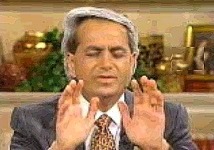

Karl Barth – David Bentley Hart (ok, totally ridiculous, but both are polemic theologians)
Jonathan Edwards – John Piper
Heinrich Bullinger – Rick Warren (it is a pity that "A Purpose Driven Reformation" was lost in that fire)
Origen – Chomsky
Charles Wesley – MC Hammer
The Sorcerer Simon Magnus – Jim West
Apostle Paul – Put Brother Yun and Rowan Williams in a blender
Calvin – Pope Benedikt XVI (it's late, I'm tired and confused. But you know I'm right)
Benjamin Warfield – Bishop Spong
Jesus - Jesus
Apostle Peter – I suppose I should say the Pope, but, well, I'm not Catholic. So:
Apostle Peter – Homer Simpson, Mother Teresa and Reinhard Bonnke in a blender (that may get me into trouble)
The Beast of Revelation – Michael Barber (nobody calls me Spong)
Saturday, October 27, 2007
Not inerrancy again
This coming February-March I will probably be giving a paper in Albrecht-Bengel-Haus,Tübingen, at the annual Doktoranden- und Habilitandenkolloquium of the Arbeitskreis für evangelikale Theologie (AfeT). I have not yet decided on a topic, but having just checked up on their Theologische Grundlage, I am thinking of providing a theological rationale for a restatement of biblical inerrancy based on Paul's reasoning in 1 Cor 8:1-11:1 concerning meat associated with idols. Yes, I know, that sounds a bit crazy, but somehow I think it works. At least it does somehow in my sick and twisted mind!
Speaking of inerrancy, I have found David Vinson's kind gift to me (Enns' Inspiration and Incarnation) very helpful (more about David again next week!). It has crystallised my thinking in a few important areas, and I will no doubt return to it again and again. However, I find myself struggling profoundly with such theologically insensitive comments as the following in Enns's work:
'The starting point for our discussion is the following: as Christ is both God and human, so is the Bible. In other words, we are to think of the Bible in the same way that Christians think about Jesus' (17)
While so much in this book is extremely helpful, thought-provoking and up-building, such that I will be using it to teach in church groups whenever possible, I couldn't disagree more with the above. The Bible is not God in the same way Christ is. Obviously, Enns merely wants to employ the language of incarnation as an analogy, to help us conceptualise the humanity and divine inspiration of the scriptural texts. But such language needs to be handled very carefully, and some of his rhetoric, in my view, simply goes too far. I ought to add that such clumsy verbal stomping on holy ground is very much the exception in this book.
Guess the author
Following are some great citations I recently found:
The Bible 'is not a sort of magical text, supernaturally giving us guaranteed information about everything under the sun. What we call its "inspiration" is its capacity to be the vehicle of the Holy Spirit, making Jesus vividly present to our minds and hearts, and so making his challenge and invitation immediate for us'.
'Life in the Holy Spirit is life where Jesus is alive in the company of others'
'When the Church is most clearly committed to the work of transforming of the earth, heaven becomes most clear'
'The Bible speaks rather seldom of life with God in heaven; it is more inclined to talk about renewal of creation, "a new heaven and a new earth"'.
As a clue, all of the above citations came from the same book.
(I know that the last one in particular sounds like Wright, but that would be too easy. Wright it ain't)
Thursday, October 25, 2007
Gunkel quotes and a response

‚Ein Wunder ist das, was der Geist wirkt'
‚das Christen leben ist aus der Welt schlechthin unbegreiflich; es ist ein Wunder Gottes'
(pp. 22 and 81 respectively from Die Wirkungen des heiligen Geistes nach der populären Anschauung der apostolischen Zeit und nach der Lehre des Apostels Paulus, 1888)
The very thorough and clever conservative scholar, D. Paul Feine, really didn't like Gunkel, though. He once wrote of him that:
'[T]here is reason to wonder whether a Christian theologian is actually writing'. He continues to speak of his 'amazing ignorance of the vitality of the Apostolic Church'!
Them were the days! Tell it like it is! His spirit lives on in the likes of David Bentley Hart.
I sometimes think similarly negative thoughts about one or two writing about NT Christology (the only subject I really know!). In particular, there is one reasonably recent work on NT Christology, written by someone very well-known but who I cannot bring myself to name, that is so much amazing drivel I wouldn't grace my bottom with its pages after potty time. As I will be looking for a job in the next two years, I will keep my mouth shut (that could make for a tricky interview situation if found out!), but if you can guess the work I refer to, then you may get a bit of free CTRVHM Holy Phlegm™ sent to you in the post (post and package not included).
Bibliobloggers alter egos
I'm not going to try to name too many, just a few that seem particularly apropos.
Chris Tilling – Superman, the good guy in films, etc.
Danny Zacharias - Homer Simpson
Jim West – Paris Hilton
Mike Bird – The kid beaten with the ugly stick in that programme about horribly clever but ugly neighbours.
Brandon Wason – George Bush
James Crossley – Freddy Kruger
Ben Myers – The bad guy from the recent movie, The Avengers (acted by Ralph Fiennes)
Stephen Carlson – Brittney Spears
Mark Goodacre – Hannibal Lecture (Accent. Plus, 'it's always the quite ones', etc.)
Judy Redman - She-Ra
Josh McManaway - Pope Benedikt XVI
OK, I really think I have better things to do with my time.
Update:
Steven Harris - Grumpy Smurf (or been-rectally-examined-by-a-large-fingered-doctor-too-often Smurf. Not yet decided)
Phil Sumpter - Austin Powers' stunt codpiece
Tuesday, October 23, 2007
A cure for the old ‘evil PC’ problem
Someone searches Google for "Jesus Please remove the evil from my PC". Steven responds.
I suggest the seeker try my own holy water. Indeed, I am able to ship at a moment's notice - to any country - my very own 'CTRVHM Holy Phlegm™' if anyone is interested. Sprinkle on infected areas to deliver from all the forces of darkness. A bargain at just 40$ per shot (all small fragments of half-chewed toast come free of charge).
Bultmann on NT Christology
'What is Christology, then? It is not the theoretical exponent of practical piety*. It is not speculation and teaching about the divinity of Christ. Rather, it is proclamation, address. It is the "teaching" that through Christ our righteousness is won, that he is crucified and risen on our behalf' (Rudolf Bultmann, Glauben und Verstehen, 1.260, "Die Christologie des Neuen Testaments")
For Bultmann, New Testament Christology is first and foremost proclamation of the Christ event (that proclamation itself caught up in this event as Christ is present in the Word). It is essentially the work of divine love and judgement in Jesus, that God is involved and met in this Jesus (who is himself the event of revelation). New Testament Christology thus boils down to the proclamation of the activity of God in Christ as he justifies sinners. The second level of Christology is faith's response to this proclamation, namely the explication of faith's understanding of its new self in light of the divine address (Anrede). This means that New Testament Christology is not an idea, it is not about the religious personality of Christ, not about metaphysical speculation over Christ as a heavenly being, nor an exponent of Christ-devotion. Christology is the divine address, the proclamation of the event of Christ as it is accepted by faith.
What is more, and something sure to get the Evangelical in plenty of us squirming, the early merely Christians used, Bultmann argues, contingent mythical and mystical categories to express this Christology (such as Christ's preexistence as a heavenly being, Jesus as 'Messiah' etc.), but these were only Jewish (or later Jewish-Hellenistic**)-bound ways of expressing the truth concerning Jesus, namely that God is met in this Jesus. As Jewish language and manners of thinking, they are not binding on modern people, who need to find different ways of proclaiming and reflecting in faith on the Christ-event.
While all of this is very clever, I tend to think that Bultmann has perpetuated the problematic (though understandable) dissolution of Christology into soteriology, and I'm pretty sure he overstretches the appropriateness of the significance of 'proclamation'. This is not to mention the huge problem of pretending to sift an eternal truth from its original form (hence Hart's searing rhetoric in my post a couple of days ago). I would also argue that his argumentation cannot account for the nature of Christology as it is found in Paul's letters - a decisive problem for me. Yet Bultmann's critique of the Religionsgeschichtliche Schule and liberal Protestantism in this essay is witheringly powerful, and his scope of intellectual vision is simply a delight to take in.
BTW, I intend to show in my doctoral work that there is another way of thinking about NT Christology, particularly of the Pauline variety, and a correspondingly fruitful way of thinking about Christology today. But that is a story for another day.
*this in contradistinction to the claims of the Religionsgeschichtliche Schule with which Bultmann had an interesting relation (cf. Sinn, Christologie und Existenz).
** Bultmann adopted the historical development scheme famously promoted by W. Bousset, a model that modern scholarship has all but entirely rejected. Cullmann was the first to raise his finger up and ask what this model did with 1 Cor 16:22. Hengel firmly hit the nail into its overdue coffin.
Monday, October 22, 2007
The Bultmann Files
Bultmann on NT Christology:
'What is Christology, then? It is not the theoretical exponent of practical piety*. It is not speculation and teaching about the divinity of Christ. Rather, it is proclamation, address. It is the "teaching" that through Christ our righteousness is won, that he is crucified and risen on our behalf'
(Rudolf Bultmann, Glauben und Verstehen, 1.260, "Die Christologie des Neuen Testaments")
I like Bultmann's statement almost as much as I dislike it. While I think he has erroneously dissolved Christology into soteriology and overstretches the appropriateness of the significance of 'proclamation', his critique of the Religionsgeschichtliche Schule and liberal Protestantism in this essay is witheringly powerful. I intend to show in my doctoral work that there is another way of thinking about NT Christology, particularly of the Pauline variety.
*this in contradistinction to the claims of the Religionsgeschichtliche Schule with which Bultmann had an interesting relation (cf. Sinn, Christologie und Existenz). Some will rightly recognise, to an extent, the genetic ancestry of Hurtado's writings in this Schule.
Quote of the Day: Bultmann bashing
'Bultmann's particular attempt to disclose the deeper "meaning" of "essence" within Christian "myth", coming when it does in this tradition, ventures far into those miasmal climes of the "existential" where meaningless terms -- like "meaning" -- and terms of dubious pedigree -- like "authenticity" -- flourish with the invincibility of weeds' (David Bentley Hart, The Beauty of the Infinite, 22).
I laughed when I read that!
Chrisendom attacked!

Our friend, Ryan Jones, has just posted a scandalous indictment of CTRVHM. Not only do I take beef with all this business about holy cows, he goes on to maintain that my 'pseudo-scholarship and lame-blog humor just makes me feel, well, crappy and defiled'.
For Ryan, who successfully earned himself four 'fingers', I wanted to suggest he go read this webpage closely and prayerfully. Admittedly, his gracious and well-thought out post certainly had a point about the inappropriateness of some of my 'violent' humour. Good call. But don't tell him I said so.
For others, naturally I want to make an official statement of apology for those among you who have ever been offended by anything on my blog:
"I am so sorry you read my blog. And I am trying not to think about you, me and the skilful employment of a cricket bat in the head department"
You see, I can be a diplomat when I need to be.
Thursday, October 18, 2007
Seeing me at SBL
When I've ironed out the last wrinkles, I'll post my SBL schedule here. Until then, it occurred to me that I am likely to meet quite a few blogging friends during my stay in San Diego, but how will you recognise me?
Here's me from the side

Here's me if you're small
Here's me if your tall
Here's me looking through your hotel door spy hole
Here's me after you openly disagreed with any comment I have made
Here's me if you dis Tom Wright
Here's me if you mutter something about my pseudo-scholarship and lame blog
Here's me listening to your paper or response to a paper (1)
Here's me listening to your paper or response to a paper (2)
Here's me listening to your paper or response to a paper (3)
Here's me if you're a fly
Here's me if you're a bat
Here's me if you try communicating with me before I've properly woken up
Here's me if you're Andy Warhol
Tuesday, October 16, 2007
Quote of the Day
'In saying "Christ Jesus", Paul captures the liberating and reconciling power of the Spirit of God as a vital and compelling agent of transformation, overcoming the power of sin, cancelling the power of evil, and creating a new humanity within every nation, tribe and culture'
An Emergent Theology for Emerging Churches, Ray S. Anderson pp. 36-37.
A confession
Pray for my worried and mortal soul. I've been sprinkling myself in water soaked in Tom Wright's Jesus and the Victory of God all day, yet still I want to read more Bultmann.
A word of clarification
It seems my last post on Bultmann got Jim West all riled up. However, to calm nerves I thought it best to simply qualify my point in the last post. I wasn't simply trying to say that there is something similar about Bultmann and popular Evangelical approaches to Scripture.
Not at all!
Calm down!
Besides, the historical Bultmann is now a figure covered in layers of myth. So rather than 'do the liberal thing', i.e. strip away the myth to reveal the historical kernel of the true Bultmann, I thought it best to demythologise, i.e. reinterpret those mythical categories for today's person. All we need to know is that Bultmann existed, and all these claims about him being an exegete are probably the construction of later communities as communities sought to express their faith through myths. So I need to find one who may approximate to the spirit evidenced in Bultmann, someone who handles the bible in a way that some may consider in some respects comparable. I need to find modern categories to express the pre-scientific myths that have built around the man, Bultmann.
Ergo, and all I wanted to say, is that Bultmann is Joel Osteen. That's all.
Monday, October 15, 2007
Cosy bedfellows: Bultmann and Evangelicalism

Poor old Rudolf has often been labelled the liberal 'bad guy' by Evangelicals - most of the time, I suspect, by people who have never read him. And while I hate to admit this in the presence of Jim West, I have come to learn that a teaspoon of Bultmann's work is far more profound than buckets of much modern scholarship. This is not intellectual snobbery on my part – just read his work and you'll see! He's still the beast of Revelation, of course. I proved that ages ago.
But as an evangelical, surrounded by Evangelicals, I have noticed something rather odd that I wanted to share. It began when I read something in one of Tom Wright's (peace be upon him) books. I think it was The New Testament and the People of God, and he argued something to the effect that evangelical and existentialist hermeneutics are very similar. 'Strange bedfellows indeed', Wright remarked. The more I have considered this, the more sense it makes. Bultmann's existentialism finds confused yet striking echo in the Evangelical treatment of scripture that tends to think every verse of the bible must be relevant to me right now and how I live and feel in my private world today.
For example, I was recently in an Evangelical meeting that was discussing Isaiah 43:19: 'I am about to do a new thing; now it springs forth, do you not perceive it?'. The discussion proceeded to 'apply' the text in a rather direct existential manner, to the effect that one needs to now look and see what God is doing new in our lives. Passage discussed.
While I don't see any harm in this procedure in and of itself, when it is the only way people read are taught to the bible, we have a problem. It is simply the sickly ahistorical, anti-intellectual, pragmatic, and individualistic Zeitgeist reading the bible through the eyes of popular Evangelicalism.

Bultmann isn't simply the same as all this, of course, but it is this individualism (think of Käsemann's critique of Bultmann) and ahistoricism that one finds in his work, where 'significance' is pushed into the perpetual advent of the (ahistorical) eschatological, as David Bentley Hart puts it in his hilarious rhetorical scolding of Bultmann's project (cf. The Beauty of the Infinite). The inability of many Evangelicals to think beyond the 'how does this apply to me now' to consider the larger biblical narratives, and their significance, and how these are rethought and reflected in the canon and in church history, is a crippling and tragic weakness in popular Evangelicalism.
But it also occurred to me that it is this existential and ahistorical, pragmatic 'rushing to relevance' that gives Evangelicalism some of its appeal, especially to those who have grown in other more traditional denominations. All of a sudden, it is as if the bible becomes more real, more personal – i.e. it is read with something of Bultmann's hermeneutic – under the guise of Evangelical orthodoxy.
My proposal, then: It is the same spirit that animated Bultmann, albeit poured into a different mould, that gives Evangelicalism part of its glimmer of appeal.
A Conversation with Chris Tilling
Right, let's get down to some serious self-indulgent nonsense!
T Michael W Halcomb (of Pisteuomen) and I had an online 'chat' this weekend. He has now posted the result here: 'A Conversation with Chris Tilling'.
Among other things we chatted about Church life, Fundamentalism, cheap ways of killing, biblical and theological scholarship, women's underwear, bridging academia and the local church, and blogging. The usual sort of stuff, really.
Jim West has already remarked in exasperation that this 'interview' is simply a symptom of Tilling-ianity. Admittedly, my aim, as Ben Myers once put it, is to generate such a fan base that when people type in 'Christendom' into Google, it will come back with 'Did you mean Chrisendom?'
Besides, there is nothing wrong with a bit of Chrisology for a change.
Thursday, October 11, 2007
Quick book note
Dr André Munzinger's PhD, Discerning the Spirits, has finally been published. I have only skimmed over it thus far but my supervisor, Max Turner (who also supervised Munziger's thesis), praises the book lavishly. It covers a wide range of matters, from Pauline pneumatology, ethics, through to epistemology. Essentially, he is asking 'How did Paul determine ethical and theological truth?'. It looks fascinating.
Online Resource
A good friend today drew my attention to a notice on the Tübingen Library webpage explaining that the 'Virtuelle Fachbibliothek Theologie und Religionswissenschaft (VirTheo)' is online!
"Die Virtuelle Fachbibliothek Theologie und Religionswissenschaft wird von der UB Tübingen im Rahmen eines von der Deutschen Forschungsgemeinschaft (DFG) geförderten Projektes aufgebaut und befindet sich gegenwärtig in der zweijährigen Startphase. Sie wird kontinuierlich ausgebaut und um weitere Module und Angebote ergänzt werden.
VirTheo – die Virtuelle Fachbibliothek Theologie und Religionswissenschaft können Sie über die Internetadresse www.virtheo.de direkt aufrufen. Dort finden Sie auch weitere Informationen, insbesondere zu den gegenwärtig enthaltenen Komponenten und recherchierbaren Ressourcen"
Go here for more information.
Wednesday, October 10, 2007
A Biblical Guide to Dating
 1. Seek out your potential wife/husband based on how strenuous their doctrinal commitments are. You don't want any flabby 'emerging' nonsense or such like. If they have read all of the major Reformed authors, pray using words like 'N. T. Wright' in close proximity to 'Satan', are sure those who don't hold to their own exact statement of faith are damned, etc. maybe you've got a winner.
For men: Of course, she's got to look gorgeous too, or there's no point.
2. When the time comes to ask her on a date try this:
'Hi, I've not said this to anyone before (one little 'White Lie' won't hurt), but the Lord told me we will get married. Do you want to obey the Lord or not?'
3. After this has won you a date, spend some time talking about any crap that seems important to him/her (for men: tell her she looks lovely in her blouse, that her eyes are like limpid pools, or any other lie that seems to work) and slowly slide up next to her/him. Then whip out the old 'the Holy Kiss is biblical' line. I.e. start your sentence with 'Is it not written in Rom. 16:16; 1 Co. 16:20; 2 Co. 13:12 and 1 Thess. 5:26' etc. Make it feel like she/he is sinning unless she/he puckers up and 'makes out' good and proper.
4. After you've done some serious Holy Kissing, you need to take the relationship to the next stage. Admittedly, the biblical case for this step is not quite as convincing, but speak quickly and avoid eye contact and you could get a way with it.
First, you need to do some Holy Kissing. Then, when time is ripe, say:
"Darling, did you know that tongues is biblical?"
Then before she/he can answer ... well, you know what to do. Frenchy his/her face off.
5. The last step shouldn't be too hard if they've strung along this far. Essentially, you need to practice some logical deduction with your partner. Wait until you've Frenchied your tongue numb, then raise in conversation:
'You remember what the Lord commanded us about getting married? Well, is it not written in 1 Corinthians 7:9 that "it is better to marry than to be aflame with passion"? Do you not feel the sexual tension in this room (i.e. that you are feeling sexual and that she/he is feeling tense - but don't mention that bit)? You therfore know as well as me what the bible says we must do'
6. Organise the wedding quickly before she/he can stop and think.
It worked for me.
Tuesday, October 09, 2007
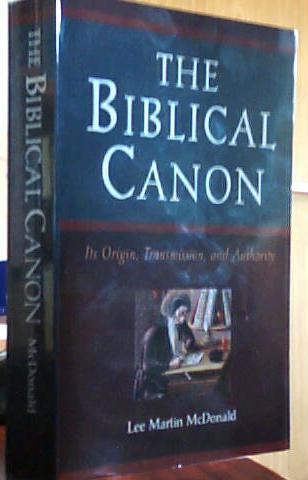
Guest Book Review: The Biblical Canon
Review by Dr. Thomas Scott Caulley of:
Lee Martin McDonald, The Biblical Canon: Its Origin, Transmission, and Authority. Updated and revised 3rd ed. Peabody, Mass: Hendrickson, 2007. 546 pages. $29.95 US.
This book is a "long overdue" revision of the 2nd edition (1995) by the same title. Addressed not least to his evangelical peers, McDonald's tome takes into account significant recent scholarship, thereby challenging some cherished but untenable assumptions about canon development. Specifically, McDonald follows research which contradicts popular ideas including: (1) the Hebrew Scriptures reached their canonical acceptance among the Jews in a three-stage development beginning in around 400 BCE (Pentateuch), 200 BCE (Prophets) and 90-100 CE (Writings); (2) the early Christians received from Jesus a closed or fixed collection of OT Scriptures; (3) most of the NT collection was fixed by the end of the 2nd century CE; and (4) evidence of the latter is provided by the Muratorian Fragment (allegedly late second-century).
McDonald takes up the challenge of J. A. Sanders: "we cannot deal adequately with the question of the structure of canon... until we have explored seriously and extensively the question of the function of canon. It is time to attempt to write a history of the early canonical process." Citing Neusner's dictum, "What we cannot show, we do not know," McDonald attempts to break free of untested assumptions and thus advance our knowledge in the area of canon development.
Similarly, McDonald borrows a definition of canon that is significant: Canon 1 is the authority given to persons (Moses and Jesus, for example), ideas, and certain texts; Canon 2 refers to the fixing of an authoritative collection of books. These levels correspond to Sanders' categories of a) texts or stories that function authoritatively, and b) sacred texts with a fixed shape. The development from Canon 1 to Canon 2 was not linear, nor was every document of Canon 1 status included in Canon 2. But the distinction helps explain early attitudes to (later) non-canonical texts, and is more precise than referring to "canon process."
The inclusion of R. Timothy McLay's essay on the use Septuagint in the NT was an unusual but serendipitous decision. The essay holds evangelical feet to the fire on some ideas long held dear, and so doing constitutes an eloquently simple dismantling of mechanistic doctrines of scripture, especially certain ideas of inerrancy. It challenges some time-honored assumptions, including the Protestant Old Testament should be based on the Masoretic Text to the near-total exclusion of the LXX ("the Protestant OT reflects a Babylonian flavor that was not current or popular in the time of Jesus"). Similarly, given that the early Christians accorded authority and inspiration to their translated texts and showed no apparent concern for the originals, an obsessive commitment to the inerrancy of the original autographs is misplaced.
McDonald walks a fine line between "conservative" and "liberal" attitudes, and avoids doctrinaire positions. He debunks as dogmatic wishful thinking conservative ideas about a first or second century notion of a settled (Protestant!) NT canon. But he also stops short of giving the standard nod to Walter Bauer (Orthodoxy and Heresy), whose heirs are recently claiming that purveyors of non-orthodox versions of early Christianity were victims, simply losers in the struggles for preeminence among early Christian groups in which the winners (incipient Catholics) rewrote the history to favor themselves. But McDonald refuses to treat all early Christian groups as equals: "While it may be somewhat in vogue to claim that all theologies of the Bible and all theologies outside of the bible equally represent the proclamation of the earliest Christian community, and that there was no theological core, but rather considerable confusion, this is simply not the case."
Though not radical, McDonald's conclusions are far-reaching. Much of the "recent" research brought to bear is not new, but is at long last presented in a comprehensive and compelling manner. McDonald denies past allegations that he wants to change the canon, something that is, after all, a practical impossibility. More importantly, he seems most interested to challenge his evangelical peers at the level of their presuppositions about scripture. McDonald repeatedly mentions the "utility" of scripture as a canonical quality (in 2 Tim 3:16-17, scripture's "God-breathed" character results in its utility), the recognition of the early Christians that the value of scripture lay in its usefulness and applicability. In terms of function, early Christian "canon" consciousness was characterized by a practical shift away from the Jewish notion of a static body of writings which "defile the hands." "Inspiration" was thus assumed as a reality but acknowledged as secondary. The documents which later came to be considered Christian scripture were in service to a larger truth, namely the apostolic interpretation of Jesus and his teaching. This remains true today: "the final authority of the church is not its bible, but its Lord." The open question to evangelicals is whether contemporary doctrines of scripture which emphasize "spiritual" qualities unknown to, or down-played by, the early church are not merely irrelevant, but actually a hindrance to further understanding of canon.
A few criticisms of the book include its inadequate index (more than one topic discussed is curiously absent from the index). Discussion of early Christian citations of non-canonical works "as canonical" or "as scripture" would benefit from more precision, as would the use of the term "orthodox." It would be helpful to see more emphasis on the problem of intertexts, as opposed to the apparent assumption that early Christian biblical citations were normally from fixed texts. The book contains some unproven assumptions (Neusner's dictum!), such as the Pastoral Epistles were consciously anti-Marcionite, or that 2 Peter's pseudepigraphy was meant to deceive (why is this not an example of the intentional fallacy?). McDonald opts for an older view of the nomina sacra and cites favorably the disputed opinion that the nomina sacra had their background in the abbreviations of hellenistic "documentary" texts, a background that supposedly suggests that nomina sacra were a feature of texts specifically not considered canonical [Hurtado argues convincingly against the analogy, and for understanding the nomina sacra as a Christian innovation]. But such points certainly do not diminish the overall contribution of the work.
All students of the New Testament and early Christianity can be thankful for this new work on the origins of the canon. It is a "must read," and will be a resource and a talking point for years to come.
Thomas Scott Caulley, Institut zur Erforschung des Urchristentums, Wilhelmstrasse 100, D-72074 Tübingen, Germany.
Monday, October 08, 2007
Just spotted
While I tend to think that the much of the literature of radical antitheism is about as useful as Borat trying to critique feminism, will this one perhaps be more helpful?
Tomorrow
If you are one of those rabid lunatics who thinks my blog posts are 'sheet', then tomorrow you will have a real treat. Cos I didn't write it.
Instead, I will post one of the most enjoyable book reviews I have read in a long time, of Lee Martin McDonald's important work, The Biblical Canon: Its Origin, Transmission, and Authority (updated and revised 3rd ed.) – and thank you to the kind folk at Hendrickson for a review copy.
It is penned by my Tübingen friend and the Director of the Institut zur Erforschung des Urchristentums (The Institute for the Study of Christian Origins), Dr. Thomas Scott Caulley.
Be sure to give this one a read, especially as McDonald's monograph seems to be a rather important work for many of us to digest – especially for those of us who are broadly 'evangelical' in our doctrine of scripture.
(Click on the link above to find a sample chapter, table of contents and introduction)
Another New Blog
Not breaking news for everybody, but I thought I'D at least mention it: the chaps at T & T Clark have started their own blog, and they are doing a really good job too!
A new blog
I've asked Kevin, author of the new blog http://dogmatics.wordpress.com/, to write a few words introducing himself and his aims in blogdom.
"Greetings. My name is Kevin, and I'm a systematic theology student at the University of Aberdeen, Scotland (but I'm originally from North Carolina), with yet another blog in the overly-crowded blogosphere. I don't pretend to fill some need in the blogging world, but perhaps frequenters of Chrisendom would find the blog interesting. I plan to do a mix of issues from the more serious (dogmatics, fundamental theology) to the less serious (music, cultural observations). I consider myself modern Reformed (Forsyth, Barth, Brunner, Torrance) and Evangelical (from Luther to Billy Graham) but Balthasarian Thomism is beckoning me.
My own concerns and thoughts are quite scattered, but this is part of the passion that drives me to do theology – I actually think, e.g., that the legitimacy of a Protestant aesthetics to be immensely important, not just for my own understanding of God but for that of the whole world, or we could mention the Reformed critique of Lutheran metaphysics, T. F. Torrance's attack on Western ontology and epistemology, Paul's understanding of law, whether Mary was immaculate and bodily assumed, and so forth. So, these are some of the scattered themes one may find on my blog. For those who may stop by, I give you a hearty welcome. By the way, the title, "After Existentialism, Light," if you haven't guessed, is a play on "Post Tenebras Lux" (After Darkness, Light) from the Reformation."
Do give his blog a look - he sounds like a rather clever chap!
Thursday, October 04, 2007
Defining Heresy

It's getting late, but let me see if I can pen something that makes a little bit of sense before my battery runs out.
Q: How would you define 'heresy'?
And no, answering with "what is written on this blog" isn't good enough.
I started pondering the question as I read Hart's The Doors of the Sea. He wrote of 'the heresy of "limited atonement", which has so dreadfully disfigured certain streams of traditional Reformed thought' (89), and continues: 'The doctrine, of course, completely contradicts Scripture', and cites, as one would expect, 1 John 2:2.
As I began to think the matter through a little, I turned to a blank page at the end of the book and scribbled some thoughts down. I decided to define heresy along these lines:
'That which encourages a (communal) activity and attitude in opposition to the mission of God revealed in Christ'.
Of course, many would simply define heresy as 'opposed to scripture', which I think is totally inadequate left on its own. Essentially, such a proposal assumes too much (that scripture is univocal and that sublation doesn't happen within the canon). Would I be a heretic to be opposed to some of the prayers prayed in the Psalms ('Happy shall they be who take your little ones and dash them against the rock' 137:9), or when I find myself in ethical contradiction to the 'ethnic cleansing' in the OT? Of course, it may be responded that the point is that heresy is to be opposed not just this or that verse but to the general tenor of scripture. Indeed. And I think that tenor is sung by the God revealed in Christ as he reconciles the world to himself (cf. 2 Cor 5).
My definition badly attempts to express the following: heresy isn't just wrong thinking in isolation from how one lives (even though 'heresy' is strictly speaking opposition to established beliefs). I say this as there are many who like to call anything a heresy that doesn't agree with their own strict propositional theological system. And I find that problematic. My series on redefining inerrancy got me called all kinds of rude things by people who were captivated by the paper majesty of their own ideological neuroses.
I will make this more concrete. I know many people who are delightful Christians, beautiful examples of Christ-ward living, and yet believe in 'limited atonement' for rather pragmatic and naive logical reasons. This doesn't make them heretics, however. But, if one takes belief in 'limited atonement' in such a way that perpetrates a superior attitude of arrogance, and that hinders the offer of the good news to one and all (because Christ dies for me, not you), then we have heresy in the making. At this point one is in opposition to the missional God's plans for the world. There is thus a process. Heresy is conceived, and then later born. To rewrite James 1:14-15 (on sin and temptation) in terms of this argument:
'But one is tempted by one's own heretical potential, being lured and enticed by it; then, when that heretical potential has conceived, it gives birth to a heresy, and that heresy, when it is fully grown, gives birth to a heretic'.
This would mean that traditional heresies like Docetism, Arianism , Pelagianism and so on are heretical in so far as the church testifies that these beliefs contain within themselves heretical potential; that they give birth to heretics. It also means that heresy cannot be defined absolutely, hence I won't try too hard to fine tune my definition above. Much like the words 'childhood', or 'beauty', 'heresy' evidences semantic overflow, it is something in becoming. But in its becoming it is essentially, I suggest, that which is opposed to God's mission, to the activity of God in Christ.
According to this reasoning I come back to Hart's claim. Is "limited atonement" heresy, as Hart claims?
Potentially.
Wednesday, October 03, 2007
Mission to America

Yes, that's right, Chris Tilling Really Very Holy Ministries will be 'power evangelising' pagan East and West Coast USA this November. The first leg of the revival evangelism will take me to Washington DC (where I plan to do some serious political ass-kicking) and then North Carolina, near Duke University. I thought about friendship evangelism but got bored at the very idea. Instead, I thought it most expedient to take some kind of weapon with me and perform a good old mediaeval Crusade - with hopefully not just a little heretic burning on the way (the gasoline is cheap in America, I hear)
After that, I'm off to convert all those so-called 'scholars' at the Annual SBL meeting in San Diego – at least I plan to (plane tickets allowing). I'll be outside the front handing out this Chick Tract. With my weapon. Apart from that, I'm looking forward to meeting a few of my blogging friends in person!
Tuesday, October 02, 2007
What is the Gospel?
"The gospel is the work of the Trinitarian God (a community of persons) to create the community of faith in order to restore humans (made in God's image) through the life, death, and resurrection of Christ as well as through the empowering gift of the Holy Spirit to union with God and communion with others for the good of the self and the world. And all of this to the glory of God."
Scot McKnight
Pimp My Liturgy - 03
It is time to turn to from the Dead Sea Scrolls to that related of Christian denominations, the Southern Baptists.
Many at the grass roots of the Southern Baptist movement are not, I am led to believe, the most ecumenical of Christ's flock. Especially when it comes to Catholics. Added to that, the Southern Baptists are also not too hot when it comes to liturgy. So, instead of pimping their own liturgy, I thought I would simply write a pre-pimped liturgical chant with which to greet Catholics during any so-called 'ecumenical gatherings'
i. to be chanted repeatedly in a Death Metal kind of way, but also said in love.
Or,
ii. To the tune of 'He's got the whole world in his hands'
"Don't look at me like that
you scabby little phallus,
Or I'll rip off your Catholic head
and play glockenspiel with your ecumenical frontal lobes
See that dog poo lying on the floor over there?
That's your room temperature IQ mum that is.
Your theology looks like it fell out of the ugly tree
and hit every heresy on the way down
Amen."
UPDATE
In the comments, one wise soul pointed out that I should have made so much more of this liturgical nugget had I given more effort to the form of the text when chanted to the tune of "He's Got the Whole World in His Hands". Below is the new text, for those who don't want to attempt the "loving death metal version":
To the Tune of "He's got the whole world in his hands"
“Don't look at me like that (you scabby little phallus)
I'll rip your head right off (you scabby little phallus)
And I'll play glockenspiel (you scabby little phallus)
with your ecumenical frontal lobes!
See that sloppy dog poo? (that's yo mama)
with room temperature IQ (that's yo mama)
theology fell out the ugly tree (like yo mama)
and hit every heresy on the way down.
Amen.”
Subscribe to:
Posts (Atom)


