Wednesday, March 05, 2008

Scandal of the day: Snodgrass critiques Wright

In discussing the various analyses of the parables of future eschatology, Snodgrass argues that 'certain options are [to be] excluded'. The second of his excluded options is the proposal that 'the coming of the Son of Man in glory' is to be equated with 'the destruction of Jerusalem as N.T. Wright suggests' (479). His reasons:

'Jerusalem had been destroyed in 586 B.C. and would be again in 135 A.D. What makes the destruction in 70 A.D. so crucial that it would be describes as the coming of the Son of Man, and why was the destruction so unimportant to the early church that it is never mentioned?' He continues: 'The early church saw the vindication and victory in the resurrection, the pouring out of the Holy Spirit, and in the expected parousia' (479).

Monday, March 03, 2008

Biblicapodcast

The extremely likeable Chris Brady, of Targuman, interviewed me for a 'biblicapodcast' this evening. Chris, as you will hear, is a dab hand at this sort of thing, whereas I struggled to get my microphone working properly. My mic ended up awkwardly draped around my neck, so my voice sounds a bit rough (actually, a bit like a couple of squirrels were trying to hump my microphone at the same time as me speaking), though you can still hear me clearly enough.

How do I introduce a post about an interview with me without sounding conceited? Let me speak about my interviewer, instead: Chris Brady has a nice smooth voice, plus he is the super hero grandmaster wizard expert of Aramaic Targuman! He's worth listening to!

You can download it here.

Saturday, March 01, 2008

Book Review: Stories with Intent

My thanks to the kind folk at Eerdmans for a review copy of Klyne R. Snodgrass' Magnus opus, Stories with Intent: A Comprehensive Guide to the Parables of Jesus (Cambridge: Eerdmans, 2008).

Some books have no rivals because of the quality of their reasoning, subtleness of exegetical insight etc. Others have no rivals because they offer something no other book even attempts. One can say that Snodgrass' Stories with Intent, also has no rivals - for a mixture of both of these reasons. At over 850 pages, Graham Stanton rightly exclaims that this book 'will be the book on the parables for the next decade and beyond'. We have here, with Stories with Intent, a real publishing event.

Of course, such a long work, as Snodgrass explains in his preface, is not meant to be read in one go. It functions as a resource manual, as a mine of relevant information concerning all of the parables of Jesus, carefully sifted from all manner of historical sources.

His introduction to the parables of Jesus includes a discussion of his definition of 'parable' ('an expanded analogy used to convince and persuade', 9), the characteristics of Jesus' parables, an examination of how parables should be interpreted, and a look at NT criticisms in relation to the parables. Wisely, in my view, he questions a number of dubious assumptions behind much previous work on the parables, such as the notion that there was 'an original' form, that 'items with allegorical significance were probably added', that 'the handing on of traditional material follows certain "laws" so that the shorter is earlier, the more detailed is later, etc.', that 'the parables can be read as mirror images of what was happening in the Evangelists' communities', and so on (cf. 32). All of this is naturally expressive of his methodological approach throughout the work.

Particularly revealing of his methodology are also his statements at the end of the introduction. In terms of the question of historical reconstructions of the life of Jesus, he argues along with Dunn that '[w]e do not have the ipsissima verba of Jesus ... and attempted reconstructions are not going to supply them ... the only Jesus that exists is the historic, biblical Christ. Anything else is a figment of the imagination' (35). As he later explains, he recognises very well the 'the essential fidelity of the Gospel writers to the tradition they received and the freedom with which they adapted it' (280). Because of this, we are left, for better or worse, with the biblical Christ. I am reminded of similar claims in Bauckham's Jesus and the Eyewitnesses, in which the author formulated his argument in dialogue with M. Bloch, R.G. Collingwood, Paul Ricoeur etc. Of course, Snodgrass is careful to fend off potential misunderstandings of his statements. But it is such comments as these that show the massive changes presently underway in much historical Jesus scholarship. But I am left wondering, Is any other approach really only 'a figment of the imagination'? How can we know that? How do we know if the Gospel writers handled their traditions with fidelity and freedom? Is this wanting to have our cake and eat it? While I think some good answers are forthcoming in terms of the last two questions, the others hang in the air, not so easily waved away. Nevertheless, I for one am heartily in favour of this overturning of the many presuppositional 'holy cows' that have driven much historical Jesus scholarship into many a bizarre dead end. About 90% of me passionately stands behind Snodgrass on these issues!

After this, Snodgrass turns to examine parables in the ancient world, namely in the Old Testament, early Jewish and Greco-Roman writings, the early church and later Jewish writings. Jesus, of course, was not the first to use parables. Yet prior to him, it appears that they were not used so forcefully or frequently. What is more, parables mostly have a very dependent relationship with the context in which they are said (which is why I wanted more appreciation of Wright's insights. But more on that anon).

In the following, Snodgrass turns his attention the various parables, categorising them thematically under the following chapter headings:

  • Grace and Responsibility (Matt 18:23-35; Luke 7:41-43)
  • Parables of Lostness (Luke 15; Matt 18:22-14)
  • The Parable of the Sower and the Purpose of Parables (Matt 13:3-23; Mark 4:3-20; Luke 8:5-15)
  • Parables of the Present Kingdom (Matthew 13, Mark 4, and Luke 13)
  • Parables Specifically about Israel (Matt 21:28-32, 33-46; 22:1-14; Mark 12:1-12; Luke 13:6-9; 14:15-24; 20:9-19; Gos. Thom. 64-66 – though it wouldn't worry me, for those panicking at the sight of 'Gos. Thom.', I say 'fear not', for Snodgrass argues that these texts are dependent on the canonical witnesses!).
  • Parables about Discipleship (Matt 7:24-27; 20:1-16; Luke 6:47-49; 10:25-37; 14:28-32)
  • Parables about Money (Luke 12:16-21; 16:1-13, 19-31)
  • Parables concerning God and Prayer (Luke 11:5-8; 18:1-14)
  • and Parables of Future Eschatology (the Eschatological Discourse; Matt 13:47-50; Matt 25:1-46; Luke 19:11-27)

For each parable, Snodgrass seeks to provide an introduction, an examination of the parable type, a list of issues requiring attention, a look at helpful source material, categorised and cited according the divisions employed in his study of 'parables in the ancient world'. He offers a comparison of the various accounts of the parable, a study of textual features worthy of attention and relevant cultural information, and an explanation of the parable (with 'options for interpretation', 'decisions on the issue'). Finally, he offers a section on 'adapting the parable' (for today), a further reading list and often some final remarks. All of these issues are raised in turn, in relation to the parables, in a structured manner.

It is clear that this material has been prepared with specific goals in mind. As he writes in the preface, the material is 'what I want when preparing to teach or preach on the parables' (xi). In other words, the material Snodgrass provides is of interest for all, whether scholar, student or preacher. As Martin Hengel comments in his book blurb. Stories with Intent is a book 'written for pastors and scholars, for students of the Bible, and for laypeople interested in the teaching of Jesus'. And given the consistent divisions in the discussion concerning each parable, finding whatever information is of interest is not difficult.

I have just one major grumble with the format of the book, however. Eerdmans decided to use endnotes. Why oh why?! Endnotes come from the pit; they are the invention of the satanic hoards! Please, oh please: Footnotes!! It makes it SO much easier to read. Perhaps the editor was worried Snodgrass' potential readers were going to be 'frightened away' by so many footnotes. But I think that the size of the book would have done all of the frightening away before that sort of reader would have been put off by footnotes. Please! FOOTNOTES!

I also had a small grumble with Snodgrass' critique of Wright's (peace be upon him) approach to material in Luke 15. Anybody who has read Jesus and the Victory of God (which is my all time favourite book, if I haven't yet mentioned that this week) will know Wright's approach to the parable of what Snodgrass calls 'the compassionate Father and his two lost Sons' (Luke 15:11-32). Wright, if you remember, argues that the controlling story for understanding the parable is that of exile and return, and that this parable is to a large extent that story in miniature. Snodgrass dismisses Wright's suggestion with the argument that his attempt to explain the significance of the elder brother is dubious (Wright proposes that the elder brother represents the Samaritans). I agree with Snodgrass that Wright's thesis at this point is questionable, but that is not enough to wipe the rest of Wright's proposal away! Luke's Gospel sets itself up to be read, in my view, in terms of the controlling story Wright posits (cf. the material relating to the presentation of Jesus in the temple as a baby, Luke's citation of the prophetic literature used by John the Baptist, and by Jesus in his sermon in Nazareth etc.). Just because Wright's Samaritan proposal does not persuade does not mean another option to explain the significance of the elder brother in terms of exile and return is not forthcoming. I believe one is, but I leave you guessing until a later date on that one. I thought it a real pity Snodgrass didn't pursue matters with a more positive assessment of Wright's (valid) insight on this matter. Is Snodgrass' project marred for its lack of appreciation of the controlling story of exile and restoration? I will let the reader decide.

Stories with Intent is a tremendous resource, one I will dip into for the rest of my life in relation to both scholarly pursuits and for sermon preparation. Even though I have sometimes found myself in disagreement with Snodgrass' judgments, I know that every time I read it I will potentially be inspired, corrected and educated by the pen of this 'parable grandmaster'. In many ways he represents evangelical scholarship at its best: mature, thoughtful, wise, balanced, not uncritical but not crazy woolly trash, deeply academic, yet pastoral and spiritual. I can think of no higher honour for a book than to say such things. Stanton calls it a 'stunning achievement', Hengel a 'wonderful' and 'inspiring' book. Bock simply says 'Bravo!' I'm not really sure what 'Tilling' can add to that list of names, but I do. Nobody preaching on the parables or working on them as a student or as an academic should be without a copy of Stories with Intent.

Thursday, February 28, 2008

Dan reflects on NT Wright and Hell

Here

How to read the NT canon

"I suggest, Christians should learn to read the canon of the NT, not in search of an essential core or purified "canon within the canon"—not, in other words, within the frame of a single abstract principle—but in a living conversation with all the writings in all their diversity and divergence. Only in this way can they continue to speak"

Luke Timothy Johnson & T.C. Penner, The writings of the New Testament: An interpretation (Minneapolis: Fortress Press, 1999), 613.

Quote of the day

"Yes, Paul was someone caught up in a mission. Yes, Paul's life-story had a cruciform shape. And yes, Paul regularly suffered for participating in God's mission and Christ's cross. But in spite of this all-consuming passion and its consequences—or perhaps because of it—Paul was someone whose participation in God's new creation was an experience of joy now (Gal 5:22; Philippians), and he was someone whose anticipation of future indescribable joy and glory kept him going (Rom 5:2; 1 Cor 2:9). The pilgrim church on earth that is shaped by his gospel will share that joy and hope, even as we discern how we can participate more fully and faithfully in the same divine mission with Paul-like zeal, courage, and imagination"

Michael Gorman, Reading Paul (Eugene, OR: Cascade Books, 2008), 188

Hanging in my study

Hanging in Jim West's study are framed pictures, unsurprisingly, of Zwingli, Luther, Bultmann etc (though I bet he's got a depraved 'Cheerleaders in Soap-suds' calendar up behind his books somewhere, as well). If I remember rightly (I may not have), Ben Myers once posted about various decorations in his study. He showed pictures of a Bultmann bust he owns! A damn bust!

My study ... well, I say 'study'. It really is a study, but it is also my lounge and dining room! ... is a different matter. Instead of a bust of Bultmann or Barth, or a portrait of a great theologian or thinker, I have, and have had so for years, hanging next to my desk:

Does my lack of sophistication worry me? Nope.

Speaking of written prayers ...

For my potentially controversial presentation at the Tübingen colloquium tomorrow:

'Dear person about whom the WWJD wrist bracelets speak, please just grant Chris unusual charisma and intelligence tomorrow with his paper presentation and the following discussion. Just smite those who would "critique him in a mean way" with bad dandruff, antiperspirant that doesn't work, milk that goes sour very quickly, like, just, really the like next day, plates and pans that just don't get clean, even after just really hard scrubbing with all kind of cleaning liquids, and an inability to speak for 40 days and nights'

Either that, or pray one of Jüngel's deeply trinitarian and profound prayers, found here. But add a few 'justs' and about three 'Lords' per sentence, or what's the point?

Wednesday, February 27, 2008

Colloquium

As Phil Sumpter explains, he is on his way down here to Tübingen for a colloquium, at which I will present a paper on 1 Corinthians 8 and inerrancy. Unfortunately, my neck went into a terribly painful spasm a couple of days ago, which literally stopped my typing or preparing for the lecture. Thankfully the pain is subsiding now, which means I'm back to the high calling of hacking at certain modern 'inerrancy' formulations such as the Disaster in Chicago Statement. I still can't believe the ETS adopted it.

Collections of Prayers

I love praying through written prayers. Of course, I have a stable diet of the C of E 'Daily Prayer' plus a few other liturgies, but I mean to refer to collections of just prayers. One of my favourites is by Karl Rahner, Gebete des Lebens. Barth's Gebete is another.

Can you recommend me any others? I would love to expand my library in this direction.

Theological breakthrough of the day

Big news today, completely destroying all of the central arguments in my own doctoral work: Undeniable Proof that Jesus is Not God

A great new site on science and theology

... has been launched by my friend, David Vinson.

Here

His story reflects, in many ways, a more advanced version of my own on the subject of theology and science (i.e. from sound and solid Fundie to suspicious compromise!).

He writes: 'As a typical American conservative evangelical, I spent over 20 years thinking that the only proper Christian approach to biological evolution was to denounce it, despite my training in physiology (UC Berkeley) and medicine (UC Davis) and an ongoing vocation as clinician and research scientist'.

He continues: 'After years of study, conversation, and conferences, what have I discovered? To my surprise (and relief!) I found that both of my presuppositions were neither necessary nor sensible. Evolutionary science is not inherently atheistic. Rather, like all of science, including medicine, it seeks to provide natural explanations for the way things work. It is not suited to speak to supernatural causes or purposes ... It's been an intriguing and exciting investigation for me. Much has been learned. And I know that more, far more, awaits me. The resources you'll encounter on the following pages are those that helped guide me out of the world of polarized and polemic (and often pointless) debate to a place of congenial and constructive dialogue'.

David's enthusiasm for learning, for honest dialogue and searching questioning is contagious. Enjoy his webpage!

Monday, February 25, 2008

The ‘knowledgeable’ in 1 Corinthians

I'd be interested to hear what people think of Volker Gäckle's recent and extensive study on the 'strong' and the 'weak' in Corinth and Rome (Die Starken und die Schwachen). It has been received well even by Gäckle's 1 Corinthians 8-10 'sparring partner', Woyke (cf. Johannes Woyke, "Das Bekenntnis zum einzig allwirksamen Gott und Herrn und die Dämonisierung von Fremdkulten: Monolatrischer und polylatrischer Monotheismus in 1. Korinther 8 und 10," in Gruppenreligionen im römischen Reich. Sozialformen, Grenzziehungen und Leistungen, J Rüpke [Tübingen: Mohr Siebeck, 2007], 101)

Based upon an examination of the likely Corinthian slogans and citations found in 1 Corinthians 8:1-11:1, the concepts and vocabulary found therein, and the semantic field of ἀσθεν- ('weak'), Gäckle proposes a compelling portrait of the 'strong'. The description of a group as 'weak' by another is based upon 'kognitiv-rationalen edukativen und psychisch-emotionalen Kategorien' (108). He thus argues that the 'strong' are notably concerned about cognitive categories. 'Ebenso wie in 1Kor 8 liegt der Schwerpunkt der Diskussion in 1Kor 1-4 auf der Frage nach der Bedeutung von Wissen und Erkenntnis' (200). Indeed, he shows in detail that there are many examples in ancient literature of the pejorative characterisation of another group as ἀσθενής by a cognitively focused group (cf. 1 Cor. 4:10; 8:7, 9, 10; 9:22; 12:22). Gäckle writes:

‚Wie fast alle korinthischen Zitate und Begriffe lässt auch dieses Zitat ['Wir haben Erkenntnis'] ein aristokratisches Bewusstsein durchscheinen, das sich auf eine intellektuelle Welt- und Gotteserkenntnis gründet ... Der Glaube der starken nahm seinen Ausgangspunkt bei der Suche nach dem intellektueller Gotteserkenntnis' (190. Cf. also 189, 200–204).

The Corinthian 'knowledge' involves elitist cognitive concerns, an Intellektualismus (201).

Hit or miss?

Discussion on hell

I'm not sure what you imagine hell to be. If you are sane then it probably has something to do with being forced to read Jim West's blog. But whatever your thoughts on this subject, you may be interested to read the discussion on my friend Jason Clark's blog. He explains:

"On Monday we have Gregory McDonald writing about why he is an evangelical universalist, based on his book which has just been released in the UK: The evangelical universalist.

On Tuesday we have a response from Kevin Corcoran an associate professor of philosophy at Calvin College. Kevin also has his own blog here.

On Wednesday we have the thoughts of Dr Justin Thacker who is head of theology at the Evangelical Alliance UK. Justin's regular comment on events of the week can be found here."

"Gregory" has posted his offering here.

Once again: A new statement on scripture


I'm presenting a paper in Tübingen this Friday which involves a discussion on biblical inerrancy. My own 'statement' below is first doxological, and 'ontological' to the biblical texts only in terms of its relation to believers and their practices, as they relate to God. It is a confession not simply about the precise nature of God's inspiration of the Christian canon (and even less when squeezed into the deductive logical wringer through which the stricter versions of inerrancy are forced), but is a statement about our daily practices and posture as we read and study scripture as Christians. This is stressed in order to emphasise that the confessions provide a trajectory of orientation towards the significance of the Christian canons. To confess the below is a sign pointing in the right direction, but Derrida's différence pushes the 'presence' of the statement not only into practices and postures, but also into the eschaton. The following statement thus does not attempt to describe scripture alone, but to provide a trajectory of meaning which supports healthy practice and posture. Actually, I would arguable that the following statement should encourage a higher appreciation of scripture than statements of inerrancy.


Part 1.
We believe[1] that all scripture[2] is inspired by God and is useful for teaching, for reproof, for correction, and for training in righteousness, so that everyone who belongs to God may be proficient, equipped for every good work.[3]
We believe that the prophets were moved by the Holy Spirit and Spoke from God.[4]
We believe that God speaks in many and various ways,[5] and most definitively he speaks in his Son.[6]
We believe that as we read scripture, we are invited to approach Christ,[7] and hear the final and definitive Word God speaks to us in his Son.[8]
We believe that as we read and study scripture together seeking Christ, we are addressed by God, that through scripture God speaks to us.[9]
We believe the word of God is living and active, sharper than any two-edged sword, piercing until it divides soul from spirit, joints from marrow; it is able to judge the thoughts and intentions of the heart.[10]
We believe that in the law there is the embodiment of knowledge and truth[11]
We believe that humans do not live on bread alone, but on every word that comes from the mouth of God.[12]
We believe that the words of the LORD are flawless, like silver refined in a furnace of clay, purified seven times.[13]
We believe scripture is trustworthy and precious, deserving of study, love, time and energy.
We believe that God’s word is truth.[14] Christ is the truth,[15] and we rejoice in the truth,[16] the gospel.[17]

Part 2.
We purpose to call out for God’s Spirit for insight and understanding as we seek to understand and apply the words of scripture.[18]
We purpose to look for wisdom therein as one would for that which is the most precious, as a poor man would for hidden treasure.[19]
We purpose to apply various creative means of impressing scripture to our hearts[20]
We purpose to regularly meditate upon and memorise scripture,[21] and hide God’s word in our hearts,[22] expectant that God will speak a gracious word to us.
We purpose to handle scripture wisely.[23]
We purpose to be discerning doers of God’s word, not just hearers.[24]
To do this we purpose to seek the help of others in every way possible, and we pledge all of our intellectual, creative, emotional and physical faculties to the process, and offer them today to God’s sanctifying Spirit.[25]

Do I hear an 'Amen', anyone?


[1] Note this Statement deliberately does not use the formulation ‘We affirm’, as does the Chicago Statement.
[2] Such statements, to repeat, are to orientate the confession; they do not make an ontological statement about the modern Protestant or Catholic Christian canons.
[3] 2 Tim 3:16-17
[4] 2 Peter 1:21
[5] Heb 1:1
[6] John 5:39
[7] John 5:40
[8] Heb 1:2
[9] 2 Cor 6:16
[10] Heb 4:12
[11] Rom 2:20
[12] Matt 4:4
[13] Psalm 12:6
[14] John 17:17
[15] John 14:6
[16] 1 Cor 13:6
[17] Col 1:5
[18] 1 John 2:27
[19] Prov 2:1-5
[20] Deut 6:6-9
[21] Josh 1:8; Ps 1:2; 77:12; 119:15
[22] Ps 119:11
[23] 2 Tim 2:15
[24] Jam 1:22
[25] Deut 6:5-6

In a nutshell: the problem with inerrancy

Modern formulations of biblical inerrancy (such as the Chicago statement) are faulty because they do not correspond with the reality to which their manner of discourse makes appeal. In other words, within the genre of analytical discourse, the medium in which modern formulations are presented, appeal to inerrancy flounders on the demonstrable error its claim, and it loses sight of its strictly doxological status.

Saturday, February 23, 2008

Eat, drink and be merry

We had a delightful meal tonight here. Swabian cuisine at its best. If you are ever in the Tübingen area and want to experience local traditional dishes, that is the place to visit.

And for the first time ever I home roasted some fresh green coffee beans. What a glorious cup of coffee they made. The first picture is of the Ethiopian raw Mokka beans. I'm grateful that the local coffee shop imports them for a few African immigrants living in the area (they've come out a bit blue in this picture for some reason??)


The second picture is taken after about 10 minutes of roasting, together with some of the freshly grounded coffee powder. I wish you could smell it through the internet as it has a heavenly aroma.


For an interesting aside on coffee and official papal activities, have a read of this. One of the points notes: 'Dervishes--mystic devotees of Islam's Sufi sect--consumed coffee at all-night ceremonies as fuel for achieving religious ecstasy'. Funny: I use coffee as fuel for achieving decent exegesis after I've woken up, when I'm so tired I can't even remember my own name.

Academic theology stuck in a crisis?

Prof. Friedrich Wilhelm Graf thinks so.

To generalise horribly, I have mixed feelings about much German NT exegesis. While it most often proves to be the best in the world when it comes to depth of research and syntactical analysis of the Greek, it can also tend to be rather insular in its focus.

Friday, February 22, 2008

Name it and claim it! 5 years married today

'If you believe, you will receive whatever you ask for in prayer' (Mt. 21:22)

Zoom back about 7-8 years to my 'prayer closet':

'Pleeeeeeease give me a super hot wife, Lord, who for some reason really loves me a lot, and who is super wonderful, likes massaging my head and is just perfect for me. Victorious AMMMEEEEEENNNN'.

Actually, in my more charismatic and pietistic days that prayer probably sounded more like this:

'If you would just hear me Lord now, Lord. Oh Lord, please just grant me, Lord, a wife, for, Lord, it is, Lord, written "He who finds a wife finds a good thing". And that I do not burn within … [here I probably reminded God of something Saint Paul said in 1 Corinthians 7], please just hear me, Lord, for a fair wife, Lord, who loves you'

And five years ago on this day, God happily answered my prayers! I married my beautiful, precious wife, Anja, whom I love so dearly. May God also graciously grant us many more happy years together!

Both of these pictures were taken on that amazing day, 5 years ago. Of course, the question on everybody's lips is: 'How the hell did he manage that?!' I point readers to the new poll on my sidebar: 'How did Chris manage to marry such a looker?' I voted for options 2 and 4 of course.

"Ich liebe dich, Anja, so ganz arg viel,
Am Abend und am Morgen,
Noch war kein Tag, wo du und ich
Nicht teilten unsre Sorgen.
Und wenn die Liebe ein Chamäleon
ist denn liebe ich dich
mit verschiedenen Farben"

Beat that, Goethe!

Thursday, February 21, 2008

Richard Bauckham - A Short Video Interview


From http://www.thechristfiles.com.au/, with other video interviews with James Charlesworth and Tom Wright.

Happy News

As many have already discovered, Jim West, so moved by the flood of e-mails, blog posts etc., has decided to give a new blog try! I'm so thankful he didn't give up, which would have only completed the malicious actions of the hackers. You will be able to find his putreficly slanderous anti-Wright (peace be upon him), foaming mouthed Zwinglilatrous, 'emergent' misrepresenting, and borderline depraved but always engaging and fun to read post here:

http://jwest.wordpress.com/

He thereby, of course, extends a deserved middle finger in the general direction of the hackers.

Book Review: Reading Paul

My thanks to the great chaps at Wipf and Stock for a review copy of Michael J. Gorman's Reading Paul, Eugene, OR: Cascade Books, 2008

It is not often that I am as excited about getting a book in the post as I was waiting for Michael Gorman's Reading Paul. Apart from the fact that Gorman is a most accomplished Pauline scholar, I simply love introductory books on biblical themes. Indeed, if I'm honest, even if a book is targeted for beginners I often learn a lot more from them than many others. Also promoting my interest in this book were the blubs by Richard Hays and Joel Green, both of whom were fairly unrestrained in their praise of this little book: 'This splendid introduction to the Apostle Paul is the best book of its kind', said Hays; 'Michael Gorman has given us an extra ordinary gift', wrote Green!

But what particularly attracted me to this little book
was its focus. Instead of detailing a Pauline chronology and the various steps in Paul's missionary journeys (matters that tend to leave me a little cold), Gorman focuses upon providing a framework for understanding Paul's theology. In practice this means that Gorman examines, after three chapters on Paul, his letters, and his gospel, 'eight themes that a lie in and behind his letters' (6). Gorman's project is not, however, an exercise in abstract theologising, but rather aims to present Paul's letters as Christian scripture. He argues:

'To be sure, there is merit in remembering that Paul and his letter-recipients lived in a culture different from our own. We need to acknowledge the distance between now and then, and we need to employ tools to understand "then." But the perspective that stresses difference should not be the governing view we bring to the reading of Paul. If it is, we betray the apostle's own purpose in writing and forget the very meaning of the word "Scripture."' (4)

As I noted in a previous post, Gorman introduces his task by attempting to summarise Paul in one sentence. This sentence introduces all the themes that he will seek to unpack in the following chapters. He first examines the apocalyptic in Paul. Quite rightly, in the next chapter, he goes on to examine 'the Gospel of God' in terms of covenant faithfulness. Gorman thus avoids the false either / or between apocalyptic and covenant. Naturally he draws from Tom Wright's work at this point, especially his language of Christ as the 'climactic event' of God is dealings with Israel (68). After examining the meaning of Christ's death in Paul, he turns, in chapter 8, to examine the meaning and (eschatological) logic of the resurrection in Paul and the meaning of the statement 'Jesus is Lord'. In this chapter Gorman pays particular attention to eschatological claims and is careful to emphasise the physicality of Paul's hope.

In a chapter that no doubt some will want to read first, Gorman then turns to the question of justification by faith. Naturally, he emphasises participation in Christ. To no doubt cause disappointment for some and prompt others to sing for joy, he explains in a brief footnote his position on E. P. Sanders' Paul and Palestinian Judaism:

'Although other aspects of this book have been rightly challenged, and although Sanders does not offer a fully satisfying account of the connection between justification and participation, he was on the right track' (113 n.6)

However, Gorman maintains that there are several interlocking streams of biblical thought informing Paul's understanding of justification/righteousness (114-115). This enables him to not only lampoon 'cheap grace' but also affirm that there is truth in different approaches to justification in Paul (traditional Protestant and 'new perspective'). For Gorman 'justification and participation are two sides of the same coin, the coin of relationship to God in Christ by the Spirit, because faith for Paul is above all sharing in the fullness of Jesus that culminated on the cross ' (130).

Gorman then goes on to discuss the meaning of the church as 'God's countercultural and multicultural beloved community that walks in the Spirit of Christ' (143). This leads naturally into his eleventh chapter and a discussion of his notion of 'cruciformity'. He proposes that '[h]oliness for Paul, we have suggested, is a countercultural life shaped by the presence of the crucified and resurrected Christ who is present within his people' (145). He maintains that '[c]ruciformity, conformity to Christ crucified, is Paul's all-encompassing spirituality' (165). It is within this frame that Gorman discusses the meanings of 'faith', 'Love' and 'hope'.

In chapter 12 he returns again to eschatological themes. He argues that '[g]ross misunderstanding and misdirected zeal characterize much popular, and even some more sophisticated, theological reflection on the things to come' (179). Of course, this involves the compulsory sideswipe at the anti-creational Left Behind novels!

The themes of the final chapter (the character of God, the theopolitical character of the Gospel and the church, some things that should mark out the church, and the inseparability of faith, hope and love) show particularly clearly how Gorman, in this book, has treated Paul's letters as scripture. Indeed, at end of each chapter is a useful summary as well as a number of questions for reflection. In other words, this is an ideal book for group discussion on Paul. In fact, I plan to use it soon in a church group myself.

I will not here detail all potential points of disagreement, but I will mention just a few thoughts. First, I remain unconvinced that '[c]ruciformity, conformity to Christ crucified, is Paul's all-encompassing spirituality' (165). While not directly engaging with this question, the kind of material analysed in my doctorate puts a question mark after such a claim. Second. I'm not sure that Wright's language of 'climax', which Gorman simply adopts, is the best. While I suspect Scott Hafemann goes too far in the other direction, do see his critique of Wright on this point in his review of The New Testament and the People of God in JETS 40 (1997), pp. 305-308. Third, I am not sure Gorman managed to grasp the historically contingent nature of Paul's eschatology firmly enough (cf. the works of Andrew Perriman for more on this topic. Though like Hafemann, I suspect he goes too far at various points as well). I would also have liked more discussion about the practice of reading the context of the OT texts which find allusion and citation in Paul's letters. Of course, it is easy to make such 'know-it-all' comments at the end of a review. The hard work has been done by Gorman, and I agree with Green: Gorman's book is indeed a precious gift.

Wednesday, February 20, 2008

From Jim West

It is with a heavy heart that I write these introductory sentences. Jim West, whose blog was deleted yesterday by malicious hackers, has asked me to post the following:

“I want to thank all those who have dropped me a line or posted on their own blog words of encouragement and urging continuation. I'm appreciative and even (potentially) a bit humbled (ah but that's already passed, thankfully- what a wretched feeling that humility nonsense is).

While I appreciate your sentiments, I don't think I'll re-enter the fray. I'll post from time to time on biblioblogs.com and occasionally on moderatebaptists.blogspot.com (both of which are 'group' blogs); and of course I'll remain active on the biblical studies list- but at present I don't imagine I'll launch another private blog. I think I'll just let the vacuum caused by my absence naturally fill with newer, better, and more adorably oriented biblioblogs, and focus on my printed works aimed at church folk.

With all my denunciations of total depravity and my constant assertions concerning the reality of Divine Providence, it would be hypocritical were I surprised to be the victim of the one and the servant of the other. Perhaps this 'closed door' is best after all.

Receive all my best wishes, biblioblogging brothers (and I think 1 or 2 sisters), as you carry on the work. It's yours now. Do well.”

From Jim West

It is with a heavy heart that I write these introductory sentences. Jim West, whose blog was deleted yesterday by malicious hackers, has asked me to post the following:


“I want to thank all those who have dropped me a line or posted on their own blog words of encouragement and urging continuation. I'm appreciative and even (potentially) a bit humbled (ah but that's already passed, thankfully- what a wretched feeling that humility nonsense is).


While I appreciate your sentiments, I don't think I'll re-enter the fray. I'll post from time to time on biblioblogs.com and occasionally on moderatebaptists.blogspot.com (both of which are 'group' blogs); and of course I'll remain active on the biblical studies list- but at present I don't imagine I'll launch another private blog. I think I'll just let the vacuum caused by my absence naturally fill with newer, better, and more adorably oriented biblioblogs, and focus on my printed works aimed at church folk.


With all my denunciations of total depravity and my constant assertions concerning the reality of Divine Providence, it would be hypocritical were I surprised to be the victim of the one and the servant of the other. Perhaps this 'closed door' is best after all.


Receive all my best wishes, biblioblogging brothers (and I think 1 or 2 sisters), as you carry on the work. It's yours now. Do well.”

Saturday, February 16, 2008

Book Review: The New Conspirators

Paternoster sent me a manuscript of a forthcoming book to be published later this month (by IVP in the US). So I have the delightful privilege of reviewing Tom Sine's, The New Conspirators: Creating the Future One Mustard Seed at a Time.

You may have heard of Sine, as I did, through his earlier book, Mustard Seed vs. McWorld: Reinventing Life and Faith for the Future, or perhaps you did through his bestseller: The Mustard Seed Conspiracy (Word 1981). If you have never heard of him, Sine is adjunct professor for Fuller Theological Seminary in Seattle, has a Ph.D. in history (with a minor in 'futures study' from the University of Washington) and is an engaging, politically aware and 'spiritually deep' author. Turning the first page I expected something good, but The New Conspirators exceeded my expectations.

About the book: It is divided into four 'conversations' (a much more trendy word than 'chapter'!). Each 'conversation' is filled with stories, information about specific groups, (sometimes very) personal reflection etc., and is consequently easy to read at the same time as being thoroughly informative.

Conversation I, 'Taking the New Conspirators Seriously', overviews four 'imaginative new expressions of life, church and mission' (11), namely the following four streams

  • emerging (including analysis of the importance of blogs!)
  • missional (those influenced profoundly by Lesslie Newbigin's book, Gospel in a Pluralist Society, and works such as The Missional Church etc.)
  • mosaic (defined as 'multicultural churches reaching out to a new generation' - 11)
  • monastic (the Northumbria and Iona communities, the Franciscans, Word Made Flesh [WMF], etc) - I sensed, perhaps wrongly, that Sine feels particular sympathy with this stream.

Conversation II, 'Taking the Culture Seriously' functions as a tour of the post 9/11 world, examining particularly globalisation and how it affects the life of faith. He writes with pressing concern:

'Not only does this imperial global economy claim to define what is ultimate, I believe it is increasingly colonizing the imaginations of peoples all over our planet to buy into its notions of what constitutes the good life and better future. No wonder that many of Islamic faith are concerned. And we should be to' (39)

He is firmly convinced that there is a 'religious' battle 'for the hearts and minds of the next generation', with the new global economy challenging the practices and beliefs of ancient faith communities, both offering incompatible and competing hopes and eschatologies. In examining these matters, and others like global consumerism, he seeks to understand how the four streams detailed in the first 'conversation' respond to the issues at hand.

Conversation III, 'Taking the Future of God Seriously', is an impassioned re-evaluation of popular eschatologies that have gripped the church in the West. It seeks to offer a more robust, biblical and practical eschatological vision, by focusing on the inauguration of the kingdom of God. Eschatology and the Christian hope, he quite rightly insists, is not just about 'going to heaven when you die', but about the recognition of 'another world that is already here' (66). Drawing upon the work of the likes of Wright (peace be upon him), Moltmann, Brueggemann etc., he looks through important Scriptures and places special emphasises on the importance of such (often neglected and/or misunderstood) matters as 'resurrection' 'evil', 'empire', 'judgement' etc.

Conversation IV, 'Taking the Turbulent Times Seriously', is an attempt to outline ways in which traditional churches, as well as those outlined in 'Conversation I', can think creatively and prophylactically about 'new challenges before they fully arrive on our doorsteps' (13). Given his minor in 'futures study', he details what he thinks are likely to be the challenges that will confront the church in the next 10 to 15 years. Rightly, he emphasises such matters as the abuse of the environment, the growing gap between the world's rich and poor, the challenges facing 'the imperilled poor' (107), homelessness, the specific concerns of the Western poor, the likely situation for the middle classes, soaring healthcare costs, the role of global power, the precarious situation of the church in the West, the coming mission funding crisis, etc., and discusses some ways that have been attempted of empowering individuals and communities to make a difference.

Conversation V, 'Taking our Imagination Seriously' is another global tour, this time introducing people who are finding new and creative ways of living in the inaugurated kingdom of God in their changing worlds. While not simply for novelty's sake, he invites us in this section to ignite our imaginations, to become innovators in the kingdom of God. The chapter starts with the question:

'Are you ready to join the new conspirators in imagining and creating new approaches to whole-life faith, community and mission that engaged the new challenges and give creative expression to that world that is already here?' (133)

This section is simply packed with practical wisdom and advice, dotted, as throughout the book, with inspirational stories. To be honest, I think that this 'conversation' is itself worth the 'price of admission'. Rather appropriately, the book ends with an index of organisations to pursue thoughts. In other words, this book is far from being a theoretical manual about various new types of church, or a theoretical reconsideration of eschatology. It is a profoundly practical call to live as followers of Christ in changing cultures.

At the end of each section he supplies a number of questions appropriate to the material in each 'conversation' such that the book can be used for groups.

'The New Conspirators' is the sort of book that I will find myself returning to in order to facilitate my thinking and stimulate my imagination as I seek, together with family and friends, to live with and for Christ and to express the inaugurated kingdom of God. I may prefer to understand some of the Bible passages Sine refers to slightly differently, and as more historically contingent to the story of Israel, but what he offers is, I think, an appropriate handling of these scriptures in light of today. For example, I am not so sure that 'kingdom of God' really means what Sine seems to think it does. I don't think we can translate the phrase one-on-one with 'social reform' today (I blame a certain Andrew Perriman for that insight). However, what he invests in the phrase 'kingdom of God' is a, I think, very appropriate reading of the term for today's 'scene' in the drama of God's dealings with creation, in which we all participate. Part of Sine's political vision reminded me of the sort of project outlined in Walsh and Keesmaat's Colossians Remixed, and, well, I'm not yet totally convinced. However, Chris Tilling talking about politics is like Rambo talking about Haiku, so I won't continue that line of thought. These (in practice small) points aside, The New Conspirators is a book written to help facilitate the implied readers live lives according to the gospel of God, a task in which Sine excels, and in my opinion more than succeeds.

Thursday, February 14, 2008

Track of the Day

I just can't get enough of the beautiful, depressing, haunting 'Ruska' by Apocalyptica, today. Here is a poor quality Youtube version.

Garlington on Piper’s The Future of Justification

Here is a superb review of Piper's The Future of Justification: A Response to N. T. Wright, written by Don Garlington.

The more I ponder some of Piper's criticisms of Wright, the more I tend to the following conclusion: His presentation problematically tends to think words like 'justification' are to be interpreted according to a story that does not quite do, one that is influenced heavily by pietism, the Calvinism of the 'period of reformation', and modernity. It lacks the scriptural robustness and biblical-narrative-hugging scope of vision offered by Wright, and to that degree it hinders his analysis and exegesis.

Caragounis’ Greek Corinth

NT scholar, Prof. Chrys Caragounis of Lund University, and author of the important WUNT title, The Development of Greek and the New Testament, has recently published a summary of his 50 page study, originally presented at the Corinthian Congress of September 2007, on the 'nature and structure of Corinthian Christianity during its early years'.

Of particular importance is his challenge to the prevailing view that the city of Corinth was formed after a Roman model. Indeed, of the three 'fundamental points for our understanding of the epistle', Thiselton places at first place the suggestion that 'the city community and city culture of Corinth were formed after a Roman model, not a Greek one' (Thiselton A., The First Epistle to the Corinthians, 3). Caragounis makes the case that the truth is precisely the opposite! So Caragounis' thesis is potentially very important. Click here for the English version of his summary.

Wednesday, February 13, 2008

A continuing Exile? (once again)

Pharisee Abtalion (teacher of Hillel) speaks against Alexandria:

'Abtalion said: Ye sages, give head to your words lest ye incur the penalty of exile and ye be exiled to a place of evil waters, and the disciples that come after you drink (of them) and die, and the name of Heaven be profound' (Mishnah, Aboth 1.11)

Cited in Richard Bell, The Irrevocable Call of God, Mohr Siebeck, Tübingen: 2005, 11. He adds: 'This puts in question the idea of N.T. Wright that Israel regarded the Babylon exile as continuing into the present day' (ibid., 11 n. 50)

I think Bell's reasoning fails to persuade, but the point is taken and is a reason why I adopt the 'exile-restoration' motif as the controlling story in the gospels as a critique, not a generally held view, especially for those living in Jerusalem. Indeed, I would argue that the parable of the Prodigal Son in Luke 15 implies some did not consider themselves in exile – one son went to a distant land, the other remained.

On the other hand, cf. the clear evidence in Baruch.

Baruch 1:21 - 3:8
21 We did not listen to the voice of the Lord our God in all the words of the prophets whom he sent to us, 22 but all of us followed the intent of our own wicked hearts by serving other gods and doing what is evil in the sight of the Lord our God. 2:1 So the Lord carried out the threat he spoke against us: against our judges who ruled Israel, and against our kings and our rulers and the people of Israel and Judah … 4 He made them subject to all the kingdoms around us, to be an object of scorn and a desolation among all the surrounding peoples, where the Lord has scattered them … 13 Let your anger turn away from us, for we are left, few in number, among the nations where you have scattered us. 14 Hear, O Lord, our prayer and our supplication, and for your own sake deliver us, and grant us favor in the sight of those who have carried us into exile … 3:8 See, we are today in our exile where you have scattered us, to be reproached and cursed and punished for all the iniquities of our ancestors, who forsook the Lord our God.

Breaking news: Amazing archaeological find

One of the great privileges of living near Tübingen is that I rub shoulders with some amazing biblical scholars. And it is a deep honour that I've been permitted by one of them based at the Theologikum, to announce an amazing archaeological find.

I feel really honoured to be the first to publically announce the following.

Recently, ancient artwork was found in excavations at Megiddo. Not only has an ancient wall portrait been found, but the figure is clearly identified in an almost perfectly maintained inscription underneath. None other than the Bible's 'bad girl' Jezebel.

The shocker, as if it wasn't already, is the portrait dates back to almost 800 BC!! In other words, we now know what Jezebel probably really looked like in real life! Of course, there is much more of interest in the picture and inscription, but early date is simply staggering.

What is more, and this is the really exciting bit, my contacts at the University have given me permission to publish a photo of the portrait on this blog!! The quality isn't perfect; the resolution of this photo is a little low (though a better copy will be published by the Megiddo team in due time).

Anyway here is a copy of the recently discovered portrait of Jezebel! (I was not allowed to publish the inscription too)

Tuesday, February 12, 2008

Hope and love

"Hope and love belong together. Only those who hope with and for others can also love them ... Love's imagination, its creative impulse, lives on hope"

Pannenberg, W. Systematic theology, Grand Rapids, Mich.: Eerdmans, 3:182

For those who pray

If you think to, please pray for an ex-pastor and his family in our neighbourhood. He recently lost his much loved wife to a sudden illness, and he is left behind with four young children.

Monday, February 11, 2008

How they get here

An interesting search from Google landed on my blog a few hours ago: 'Can Christians use swear words during sex'!

?!?!?!

Not a question I've actually heard before, but valid enough I guess. I'm glad to see Chrisendom being used as a service for all kinds of concerns. To be even more helpful:

Yea, as it is written in Second Deuteronomy 55:16 'Thou canst employeth many colourful expletives during copulation, but only in the act of copulation and not out of it. Otherwise the offending partner shall be removed from the camp for 10 days, and all the members of his tribe shall pooreth old dish water out unto his gutter-mouth until his lesson about out-of-copulation-filthy-cursing hath been learned'

What if?

I had a thought this morning: 'What if new documents were found that proved Zwingli was pro home-schooling? Would Jim West's brain crash like an old PC trying to run new software?' Then I carried on brushing my teeth.

A little lower than angels

Humans: the prize and pinnacle of evolution, masters of their environment. Here's the proof. Thanks, Robin, for sending me the PowerPoint file!

Getting to know me

Question: Chris, what are you giving up for Lent?

Answer: Exercise

Sunday, February 10, 2008

Guest Book Review: Jastrow’s Dictionary

(Thanks to Hendrickson Publishers for a review copy)

By David M. Moffitt

Marcus Jastrow's monumental Dictionary of the Targumim, the Talmud Babli and Yerushalmi, and the Midrashic Literature is well known to anyone who has worked with the immense corpus of rabbinic literature in its original language. The fact that this reference, which was first published in full in 1903, continues to serve as a foundational resource for those wishing to access this body of literature testifies to its enduring quality. Hendrickson's recent republication (November 2005) of this massive lexicon (a whopping 1,736 pages) is a welcome addition to the various other reprints available. The primary advantage of this latest printing lies in its return to the larger format of the original two volumes published over a century ago. The eyes of anyone who has grown accustomed to working with the older, less expensive and more portable reprints from Judaica Press (copyright 1971) will likely be grateful for the Hendrickson volume. Moreover, the list price of $49.95 US dollars (and the actual retail price on Amazon.com of $29.97) continue to make this an affordable reference for those with limited budgets.

Having said that, this reviewer regrets—particularly in light of the delays in its production— that Hendrickson did nothing more than reprint this lexicon. It is perhaps understandable that they did not undertake the massive project of revising and updating Jastrow. Nevertheless, even a few changes and additions to the present text would, in my opinion, have made it worthwhile to pay a bit more for a modified edition of this resource.

First, while the reprint of the larger typeface aids in reading the entries, the less than desirable quality of the original printing remains a problem. Quite apart from the issues of deciphering partial imprints of the English glosses and Greek loan words, distinguishing between partial forms of Hebrew letters such as ב and כ, or ה, ח and ת, or י and ו, or מ and ס (to note only a few of the trickier ones) continues to hobble users for whom Hebrew and Aramaic are not mother tongues. I cannot pretend to know the ins and outs of the realities of the publishing world, but in this age of digital processing and printing, one wonders what prevented Hendrickson from resetting, or, at the very least, polishing the type of the original text.

Second, a few additions to the original lexicon's sole index of biblical references would have been a welcome improvement. One thinks immediately of the potential utility of an appended index of rabbinic citations. Further, given the organization of the original lexicon around roots, more novice students would certainly benefit from an index of Hebrew and Aramaic words. An index of loan words transliterated into Hebrew characters would also increase the research value of this resource. If such tools already exist, I am not aware of them.

In view of the continued usefulness of Jastrow's Dictionary, this new printing—in so far as its size and cost make it an affordable and accessible resource—truly is a positive addition to the library of anyone who intends to work with rabbinic texts in their original language. Regretfully, Hendrickson missed the opportunity to further improve the utility of this work. Perhaps they (or some other publisher) would consider producing a volume of additional appendices for Jastrow? This reviewer, at least, would be grateful.

Wednesday, February 06, 2008

A continuing exile?

Would most Jews contemporary with Jesus have considered themselves still in exile?

Points that need to be considered:

  1. Some of Judah returned from exile after the Babylonian exile. A temple was built and the name 'Israel' adopted by many for just the southern tribes, even though the kingdom of Israel was still, as tribes – not just individuals, assimilated into Assyria. Under John Hyrcanus, Judaean territory began to increase.
  2. But, the Assyrian exile of Israel did not end with the return a minority of Judah from Babylon
  3. After domination by one foreign power after another, in Jesus' generation Judah (or 'Israel') found itself under yet another foreign power - Rome.
  4. The Prophets foresaw a restoration of Israel, and this event came with a complex of associated promises: a new heart, a new covenant, new creation, the gift of the Spirit etc. There is no evidence, as far as I know, of a fulfilment of this complex of associated promises before Jesus (correct me if I am wrong)

But did most Jews accept this as true of Israel in Jesus' generation? The evidence is sparse.

For Jesus (or Matthew, Mark or Luke) to have proclaimed a message implying or even explicitly stating the return from exile, it is not necessary to argue that all believed they were still in an exile. To have spoken of a restoration would have implied that Israel and Judah was still in exile, but this could have been an implicit critique of the Temple, and of the sort of confident righteousness with which the synoptics charge the Pharisees.

To make their critique a powerful one, the synoptic authors, and Jesus, would have been able to cite the Prophets for their case (point 4 above – regularly throughout the synoptics, culminating in the Luke 22:20 and the 'new covenant in my blood', the breathing of the Holy Spirit on the disciples in John etc.), as well as point to Diaspora regions (Acts 2 and Pentecost), point to Rome's domination, critique the Temple (as many did, not just Jesus) or mention the lost northern tribes (parable of the Prodigal Son? The mention of Anna in Luke 2?).

So did most Jews contemporary with Jesus have considered themselves still in exile? Perhaps it doesn't matter all that much. The message of a return from exile could have functioned as well as a critique of a supposed 'restored' self-identification, perhaps even more poignantly than as a restatement of an agreed fact. That said, the synoptics would have had the Prophets, the present political situation and the fact of lost northern tribes on their side. Perhaps that is one reason why so many were open to listen to the likes of John the Baptist and Jesus proclaiming Isaiah's 'good news' of the promised restoration?

There is much more to explore here, but it is getting late and I need to head to bed!

Disturbing Scenes

This made me quite nauseous.

Holding hands??

*pukes uncontrollably*

Tuesday, February 05, 2008

Breaking News

Scholars Find Treasure Trove of Early New Testament Manuscripts

I'm waiting with seriously bated breath for more news on this!

Windows of the soul

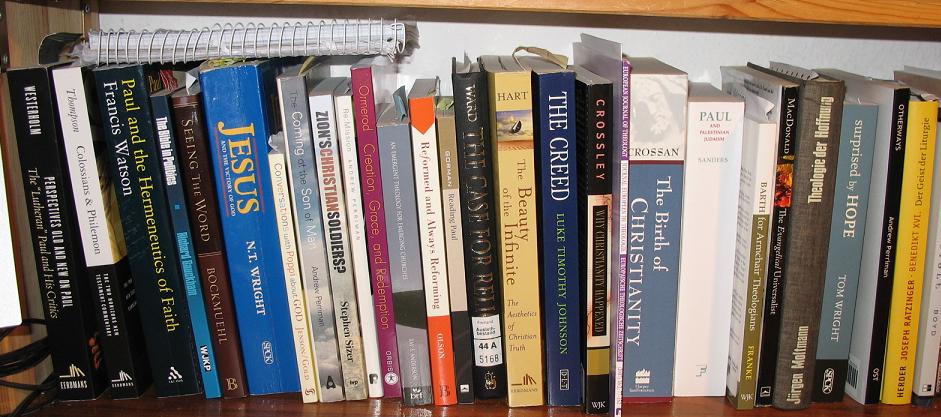
I love looking at other people's bookshelves. I'm persuaded it says a lot about a person. The shelf below constitutes about half of my to read / being read / being re-read pile – though included are only those books that are not a direct part of my doctoral studies. The latter occupy different shelves. This is what I enjoy reading in my spare time.


What a glorious, glorious feast! Jim, I want to draw attention to the big blue one in the top photo towards the left. My all-time favourite!

Monday, February 04, 2008

Intertextual Delusions?

'16 For I am not ashamed of the gospel; it is the power of God for salvation to everyone who has faith, to the Jew first and also to the Greek. 17 For in it the righteousness of God is revealed through faith for faith; as it is written, "The one who is righteous will live by faith." (from Hab 2:4) 18 For the wrath of God is revealed from heaven against all ungodliness and wickedness of those who by their wickedness suppress the truth' (Romans 1:16-18).

Andrew Perriman's reading of these verses is fascinating (this post is not a summary of his views, more of a thought experiment with some of his ideas in the back of my head). He is particularly careful to allow the wider context of Habakkuk to inform his understanding of the flow of reasoning in these verses. The first couple of chapters in Habakkuk run as follows:

  1. the Prophet asks God: Why are you letting all of Judah's sins go unpunished (1:2-4)
  2. God answers: I will judge them through Babylon (1:5-11)
  3. the Prophet asks God: But God, how can you use wicked Babylon to punish a nation more righteous than themselves? (1:12-2:1)
  4. God answers: I'll punish Babylon too! (2:2-20)

Just as God's wrath was first to Judah, then to Babylon, so too for Paul's gospel is offering salvation first to the Jew, then to the Gentile. Just as God's wrath will overtake Israel first through Rome's armies, so too will God's wrath also fall upon Rome. So Paul emphasises that God's wrath will be revealed against all ungodliness. This would likely mean that the wrath Paul mentions is coloured by the many OT 'wrath' passages, which speak of that wrath as a concrete historical event, usually involving a military. Think too of 1 Corinthians 7:26 'I think that, in view of the impending crisis, it is well for you to remain as you are. Did Paul think of an impending crisis across the Mediterranean world because of the sort of prophetic narrative encapsulated in Habakkuk? Is the 'wrath' Paul mentions a military event?

On the other hand, Francis Watson's masterful analysis of Rom 1:17 in Paul and the Hermeneutics of Faith, argues that Paul's introductory formula ('as it is written') does not really allow for too exact an allusion to the wider context of specifically Habakkuk (such sentences as these happen when I write too late at night!).

Is Perriman overplaying the metalepsis card? Or is Watson missing vital clues from the Habakkuk context? Part of the fun of exegesis in Paul is learning to get a feel for when potential intertextual metalepsis is really present, by judging how it illuminates the Pauline text at hand.

I think Pauline studies can be so utterly engrossing and exciting!

Saturday, February 02, 2008

Categorical Imperative of the Day

Try to convince a Catholic that the Roman Catholic Church is the Whore of Babylon in Revelation because the 'purple and scarlet' mentioned in 18:16-17 is obviously a prophecy about Catholic priestly dress sense ...

... at the same time as convincing a Fundamentalist Protestant that the 'purple and scarlet' mentioned in Revelation 18:16-17 more likely refers to verses in Exodus 35:30-36:1 and 39:1-2, 8-14, not Papal colour fetishes.

The Logic of Gentile mission in Paul and Acts

I'm getting wary of writing posts too late as I tend to write sentences that only need to be refined later. But what the hell.

To detail a point I made in response to Christian Zionism recently:

The fate of the Gentiles among the Prophets is a mixed chorus. Zechariah 8:13 states: 'Just as you have been a cursing among the nations, O house of Judah and house of Israel, so I will save you and you shall be a blessing'. This reminds me of many passages in Isa 40-55, like the following:

Isaiah 49:5-8 And now the LORD says, who formed me in the womb to be his servant, to bring Jacob back to him, and that Israel might be gathered to him, for I am honoured in the sight of the LORD, and my God has become my strength-- 6 he says, "It is too light a thing that you should be my servant to raise up the tribes of Jacob and to restore the survivors of Israel; I will give you as a light to the nations, that my salvation may reach to the end of the earth." 7 Thus says the LORD, the Redeemer of Israel and his Holy One, to one deeply despised, abhorred by the nations, the slave of rulers, "Kings shall see and stand up, princes, and they shall prostrate themselves, because of the LORD, who is faithful, the Holy One of Israel, who has chosen you." 8 Thus says the LORD: In a time of favour I have answered you, on a day of salvation I have helped you; I have kept you and given you as a covenant to the people, to establish the land, to apportion the desolate heritages

Significantly, when Paul speaks of his ministry he turns and cites ... Isa 49:9 (cf. 2 Corinthians 5:17 - 6:2)

Likewise, Acts 15:14-18 runs:

'14 Simeon has related how God first looked favourably on the Gentiles, to take from among them a people for his name. 15 This agrees with the words of the prophets, as it is written, 16 "After this I will return, and I will rebuild the dwelling of David, which has fallen; from its ruins I will rebuild it, and I will set it up, 17 so that all other peoples may seek the Lord-- even all the Gentiles over whom my name has been called."'

Gentile mission is presupposed upon the 'rebuilding of the dwelling of David', upon the 'gathering of Jacob', the 'raising up of the tribes of Jacob and restoration of the survivors of Israel'.

In other words: Exile –> Return –> Gentile Mission

Thursday, January 31, 2008

Acts 1:8

"But you will receive power when the Holy Spirit has come upon you; and you will be my witnesses in Jerusalem, in all Judea and Samaria, and to the ends of the earth"

For those of us in Pentecostal circles, Acts 1:8 is an important verse. It occurred to me today that Samaria, the capital of the old northern kingdom, could perhaps be understood as symbolic of the ten lost tribes in Acts.* After all, 'Jerusalem and all Judea' likely indicates the southern kingdom of Judah, and 'the ends of the earth' is an appropriate Gentilic scope of view that comes into sight, in the Prophets, only after the twelve tribes are restored.

Add to this Richard Bauckham's fascinating analysis of the significance of the nations mentioned at Pentecost in Acts 2:9-11 (cf. Bauckham, "The Restoration of Israel in Luke-Acts." In Restoration: Old Testament, Jewish and Christian Perspectives, edited by James M. Scott, 435–487. Leiden: Brill, 2001).

* My friend, Steve Walton, tells me that there is a discussion about this in Samkutty, Vanmelitharayil J., The Samaritan mission in Acts, London: T & T Clark, 2006

Links

1) Kevin P. Edgecomb has done an amazingly thorough job with the Biblical Studies Carnival XXVI.

2) It is not often that I laugh aloud reading a biblio/theology blog. But Eric Sowell managed to get me laughing twice in just a few days. First he tells, er, me why I should read his blog – and thereby shows us all why he is a man of wisdom. Second, and Jim West will love this, he tells it like it really is when it comes to reading Zwingli on the one hand, and Wright on the other.

3) Doug Chaplin gets lippy!

4) Are there really hidden messages in some song segments if you listen to them backwards? My friend Robin sent me a link to this spooky site.

5) Fancy reading a bit of really sick doctrine? Of course you do. This webpage will tell you that not only is America mentioned in the Bible, but we learn that the Old Testaments Prophets wrote about America and that Jesus' kingdom parables describe America! Prepare for a few pages of some seriously wacked-up side flipped mangy dribbled nasty crap job stick mashed up disaster of exegesis.

Emerging in Germany

From numerous discussions I have had in the last few days, it appears that the 'emerging conversation' is finally starting to take off in southern Germany amongst Evangelicals. And one or two theology blogs are in the pipe-line to boot.

While I am not comfortable with the line of reasoning that runs 'Postmodernity, therefore...', my own experience of things emergent has been of a liberation into a reforming and healthy theological adventure. So all I can say about this news is 'Wonderful!'

I look forward to seeing what shape this 'conversation' will take in Germany. You can bet it will be different from that found in the States and the UK – at least I hope so, or something has gone wrong, and 'emergent' will have been understood amiss and simply McDonaldsised for mass consumption with an Anglo-American pre-package. That would be a pity.

Tuesday, January 29, 2008

Internet Searches that Land on Chrisendom

'How can I win any argument against my wife'

A wise investment of internet research time.

Categorical Imperative of the Day

Publicly rebuke someone by simply listing a number of Bible verses (e.g. '1 Kings 12:1; 2 Cor 3:4; 2 Peter 1:4; Revelation 4:5; Amos 3:2'). Then give a condemning glare.

Paul’s negative view of the Law

For those who have e-mailed me recently, apologies for my lack of response. I'll try to get round to responding in the next day or two. I've been happily busy the last few days.

Anyway, how could a Jew like Paul say such negative things about the Law? Some resort to a Lutheran scheme. Others an apocalyptic framework. Others will argue that Paul's polemic is directed at Gentiles trying to adopt the law. Still others will claim Paul is given to rhetorical manipulation, and doesn't mind the odd contradiction or exaggeration.

I think the question needs to be reframed: How could a first century Jew not have such a negative view of the Law? After all, Moses himself prophesied (in the last few chapter of Deuteronomy), that Israel would not inherit the promised blessing through the Law, but rather its curse, i.e. exile. Standing in the first century, Paul's world was shaped by the clear fulfilment of these Mosaic prophecies. So how could a first century Jew, who knew all about the exile first of Israel, then of Judah, and later oppression under Roman rule, think anything else? Of course Paul speaks of 'the curse of the law'. It was historical fact.

Saturday, January 26, 2008

Eschatology in Popular Evangelicalism

A good litmus test for whether one has a good understanding of the biblical narrative and its relevance for exegesis is to ask one about their eschatology. If their eschatology is loopy, there is a good chance that they lack in their understanding of the significance of the wider biblical narrative.

I say this because I watched GODTV for a while today. On the channel I recently saw a sermon by Rick Warren and, I am not at all ashamed to confess (sorry Jim!), I was impressed. Today was a different matter. The guy who runs the channel told his (massive) audience about his discoveries in a new book by a certain Grant Jeffrey. Based on a few verses in Ezekiel, stirred together with another from Leviticus, a potent cocktail was developed to justify 1948 as the so-called third return from exile.

This was coupled with calls from a co-presenter to visit Israel, who made exclamations to the effect that he could not understand why Christians do not visit Israel and Jerusalem in particular. This was interrupted with further enthusiastic comment that God is present in a special way in Israel, and that just as God 'made a nation in a day' (referring to 1948), so God is going to suddenly fulfil all of his promises in your life 'during this season'! I was starting to get a little bit angry.

Apart from the obvious arbitrariness in the way Scripture was treated in these arguments, it was shocking that no knowledge of the significance of Maccabees was demonstrated. What is more, this kind of handling of Old Testament prophecy fails on at least two more points:

  • it does not recognize the context of the language and the Prophetic literature. Talk concerning the return from exile in Isaiah, Jeremiah, Ezekiel and in some of the Minor Prophets, is associated with such themes as the new covenant, the giving of the Spirit, the giving of a 'new heart', etc. These issues find the beginning of fulfilment in and through the ministry, death and resurrection of Jesus of Nazareth. That is why Luke frames much of his 'ancient biography' by bringing Anna and Simeon into the narrative as Jesus is first bought the temple. They are waiting for the consolation of Israel and the redemption of Jerusalem (compare the LXX of Is 40:1!). That is part of the point behind Matthews genealogy with which he frames his whole Gospel (See also 2 Cor 3).
  • The prophetic literature envisages the restoration of the tribes of Judah and Israel, i.e. all the 12 tribes. 1948 is not a literal fulfilment of this. The 10 northern tribes had long since been assimilated into Assyria, and so Jesus symbolically reconstitutes the 12 tribes of Israel by choosing 12 disciples.

And with this I do not mean to assert a replationist Israelology. That implies discontinuity where there is continuity and ignores, among other things, the image of ‘in grafting’ which Paul uses in Romans 11. I think it is difficult to avoid the conclusion that Paul, when he speaks of all Israel being saved in Romans 11, envisaged a salvation waiting for ethnic Israel. In other words, God is not done with Israel. But these points aside, Christian Zionism needs to be challenged and those who do not like what we say need to responsed to the arguments without irresponsibly throwing the label 'anti-Semitic' around.

Blogroll updates

I've been meaning to add blogs to my blog reader for a while now, and I've come across many promising looking new blogs that I intended to add ... but never got round to it.

So I guess the best thing to do is simply ask: If you are not on my google reader then please leave a comment if you think I would like your blog.

Thursday, January 24, 2008

How to win any argument

I thought this was rather amusing. I just tried it on Anja, attempting to claim that an espresso before bed helps one to obtain deep sleep. I really fancied an espresso, but my rhetoric, even with mention of a Southern Journal of Sleep Pattern Science in my argument, failed to win the day.

Michael Halcomb look-alike

In light of this, I offer this:


Enough said.

CTRVHM Proverbs

"N.T. Wright is (very often) most likely right simply because he seeks to explain as much of the evidence as possible, and address as many of the possible questions together. This is what makes his own case concerning the historical Jesus, in Jesus and the Victory of God, so compelling"

Wednesday, January 23, 2008

The Apostle Paul in a Sentence

In the near future I will write a short review of Michael J. Gorman's superb little book, Reading Paul. Until then, here is Gorman's attempt at 'Paul in a sentence'.

"Paul preached, and then explained in various pastoral, community-forming letters, a narrative, apocalyptic, theopolitical gospel (1) in continuity with the story of Israel and (2) in distinction to the imperial gospel of Rome (and analogous powers) that was centered on God's crucified and exalted Messiah Jesus, whose incarnation, life, and death by crucifixion were validated and vindicated by God in his resurrection and exaltation as Lord, which inaugurated the new age or new creation in which all members of this diverse but consistently covenantally dysfunctional human race who respond in self-abandoning and self-committing faith thereby participate in Christ's death and resurrection and are (1) justified, or restored to right covenant relations with God and with others; (2) incorporated into a particular manifestation of Christ the Lord's body on earth, the church, which is an alternative community to the status-quo human communities committed to and governed by Caesar (and analogous rulers) and by values contrary to the gospel; and (3) infused both individually and corporately by the Spirit of God's Son so that they may lead "bifocal" lives, focused both back on Christ's first coming and ahead to his second, consisting of Christlike, cruciform (cross-shaped) (1) faith and (2) hope toward God and (3) love toward both neighbors and enemies (a love marked by peaceableness and inclusion), in joyful anticipation of (1) the return of Christ, (2) the resurrection of the dead to eternal life, and (3) the renewal of the entire creation"

(Michael J. Gorman, Reading Paul, Eugene: Cascade Books, 2008. p. 8)

I couldn't help but feel he was cheating a bit by using such a long (German style) sentence! So here is a quick stab at an alternative (and shorter) suggestion:

'The Jew Paul was a Jesus Christ-obsessed and Christ-community-building canonical interpreter of Israel's Scriptures, proclaiming the Gospel of God to those living in an eschatologically charged time in the first century Mediterranean, and Roman Imperial, world'

A friend of mine, suggested using Paul's own self description:

'Chief of sinners'!

That is, of course, even shorter – and a bit clever! Perhaps we can trim even a few more words off:

'Not Jeremy'

Which would at least be factually true. But can we go even shorter? I think we can. At the risk of circularity:

'Paul'

Which tends to lack the explanatory power of Gorman's, but it is quicker to read.

What would be your 'Paul in a sentence'?

Tuesday, January 22, 2008

Nanos and The Polytheist Identity of the 'Weak'

Loren Rosen III has done us all a favour by drawing attention to Mark Nanos' new article, "The Polytheist Identity of the 'Weak,' And Paul's Strategy to 'Gain' Them: A New Reading of I Corinthians 8:1-11:1". His position, that the weak mentioned in 1 Corinthians 8 were not Christ-believers at all but polytheists, is an option I toyed with for a short while after thinking on 8:7. There Paul writes:

VAllV ouvk evn pa/sin h` gnw/sij\ tine.j de. th/ sunhqei,a e[wj a;rti tou/ eivdw,lou w`j eivdwlo,quton evsqi,ousin( kai. h` sunei,dhsij auvtw/n avsqenh.j ou=sa molu,netaiÅ

With the genitive eivdw,lou, sunh,qeia is usually translated as something like 'accustomed to' idols. So the NRSV has 'It is not everyone, however, who has this knowledge. Since some have become so accustomed to idols until now, they still think of the food they eat as food offered to an idol; and their conscience, being weak, is defiled'.

However, BDAG has as the first meaning of sunh,qeia the following:

'a relationship in which the participants are compatible because of shared interests, friendship, fellowship, intimacy'

This would gel rather well with the use of mete,cw and koinwni,a used with the genitive in 1 Cor 10 in a few places. Hence I tried to make the following translation work:

'But not in all is the knowledge, but some, being in fellowship with idols until now, eat food as food sacrificed to an idol, and their conscience, being weak, is defiled'

This was part of a translation I worked on a few weeks ago. However, I dropped the idea given a few points that I will perhaps mention on the blog in a few days in more detailed critical reflection on Nanos' essay. Despite the fact that I think Nanos had a couple of good points, I was far less impressed than Loren Rosen.

By the way, there have been some hilarious comments to my previous post, so do give them a read if you haven't yet!