-------------
Meich Pearse, The Gods of War: Is Religion the Primary Cause of Violent Conflict? (Nottingham: IVP), 2007.
The current spout of religious warfare has generated a more vigorous secular critique of the religious worldview as inherently violent. Pearse reports that an opinion poll in Britain in late 2006 indicated that 82 % of adults “see religion as a cause of division and tension between people. Only 16 % disagree” (14). This is a sentiment expressed both in the media and amongst many Western intellectuals. In response to this misrepresentation, Meic Pearse has taken it upon himself to demonstrate historically that wars are multi-causal and complex, and are motivated by all ideologies, secularist as well as religious. His book attempts to substantiate four main arguments:
1. Irreligion has produced wars far worse and far bloodier than religion.
2. We must distinguish between belligerent and non-belligerent religion.
3. Cultures enshrine religion, and wars fought for one often appear as being fought for the other.
4. The global secularist campaign against religion and traditional cultures (as supposedly violent) is already and will continue to be productive of the most ferocious violence.
The first chapter opens with the truism that the 20th Century was the bloodiest century of all. The key question is whether this massive bloodshed was simply a result of more developed technology or whether it was connected with the prevailing secular ideologies of the time. Pearse illustrates how within the ideologies of the key thinkers of Communism, Fascism and the French Revolution, human life was considered expendable for the sake of the attainment of a particular abstract ideal, an understanding of “the grand scheme of things.” Within these secular creeds, the end not only justified the means of its attainment, it defined what it meant to be human. “People” had no intrinsic value grounded in the imago dei, rather they were a theoretical construct to which the “facts” must conform. This attitude, combined with technology, has catastrophic consequences.
Not that religion can be excused. Chapter two looks at the question of religion as a cause of war. Religion is defined as “an interconnected system of beliefs and/or practices rooted in the numinous or spiritual world that gives meaning to the lives of those who embrace them or have been reared in them” (22). Yet when we try to analyse concrete historical examples, we are faced with the complexity of their causes. Were the Jewish revolts of the first century religious or political? How about the druids in Roman Britain? Christianity was peaceful for the first 300 years of its existence, and then became bloody from 330 A.D. An overview of the wars of the Greeks, Romans, Vikings, Mongols, French and Americans indicates that more mundane factors such as greed, security, booty, glory, territory and nationalism were the predominant factors rather than religion.
More clear cut cases are the subject of chapter three. Islam, in contrast to Christianity, was “cradled in war.” Pearce outlines its history of violence and notes that it shares a teleology or dynamic with communism: universal, this-wordly rule. In dividing the world between dar al harb (“sphere of war,” i.e. the non-Muslim world) and dar al Islam (“sphere of Islam”), the price of peace becomes submission to Islam. Christianity, on the other hand, had a different beginning and ideology. It doesn't have an equivalent of the Muslim ummah, the believers whose life must be expressed as a political entity. Though the Crusades were no less violent, Pearce argues that their causes are more “mixed.” Indeed, the undefined frontier of Europe has always been a source of war, regardless of the religious affiliation of each side. In a sense, war between East and West seems inevitable.
Chapter four offers an historical analysis of wars in which the situation is far more ambiguous. The English and American civil wars, the conquests of South America, the conflicts between the Orthodox church and the Ottoman empire. Often cultural identities are enshrined by a religion, so that a challenge to this identity leads to an increase in religious intensity. Often, religion functions as a morally convenient cloak for another cause. In the end, religion in inseparable from cultural, social and political issues.
The following two chapters look in detail and a particularly insidious mix of politics and religion: religious-national myths. In the cases of Serbia, Russia and England, the nation is deified and rendered immune to criticism.
So what causes war? Chapter seven offers a historical overview. In ancient times religion was hardly significant. The key issue was was access to property in the form of livestock, food, slaves, land and women. When religion was present, it often functioned as a restraint on war, as the fall of the Roman Empire, the medieval papacy and the Islamic umma indicate. For Pearse, it wasn't until the rise of popular rule that religion became a major factor in creating conflict. When loyalty to an absolute ruler is not enough to acquire popular support for war, reference to an abstract principle that generates both group identity and enthusiasm is necessary. Religion becomes a handy framework of meaning to meet these needs.
This is, more or less, what Marxists have always said, and so Pearce draws on their arguments in chapter 8. Though for the first 300 years Christianity was spread by persuasion, the moment it was adopted as the meta-narrative of the state, the sanctification of that state's wars is inevitable. Marx helps us uncover the real aspirations that undergird a states use of religious language: namely economics and politics. This can be seen in the transformation that Christian doctrine underwent from the time of Eusebius onwards, through the Middle Ages and into the Reformation, as various states adopted varieties of the religion for its own purposes. The same pattern, claims Pearse, can be seen in other religions.
Chapter 9 seeks to exculpate Christianity by find out what it really is. Pearse argues that both historically and theologically the church was never intended to form the basis of a political order. When that has occurred, the church has strayed from its roots and a belligerent form of Christianity is the result. It wasn't until the Anabaptists, with their insistence on the split between the state and church, that a situation similar to that of the early church was rediscovered after the “Constantinian” development. In addition to this, the pluralistic political developments in the modern era have helped create a situation in which the church can stop trying to do that for which it was not designed—running society—and get back to it's original function: guiding individual lives. Today, though there is still an inner-ecclesial debate concerning pacifism, it is universally agreed that when war is waged, it cannot be fought to spread the faith.
So, can a Christian fight at all? Pearce doesn't provide an easy answer, for to do so is to sanitize war. War is an insoluble dilemma and neither pacifism nor theories of just war can adequately deal with it. Both arguments are analysed for their strengths and weaknesses, and Martin Luther King and Bonhoeffer are drawn on as role models. The solution? In war there is none, neither in theory or practice. The best we can do is take moral responsibility for our own actions and to keep those decisions conscious. No general or king can do that for us.
Pearse ends with a glance at our contemporary situation. In his final chapter, “The War Against Faith and Meaning,” he points out that apart from greed a principle cause of war is conflict over the shape of society. The principled irreligion of the West, spread through globalization, in which meaning itself is held to be the problem and thus must be banished, is an “absolutizing relativism” that is itself a cause of violence. Rather than being a universal pancea, the attempt to eliminate difference both inside and outside the West is just another unattainable utopianism which produces violence through its intolerance. The only real solution to world peace is genuine tolerance, which can accept different kinds of polity and the cultural spaces that make them possible. “And to that end, Christians, who know from Scripture and from their own painful, error ridden past that their faith is not a basis for governing society as a whole but a private choice and a transcendent calling, have far, far more to contribute than most” (207).
I thoroughly enjoyed this read and can recommend it to all. Whether one agrees with his construal of Christianity or not, this informative and eloquent book provides us with important categories for entering an important debate.
N.B. For those wishing to look at this issue in relation to Christian Zionism, check out this fascinating article.
Friday, May 23, 2008
Guest Book Review: The Gods of War
Quote of the Day: Evolution and Christology
"The God of natural selection is the liberating, healing, and inclusive God of Jesus"
Denis Edwards, cited in LeRon Shults' Christology and Science, 50.
(In other words, Edwards claims that the God revealed in Jesus Christ is consistent with the God assumed in the evolutionary process of natural selection)
Wednesday, May 21, 2008
Thought of the Day
Boy oh boy I'm a busy bee at the moment. I would point readers to the terrific discussion in the previous post, but tonight I have no time to join in. I can only offer a thought that occurred to me as I was entering Tübingen library today:
If a murderous alien life force were to suddenly possess my body, armed with a golf club I could seriously dent the living theological halls of fame in a pretty short space of time. Imagine it: Jüngel down with a nine iron in his head, Moltmann a sandwedge, Küng, Stuhlmacher, Hengel ... enough to get my face on the Church Times front page as the most hated person ever! Of course, I might just have very bad luck and take a few out accidently in my Audi (I fall asleep at the wheel and curve into the Theologicum were the aforementioned greats happen to be unfortunately gathered together).
Of course, all this is less likely to happen than every single one of my readers winning million pound/dollar/euro lotteries every day for the rest of their lives. But such a detail aside, such was my idle thinking strolling across the lawn to the Universitätsbibliothek Tübingen this pleasant afternoon.
Monday, May 19, 2008
Enoch and Christian Universalism
I've been repeatedly reading the Similitudes of Enoch recently (1 Enoch 37-71 – the new Vanderkam and Nickelsburg is both the most authoritative translation and, in my view, the most accessible), and it occurred to me that it is a potentially relevant text to the Christian Universalism (CU) debate. If Matthew did indeed draw from the Similitudes for the 'parable' of the sheep and goats (Mt. 25:35-46), as Jim Davila and others think, then one ought to best consult 1 Enoch to understand Matthew. And I think one would be hard pressed to maintain any version of universalism based upon 1 Enoch!
In other words, the canonical Gospel text of Matthew likely does not support the notion that Jesus held universalist convictions, and, especially if the Similitudes link is pursued, indeed held convictions opposed to CU.
To run with this line of thinking: While it can be argued that Paul's letters do not have to be interpreted in a way that is incompatible with CU, one would also be hard pressed to claim that Paul was himself a universalist, even if there are CU seeds in his letters. Add to this the general view of Christian tradition, which in the 6th century explicitly condemned (albeit an extremely dubious variety of) CU, and one has a formidable artillery lined up against universalist convictions.
Further, and for me at the moment decisively, to add the CU footnote at the end of this picture is not simply a tame option but vital for one's understanding of the whole (much like the last chapter in a book telling you what happens at the very end is crucial). And to this extent, because it is difficult to understand the CU option as merely a subtlety, I struggle to accept a version of the story's end that does not square too comfortably with a canonical portrait of Jesus' teaching, Paul, nor the tradition of the church. Of course, I hope CUs are right. Gregory MacDonald is a 'hopeful dogmatic universalist'. For now, I remain simply a hopeivist.
Quote of the Day
"In conclusion, let me ask you to hold in your mind traditional Christian visions of the future, in which many, perhaps the majority of humanity, are excluded from salvation forever. Alongside that hold the universalist vision, in which God achieves his loving purpose of redeeming the whole creation. Which vision has the strongest view of divine love? Which story has the most powerful narrative of God's victory over evil? Which picture lifts the atoning efficacy of the cross of Christ to the greatest heights? Which perspective best emphasizes the triumph of grace over sin? Which view most inspires worship and love of God bringing him honor and glory? Which has the most satisfactory understanding of divine wrath? Which narrative inspires hope in the human spirit? To my mind the answer to all these questions is clear, and that is why I am a Christian universalist."
----- The final paragraph of Gregory MacDonald's The Evangelical Universalist, pp. 176-77
Saturday, May 17, 2008
Thought of the Day
'As it stands presently, NT scholarship will always get largely Christian results, be they the nineteenth-century liberal lives of Jesus, the Bultmannian dominated neo-Lutheranism, or the results of smaller subgroups, such as the social reformer/critic Cynic Jesus associated with the Jesus seminar: all different but all recognizably Christian'
James Crossley, Why Christianity Happened, 23
I suppose James' proposal raises again the important question as to what counts as 'recognizably Christian'.
Back from England
... loaded with a copy of Ben Witherington III's The Living Word of God, Celebrating Common Prayer and Tim Gorringe's Salvation. My search for church history books in London was a spectacular failure, though only because I didn't manage to make it to the London School of Theology bookshop, Phil ;-)
I also returned to happily find a review copy of LeRon Shults' Christology and Science lying on my desk. I was present at LeRon's inspiring presentations on the book in Tübingen, and I am very much looking forward to reading the final result.
Thursday, May 15, 2008
Gorringe on Salvation
Gorringe used to lead one of my seminar groups in St Andrews, but at the time I was living in a very small theological world and thought the man a screaming heretic! Well, maybe not heretic, but I didn’t like the fact he didn’t live in my “individual sin-penal atonement-personal faith alone-heaven” schema. This book, among other things, helps shows why precisely that schema is inadequate!
Jim's new blog title
"Idiot with keyboard"
But here are ten more for consideration
1) Zany Zwingli Zordidness with Zilch Theological Content
2) Dribbling Ape with Keyboard could do better
3) Man bungee jumping from bridge and landing accidentally a few times on a keyboard headfirst could do better
4) Minimalists don’t believe Zwingli ever existed
5) Mini-malists R Us - in every sense of the word
6) Bold Heresy Below
7) Total Depravities R Us
8) The Historical Bultmann demythologised and raised in the kerygma of Joel Osteen below
9) Zwingli Ninja
10) Utter Tripe
Monday, May 12, 2008
Seeking a book recommendation
Today was my granddad’s funeral, and it was naturally quite an emotionally exhausting day. For all of you out there who read this blog, whether Christian, atheist, or whatever, do take a few minutes to give thanks for those around you, for your loved ones. They won't always be there.
Judging a book by its cover
But before I try to get poetic about my comings and goings in Ol’ Blighty, a bit of self-realisation: I popped in to a local Christian bookshop in the afternoon, and, as is my custom, piled up some ‘potential buy’ books before filtering them down to the one I eventually purchased (a half price copy of Celebrating Common Prayer).
Now apart from the fact that many of the books being sold in the shop caused me some consternation, as I whittled my books down I noticed something else rather alarming, namely I noticed how influenced I was by who was recommending the books with the blurb on the back cover. If Bauckham had his name on it, for example, I took notice. Or, if it was a scholar I generally disagree with, yet is more liberal, I kept the book for a second look - hungry to find out more. But if other big scholarly names were on the back, the book hardly stood a chance. More significantly, if the ‘big names’ were of the conservative variety, I really struggled to consider the book at all - even if I was attracted to the book itself. Why do I react like this, I wonder, especially as I am pretty conservative in some ways? One name in particular, one I think almost all my readers will know ... well he tends to just get me irritated, even though his work is of the highest academic quality. Yet I just can’t read his stuff anymore with wincing (go on, guess the name if you can!). Ergo, put his name on the back: bye-bye book. Cranky revisionist and foaming mouthed blathering Liberal mash I don't always agree with, I get. Conservative stuff I may have more in common with in terms of conclusions, wind me up. Figure that!
Friday, May 09, 2008
Guest Book Review by David M. Moffitt
My thanks both to the kind folk at Westminster John Knox for a review copy of Luke Timothy Johnson's Hebrews: A Commentary, and to Dave for the following stimulating review.
---------------------------------------
Luke Timothy Johnson's recent commentary on Hebrews (Westminster John Knox, 2006) accomplishes a feat rarely achieved by scholarly commentaries. It is easily accessible and readable. Johnson's volume is no substitute for more thorough studies like those of Attridge, Grässer or Spicq. Yet, what this commentary lacks at the level of detailed discussion and engagement with secondary literature is atoned for at the level of lucid prose and exposition. There is little to distract from Johnson's own sustained interpretation of this oft neglected text. As such, this volume is a welcome contribution for those of all levels of expertise who share an interest in this ancient homily.
This review will neither detail the contents of the commentary, nor expend a great deal of verbiage explicating the main emphases of the book (for those seeking more information, see the helpful reviews of Craig R. Koester and Wolfgang Kraus already published in RBL: http://www.bookreviews.org/bookdetail.asp?TitleId=5445). Suffice it to say that this is a thoughtful and at times provocative study (e.g., Johnson's argument for a pre-70 dating) that is well worth reading. Instead, I will briefly discuss Johnson's welcome emphasis on Jesus' resurrection in Hebrews in view of one of the major themes that orients the whole of his interpretation of the "epistle"—his claim that the argument of Hebrews is best understood in terms of a Platonic worldview.
In his introduction, Johnson claims that, "Hebrews appreciates rather than deprecates the physical. Only because Jesus had a human body could he be a priest … His body, moreover, is not cast off at death but is exalted: Jesus opens the new and living way to God through the veil that is his flesh …" (p. 20). He later adds, "By his resurrection and exaltation, Jesus has entered into the true holy place, which is the presence of the eternal God, with his own blood …, which he offers for the sins of many …" (p. 52). Johnson is not the first to argue for a real emphasis on the bodily exaltation of Jesus in Hebrews (e.g., Spicq, Vanhoye and especially Hofius—whose intriguing interpretation of 10:20 has been largely neglected). As someone actively pursuing dissertation work on this topic (http://www.duke.edu/~dmm20/Dissertation.html), my interest was especially piqued by Johnson's bold and somewhat surprising comments. In any case, it should be noted that the suggestion that Jesus' bodily presence in heaven forms an important element of Hebrews' soteriological and Christological claims is a minority view.
Such a notion, however, seems at odds with the assumption of a Platonic worldview for the author of Hebrews. Johnson notes the problem stating, "The Platonism of Hebrews is real—and critical to understanding the argument—but it is a Platonism that is stretched and reshaped by engagement with Scripture, and above all, by the experience of a historical human savior whose death and resurrection affected all human bodies and earthly existence as a whole" (p. 21, Johnson dubs this "biblical Platonsim" on p. 173). Granting that "Middle Platonism" is typified by the diversity of opinion and comment on Plato's texts, one still wonders if the fundamental dualism between the material and spiritual realms could really be "stretched and reshaped" to the degree that the confession of Jesus' bodily resurrection and ascension entails. Are we really dealing with an author whose Platonic dualism is being reshaped by Jesus' exaltation, or are the author's claims simply better explained by an appeal to some other set of cosmological presuppositions like those of some form of Jewish apocalyptic?
I do not mean to imply that one can view "Platonism" and "Apocalyptic" as hermetically sealed ideas that never influenced one another. I only want to suggest that if the confession of Jesus' bodily resurrection is actually important for Hebrews—not to mention notions like those of the ongoing personal identity of Jesus after his entry into God's heavenly presence, or that of belief in Jesus' personal return (cf. 9:28), it would seem that there are better cosmological analogies to be drawn in the ancient world than to presume that the author forges a new kind of paradigm breaking Platonism.
These decisions are important because they inevitably color the way one interprets other issues in Hebrews. For example, Johnson often conflates the categories of Jesus' resurrection and exaltation. In his index of subjects one even finds "resurrection/exaltation" listed together as one topic (p. 402). While this conflation fits well within the consensus position on Jesus' resurrection in Hebrews, such an approach more easily coheres with a notion of spiritual ascension in which Jesus' immediately enters God's presence at the moment of his death, than it does with a confession of his bodily resurrection.
More to the point, the supposed fusion of resurrection and exaltation in Hebrews more readily aligns with some form of Platonism than does the claim that Jesus' rose and ascended bodily into God's presence. One therefore wonders if the confusion between the categories of exaltation and resurrection in Johnson might result in the encroachment of his assumption of a Platonist cosmology upon his claim that Jesus' bodily exaltation actually matters in Hebrews. Such a suspicion is born out when later in the volume Johnson comments that, "[T]he notion of 'eternal' does not mean simply 'everlasting,' but more, a participation in the life that is God's own. Salvation, therefore, is more than possession of the land and success, it is 'heavenly' …, transtemporal because also transmaterial" (p. 148, emphasis mine). Somewhere—when speaking of Jesus' offering through the eternal spirit— he also says that by this comment, "[T]he author [likely] intends to describe the mode of Christ's offering. … If spirit is the realm of God's existence, then Christ's entry into that presence is appropriately described as 'through the eternal spirit" (p. 236). And again he says, "The use of 'spirits' [with reference to righteous in 12:10] simply reminds that the way they now live is as God lives, not in their former mortal bodies but in the dimension of spirit." Those who say such things seem to show that they look for a resurrection in which the body no longer plays a role. Thus at sundry times and in various ways it appears that Johnson has actually allowed a Platonic worldview to stretch and reshape his claim that Jesus' human body is not cast off at death (p. 20).
As should be clear, the immediate goal of this review is not to offer a solution to the conundrum I have sought to identify, but only to problematize Johnson's appeal to Platonism on the one hand while claiming that Jesus' body was exalted to heaven on the other. The two assertions stand in sharp tension and it would appear that even for Johnson himself one of these claims really does become obsolete, even to the point of fading away, as his exposition proceeds.
My larger goal, however, is to highlight the less than clear way that commentators on Hebrews tend to employ the language of "resurrection" when explicating the homily. What do we mean when we use this terminology with reference to Hebrews? Does writer affirm Jesus' bodily resurrection? Is resurrection simply another way of speaking of exaltation? Can these two positions be held together or does one exclude the other? Or, does the paucity of resurrection language (some would say total lack—e.g., Attridge) suggest that this author intentionally avoids or denies the resurrection? This latter view seems to offer the most consistent explanation of Hebrews when viewed through the lens of Platonism. Regardless, some clarity in terminology, especially for those who want to use "resurrection" language remains a desideratum.
In conclusion, let me say again how much I appreciate Johnson's commentary. His generally balanced approach and clear exposition not only provide those of all levels who would learn more about this homily with an excellent resource, they also provide a fine example of how a fine commentary can be written.
David M. Moffitt
Thursday, May 08, 2008
Blue Man Group
Anja, my brother-in-law and I went to see the Blue Man Group in Stuttgart tonight. Great fun. I recommend them if you get the chance to see them on their tour.
Casey responds to Bird
Maurice Casey responds to Michael Bird's review of his book, The Solution to the 'Son of Man' Problem. Mike promptly posted it on his blog (and James Crossley also posted it here). Such exchanges as these are reasons to give thanks for biblioblogdom. Incidentally, Mike's forthcoming book Are You the One Who is to Come? is a superb contribution, one I will regularly recommend.
Chrisendom glossolalia and interpretation
David Ker recently posted on glossolalia, and because he happened to mention me a certain Peter Kirk seized his opportunity and exclaimed:
"As for Chris Tilling, I can understand why Jim gives him such a hard time"
What the hell?! Persecution!
Glossolalia: "Kiwi mah ma bung giftteemax imo banjo beeeum poomarkswiftworthy Mr Kirk slip dunk skdit bhwosidth sdkh! karate kid weiu ueif ywqplcxnf duwiel! dhsido? sdlkjq0gjn, sdld, tqnod, thewioghs wehros q wepop hfow"
Interpretation: "Calling on all angels, cherubims, living creatures and intermediary figures to give Mr Kirk a convincing dose of 'karate kid' wax on wax off in the head department, till his face resembles a damaged Picasso, the snot from his nose is removed, and righteosness is imparted in a restorative type way"
At least that was my interpretation.
Tomorrow, I will post a superb book review by one of the smartest up-coming scholars I know, so stay tuned.
Wednesday, May 07, 2008
Religion TV documentaries free online
The German station, ZDF, have a load of their shows to stream free online. Click here to explore. You'll find documentaries about Jesus, Church history, and all manner of other subjects. Of course, it is all in German, but what a great way to improve your German language skills! Thanks, Alex, for the hat-tip.´
Here are a couple that caught my eye:
- Imperium der Päpste: Duell zwischen Kreuz und Krone
- Die Geheimakte Jesu
- Homo erectus konnte abstrakt denken: Älteste Holzspeere beweisen Intelligenz der Urzeitmenschen
- Julius Caesar, der Imperator: Die lange Nacht der Eroberer
- Martin Luther - Kampf mit dem Teufel: Ein Mönch gegen Papst und Kaiser
- Das Geheimnis der ersten Christen: Von der Sekte zur Weltreligion
- Griechisch-orthodoxer Gottesdienst – well, I thought that was interesting!
Tuesday, May 06, 2008
A link
A great list of 'Scholars Who Have Influenced Me Most' by Nijay Gupta. His blog is definitely one to add to your readers, by the way.
Post Charismatic?
I really don't like all the post-this and post-that business, but I did venture to get Rob McAlpine's new book, Post-Charismatic?, which I started a couple of days ago.
In terms of the question of whether the gifts of the Spirit are around today, I'm an unashamed charismatic. The popular way of justifying the theory that the gifts vanished with the death of the last apostles is to eisegete into 1 Cor. 13:9-10, but the 'perfection' there named is not a biblical canon, at least not in Paul's mind. However, when it comes to charismatic culture, I often want little to do with it. And, if I am honest, I sometimes struggle with the tension this creates. Just recently a well meaning person tried to speak with 'prophetic authority' into my life, but to put it politely ... they didn't bless me. As my charismatic friends would say, the person apparently spoke 'from the flesh' (which is also a polite way of putting it – I thought of other ways, but alas that aspect of my creative urge is best left unpublished. Besides, they meant well).
To be honest, my understanding of what counts as 'prophecy' has changed somewhat. I would understand particularly socio-political theological engagement (e.g. aspects of liberation theology, and books like Colossians Remixed) to be sometimes profoundly prophetic, for me more so than the 'I had a picture but don't know what it means' variety. But through whatever manner God chooses to speak I want to be ready to hear (1 Thess. 5:20 'don't despise prophecies'; 1 Cor. 14:1 'Pursue love and strive for the spiritual gifts, and especially that you may prophesy'). Hopefully this books will help me out on at least that front.
Prophetic word of knowledge idea of the day
1) Grab a charismatic. Lay a hand on him or her and say 'I have a word, brother/sister'
2) Say 'I saw an odd picture. I saw a dirty tissue, filled with snot and phlegm and sneeze'
3) *pause with eyes closed looking all earnest like you are waiting for an interpretation*
4) Continue: 'That dirty tissue?',
5) *wait for a nod*
6) 'That's you, that is'
Monday, May 05, 2008
Unbelievable?
No, not silly nonsense such as people who dare to disagree with me, who bother to read Jim West's blog without laughing derisively, or those who claim to converse with the alien 'mother ship', who use Domestos as a breath freshener, or who turn their underpants inside out to double their pre-washing machine life-span etc.
Rather, these Premier Christian Radio programmes, ably hosted by Justin Brierley, are worth a listen. They discuss the expected mix of subjects in a respectful way, and the listener 'phone ins' and e-mails are most revealing in that they show were some pew-level evangelical thinking is at. I needed to be reminded of the evangelical world beyond the world of blogdom and Tübingen. A sobering wakeup call.
Sunday, May 04, 2008
Guest Book Review: The Crucifixion of Ministry
------------------------------------------------
Andrew Purve's little book is a call to return to the heart of what being Christian is all about—discipleship to God, in Christ, in the power of the Holy Spirit. It may sound pithy, but there's a concrete reality at work in this world which functions independently of our theologies, strategies and cherished agendas. This reality is what it's all about and so the most significant question you can ask is "what is this reality" and "how do I connect to it"?
This brings us to the interface of praxis and doctrine. The peculiarity of the Church is that it doesn't have a mission statement to fulfil in any strategic sense of the word. It has an identity as adopted son, and everything it does is dependent on its realizing its identity. This is because whatever ministry the Church may have in its various contexts is utterly derivative of the true ministry of the Church's Father. It's His ministry, and so if the Church is to do anything of lasting value, it must do it as a participant in the true ministry of the One who is the creator and perfecter of all things. The consequences of doing it alone, of attempting to be your own "ministerial messiah," is the burnout that many in the clergy are experiencing today.
For this reason, Purves opens his book with a call on church ministers—though by extension this applies to any Christian—to give up the claim that their ministries are theirs, rather than God's. Rather, we should embrace with joy the "crucifixion" of our ministries in order to make space for God to use us in His unfolding ministry. In other words, true Christian ministry is a profoundly theological act. The primary question we need to be asking is not "What strategies will work best in my ministry?" but rather "What is God doing and how do I join in?" The heart of Purve's book is dedicated to unpacking this doctrinal question.
For Purves, the foundation for our ministry is the Trinitarian claim that God is working in the world through his Son, in the power of the Holy Spirit. It is within this Trinitarian movement that the church is to find its true identity and the substance of its witness. God acts to save us in Jesus, who as a human offers back to God the service and worship he desires. The Holy Spirit is Christ's chosen form of presence among us and his function is to join us to Christ so that we can share in the love that takes place between Father and Son. This redemption results in a life of thankful response, and it is the task of pastoral work to call people to share in this "alien love." In short, "The centre of Christian faith and life is our sharing in the love or communion within the Holy Trinity and in the ministry that flows from it" (71).
Within this Trinitarian movement Purves highlights two truths that are of especial importance for ministry: the Doctrine of the Vicarious Humanity of Christ and the Doctrine of our Unity with Christ. Following Athanasius, Purves holds that "Jesus Christ ministers the things of God to us and the things of humankind to God." This involves the paradox that Jesus is both the Word of God to us as well as the the one who receives God's Word for us. In other words, our response to the covenant is already fulfilled by one more capable of doing it. This has implications for how we worship, preach and teach, as the primary function of the minister is not to be Christ within the church but to witness to him. Ministry is inherently kerygmatic, pointing beyond itself to what God has done, is doing, and will do in Christ.
This reality is actualized for us by the Spirit's uniting us to Christ. Union with the person of Christ means union with his ministry and thus provides the ground of the Church's ministry. In short, the being of the Church involves sharing the mission of Jesus from the Father for the sake of the world.
But what does all this mean practically? "Our task is to locate the identity and practice of ministry in the pattern and event of Trinitarian activity as the Word/Act of God, Father, Son and Holy Spirit" (125). Purves refers to his "three-fold mantra" to help guide the minister in his or her work amongst parishioners. First, we must look for the "declarative moment" when we can bear witness to a particular aspect of Christ's ministry relevant to the life situation of the parishioner. This involves the hermeneutical move of locating his or her life within the Gospel. This should be accompanied by some liturgical, symbolical action, in order to communicate the depth of what Christ is doing. The book ends with three helpful case studies, illustrating the challenge and potential of deriving one's ministry from Christ's.
This review may give the impression that Purves has written a book of abstract theology. However, the argument summarized above is spread over 149 pages, which gives him ample opportunity to fill in the gaps with case studies, anecdotes and exegesis. The message is unfolded very slowly, perhaps a bit too slowly, so that by the end of the book you are panting for it to come to a resolution. He manages to fit in the practical dimension into the last few pages. Though this was not as much as I would have liked, he does well to include three helpful case studies to fill out the picture.
All in all, the significance of the subject matter and its general readability make this book an important read for those wishing to locate their practical ministry on the horizon of the doctrinal tradition of the Church.
By Phil Sumpter
Friday, May 02, 2008
Gregory MacDonald starts his own blog
Gregory MacDonald, the pseudonymous author of the brilliant and controversial book, The Evangelical Universalist, informed me that he has started his own blog. See here:
http://evangelicaluniversalist.blogspot.com/
While I will obviously add this to my 'stunningly bold heresy' blogroll, he has posted some really stimulating material! Rather amusingly, he draws our attention to a radio discussion in which he took part – with disguised voice of course!
A prayer request
Posts have not populated my blog the last week as we have had a small holiday. We also heard the sad news that my dear granddad passed away on Wednesday, so please do pray for our family at this time. I will return to England for the funeral soon.
I did have the glad pleasure of meeting fellow blogger Mark recently – a lovely fellow who will also be presenting a paper here in Tübingen next week (hopefully I can still come before I leave for England)
Tuesday, April 29, 2008
20 enjoyable books
The following 20 books are not necessarily the best books I have ever read, though some are, nor are they necessarily the books that have taught me the most, and nor are they even the ones I would automatically recommend first on the subjects they address. Rather, here are 20 books that I have read in the past few years that I really enjoyed reading. There are others that I would add if I were to think about it a bit longer, and perhaps a few important ones, but it is a first stab. (By the way, if it came down to favourite passages and book sections, Barth would be regularly named)
In no particular order:
- Jesus and the Victory of God (Wright). I can hear Tina Turner in the back ground singing, "Simply the Best"
- Models for Scripture (Goldingay) . Life changing.
- Die Sache mit Gott (Heinz Zahrnt). Utterly brilliant prose, detailing the theological moments of 20th century Protestantism till about the 1960s
- God Crucified (Bauckham).
- The Nature of the Atonement: Four Views today. (G.A. Boyd; Joel Green; B.R. Reichenbach; Thomas Schreiner). Superb debate, and the articles all honoured their respective positions.
- 1 Corinthians (Thiselton). The best commentary on any of Paul's letters, blending deep exegetical insight and wide reading, with deliberate dialogue with modern systematic theological concerns. Brilliant.
- The Evangelical Universalist (MacDonald). What a great read. It regularly anticipated my questions and I found it almost convincing. Almost.
- Paulus (Schnelle). A great book to learn German with.
- Old Testament Theology vol. 1 (Goldingay). This book astonished me. I have not had so much fun with a book since Wright's at the top.
- What the Bible Really Teaches (Keith Ward).
- Romans Commentary (Wright). Sorry, I know it bruises the pride of many other scholars and critics, but this guy really is something else.
- How to Reassess your Chess (Silman). Well, I liked it!
- A Short History of Christianity (Tomkins). Very funny in places.
- The Interpretation of the NT (1861-1986). Inspiring.
- Re:Mission (Perriman). It totally messed with my head – the sort of book I LOVE.
- Perspectives Old and New on Paul (Westerholm). What a great summary of various the approaches of various scholars.
- Inspiration and Incarnation (Enns). Very engaging and honest. A delightful invitation to continue an important conversation.
- Glauben und Verstehen (Bultmann). Some of the articles (I haven't read them all) were simply superb.
- The Beginning of All Things (Küng). Helped me settle my mind on numerous issues.
- The Rhythm of Doctrine (Colwell). A smooth tonic to my soul.
- The Life, Errors, Bad Theology, and 'Slack Jaw Breathing' Sin-Log Book of Jim West. Volumes 1 to 64 (Tilling). An important denunciation of bibliobloggers 'minimalist'. I don't think most really know what 'minimalist' means. So, for your information, it refers to the size of the 'you know what', hence 'mini-malist'.
Monday, April 28, 2008
Guest Book Review by Luke Welch
My thanks to Hendrickson for a review copy of:
Mikeal C. Parsons, Luke: Storyteller, Interpreter, Evangelist (Peabody, Mass.: Hendrickson, 2007)
and to Luke Welch, of the University of Tübingen, for the following review.
(the Hendrickson webpage also has, for your inspection, pdf files of the Table of contents, a Sample Chapter and the Introduction)
---------------------
Parsons begins by admitting that this is not a commentary on the Gospel or a monograph or, I would add, even a classical introduction to the Gospel of Luke but instead a series of penetrating inquiries into a few topics. The study incorporates much previously published material ranging from 1997 to 2006.
The introduction offers the description of Luke the Evangelist from Eusebius, outlines the proomia in Luke and Acts, and accepts that Luke-Acts stem from the same author. He then discusses the ethnicity of Luke and his hometown, and ultimately leans toward Luke's Jewish identity and Antioch as his hometown although he leaves the question open.
The discussion of Luke's hometown as Antiochene is a bit confusing at first sight. It is assumed that when someone is from Antioch, they are not Jewish. He cites the mention of Jews in Antioch by Josephus, but this is sandwiched between a statement about the possibility of Jews being "Antiochenes" and the lack of archeological evidence for Jews in Antioch. A similar problem presents itself from Josephus. He takes a wife from Crete, where the presence of Jews is poorly documented, but there she was specifically labeled Jewish. This chapter on the background issues will have to be supplemented in seminary classrooms. Here could have be mentioned the possibility that Luke came from Philippi (Pilhofer). He also fails to mention E. E. Ellis who argues most persuasively that Luke was Jewish and is in fact the same person mentioned in Colossians.
I will concentrate most of my comments on Chapter 2. He begins by citing opinions about the style, conciseness and clarity of the Gospel in both the ancient world and the middle Ages. The possibility is not raised whether these statements could reflect the awareness of rhetoric among the church fathers because they themselves were so educated and were simply describing Luke in these categories. Parsons cites the famous statement of Kennedy to the effect that even the Gospels are molded by the thinking of the progymnasmata, which launches his comparison of some of these exercises with aspects in the Gospel of Luke.
The speeches in Acts are then raised as the proof that Luke was familiar with the progymnasmata. There is a very useful chart outlining the Progymnasmata per subject on page 20. In outlining just a few examples where Parsons thinks Luke shows familiarity with the rhetorical conventions, he focuses on chreia, fable and narrative (he does not at all claim any kind of direct literary dependence on Aelius Theon of Alexandria 19, which is to be applauded). The objections will become clear.
The chreia is "a brief assertion or an action revealing shrewdness" (20) and Parsons cites Vernon Robbins on the use of chreia in Luke 11:1-3, but admits differences between the progymnasmata and Luke. This is then justified through the fact that "there was no compulsion for writers to follow the exercises slavishly" (21) but the question is then begged how much deviation from the handbooks serves as evidence against knowledge of them. One morsel in this direction is hinted at by Parsons, on page 21 he says the audience "would have easily understood" the rhetorical subtleties, but on 19 he admits the possibility that "rhetoric (was) in the air" and that "the audience knew how to respond appropriately (in unconsciously)." I understand this to be a sign of the difficulty in rhetorical studies to claim conscious use and understanding of rhetorical devices. This is by no means a knockout punch to rhetorical studies, at the very least they could be useful for a heuristic comparison. The methodological issues must be further defined and discussed.
In the discussion of Chreia, it is not mentioned what is actually done with them. They are scrutinized and there is a whole sequence for a writing exercise on a famous Chreia (Apth 2,23 pages 98-99 in Kennedy). I simply raise the question, why is there recourse to the progymnasmata, where the exercises, for taking an existing Chreia and paraphrasing it, showing the cause and contrary, comparing it and finding an example, seem foreign to the Gospel material? In elementary education, students copied and ruminated upon Chreia and maxims, they were even enjoyed in adulthood.
Fables are then brought to bear on the difficult passage in Luke 16. I am not fully convinced that more than one conclusion or interpretation as viewed from the Progymnasmata is the only solution, but it nonetheless sheds light on this passage.
On Narrative some of the observations of Parsons are acute and enlightening, but it must be asked, is not clarity a principle already evident in Aristotle, and Plausibility or including the reason or cause for an action already a well established principle of Geschichtschreibung since Polybius?
Some of the other exercises are listed and examples are culled from the Gospel. The least convincing of which is inflection. The fact that the word "God" appears in Paul's speech on the Areopag in four cases and is repeated is not a special phenomenon. Repetition was common to all cultures as a way to accentuate a topic. Of course the topic of the speech is God, and the opening and repetition makes this clear, but this observation could have been made without recourse to the Progymnasmata.
At the risk of not being concise I will repeat the overall concerns of this type of study. What would suffice as evidence that Luke was not consciously using rhetorical conventions of his day, perhaps when rhetorical devices are found among the writings of authors of whom we are sure they are not familiar with these conventions? But this is surely not possible, for the most part only educated people wrote narratives. I hope to show in a forthcoming study how these Merkmale can also be found among writings that clearly stand outside of the influence of rhetoric.
The use of rhetoric by Luke in composing the speeches of Paul in Acts may be present, but this must be correlated with the fact that Luke was the only early Christian writer who shows striking familiarity with Greek literature, and more specifically the Bacchae of Euripides (on this whole complex of Greek education in Palestine see my forthcoming University of Tübingen dissertation).
Apart from these methodological concerns, the chapter offers some insights that have helped me better understand the Gospel of Luke.
In Chapter 3 the author argues that Luke is criticizing his predecessors because they fail to present a complete persuasive narrative then on this assumption the various phrases in Luke 1:1-4 are interpreted, the least convincing of which is "undertake". In this chapter, Parsons once again mentions that slavishly following the progymnasmata was never the goal, but here he grounds it in Theology (46). This will lull the fears of conservatives to the effect that someone using rhetoric could invent things, therefore Luke didn't use rhetoric. This sort of reasoning may seem laughable, but I am sure that it is employed in some institutions in America.
If Luke was trying to present a rhetorically complete narrative (43), then he should have included the death of the apostle Paul in his account of Acts. The death of the character is precisely the issue that Parsons raises with Luke's completion of Mark. I suppose it could be said that Paul is not the main character in Acts.
Chapter 4 contains much good information but it is bit specific for the college student. The student who is obliged to write a term paper will be hard pressed to use the information. In chapter 5 Parsons tackles two issues under the rubric of Interpreting Jewish Traditions, the place of Jerusalem in Luke-Acts and the use of Isa 53 in Acts 8. He challenges Morna Hooker's thesis that "Jesus himself was profoundly influenced by the Servant passages in particular" (96). He argues that Luke 24 is echoed in Acts 8 and this gives "theological exposition." Intertextuality is a difficult issue, the arguments sometimes not able to outshine the other positions. The discussion of the Eunuch in ancient society is well informed by primary sources.
Chapter 6 contains a wonderful starting point for understanding the discussion of Luke's portrayal of Paul. He uses rhetoric as one anchor point for a connection between the Paul of Acts and the Paul of the letters. There is one underlying assumption in this chapter, that the same readers had access to some of Paul's letters and Acts. The distribution and knowledge of these writings are unclear. Of course some of the churches, Rome and Corinth had some texts, it is not clear when and where Acts was distributed, of course early enough to inspire the flood of apocryphal Gospels.
Apart from a few minor mistakes (after Gabriel has revealed - 43), the sentence "why the fisherman would have left Jesus to follow everything" seems to mean "left everything to follow Jesus" (24), a missing accent for polyptoton (28), and note 13 on page 73 which is in a different font, Parsons suggestions for interpreting the Gospel of Luke is embodied in this compact readable volume which will can be used fruitfully in religious courses over the Gospels, Jesus, Paul or the New Testament.
By Luke Welch, University of Tübingen, Germany
Friday, April 25, 2008
Quote of the day
From the fact that a human being is a member of the Church, he becomes an "image of God", he exists as God Himself exists, he takes on God's "way of being". This way of being ... is a way of relationship with the world, with other people and with God, an event of communion , and that is why it cannot be realized as the achievement of an individual, but only as an ecclesial fact
-Zizioulas
Thursday, April 24, 2008
I am sorely tempted ...
... to include the following in a chapter examining Pseudepigraphal material in light of Pauline Christology:
"... Because Adam is worshipped as the image of God in the Life of Adam and Eve, Fletcher-Louis argues ... Barker argues that the reverence accorded the High Priest .... Horbury can ... praise of Jewish kings. ... ... so also Casey, Chester and others. This chapter aims to show how such reasoning is entirely misleading; it fletches-loose with the data, is barkering up the wrong tree, and is a sad casey of not paying sufficient attention to Paul's own language. Paul would be anything but a grinning Chester-cat to learn how he has been misunderstood"
This raises the interesting question of how appropriate attempts at humour are in a NT PhD genre. A part of me thinks 'Why on earth not?', and the other part thinks 'the Viva!'
Wednesday, April 23, 2008
A video of Küng’s entire birthday celebrations
My good friend, Alex, has kindly drawn attention to an online video of the entire proceedings of Hans Küng's 80th birthday celebrations. Click here to watch, and as I said, I highly recommend Kuschel's brilliant speech (it starts about 48 minutes in).
Tuesday, April 22, 2008
Küng’s Birthday Celebrations
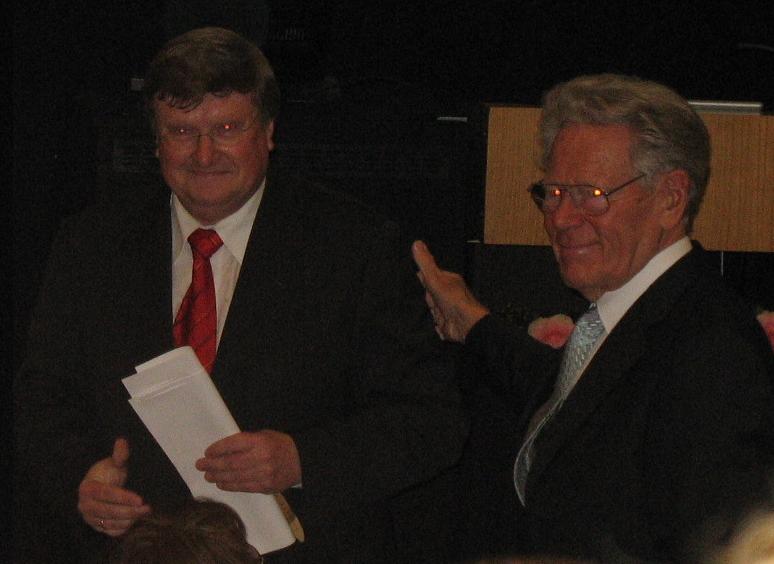
Anja and I had a great time yesterday at Küng's birthday celebrations. Particularly memorable was Karl-Josef Kuschel's speech - it was simply electrifying, his examination of Küng's theology inspiring, and his wit, er, funny.
I've uploaded an amusing bit of that speech to Youtube tonight, where he speaks about some of the amusing artistic representations of Küng and his relations with the Vatican (see below).
I also videoed Küng's entire 'thank you' speech, which I may upload to Youtube if people are interested. But I'm a little reluctant to at the moment as uploading takes flippin ages, and the file is over 200 MB!
Eschatological Events
Something scary happened today: For the first time, and I mean this literally, for the first time in over 5 years of married life, Anja wanted a cup of tea ... and I didn't.
I love good-old English tea with milk and sugar (it's the only real tea, by the way. All of the herbal teas originate from the shores of the primordial chaos)
The Rapture Index jumps up three points as a result of these shocking events. This in turn means that my Enochian loins are really rather concerned, so I'll make sure to wear my asbestos underpants for the next few weeks.
Monday, April 21, 2008
When an intermediary figure gives us way too much information
1 Enoch 60:2-3
'And the Antecedent of Time was sitting on the throne of his glory surrounded by the angels and the righteous ones. And a great trembling and fear seized me and my loins and kidneys lost control'
I really didn't want to know that, Enoch; it almost put me off my cup of tea. Nearly as bad as Philo.
Sunday, April 20, 2008
Goldingay OT Theology Day – 5 of 5
I wanted to cite an example from volume 2 in the final post of this series, but I was tempted by yet another from volume 1.
A particularly delightful feature of these volumes is Goldingay's fearlessness to tackle difficult questions as the text throws them up. So he looks at divine sovereignty, creation and the problem of evil, the morality of 'holy war', the apparent limits of divine knowledge etc. This is one of the things that makes the books so enjoyable to read.
"Like the relationship of Ishmael, and later Esau, to Yhwh's promise, this point about the promise of the land links with some questions in current Middle Eastern politics. Yhwh's original promise and the consequent history of Yhwh's activity in the land imply that Yhwh still wants Jewish people to be free to live in this land and to control their own destiny there. Yet Yhwh's attitude to the moral rights if the Amorites suggest that this consideration would not override the moral rights of the Palestinian people as subsequent long-time occupants of the land. Further, as members of Muslim and Christian communities, the Arab peoples see themselves as members of Abraham's household. As such, they have some claims of their own on Yhwh's promises to the ancestors of Israel who are also their ancestors. A moral Middle Eastern settlement needs to find a way of respecting both people rights. It will be a more satisfactory settlement if they can first recognise each other's" (Old Testament Theology. Volume 1: Israel's Gospel, 212-13)
In this short paragraph he makes a number of important points, I think.
So ends my enthusiastic and shameless promotion of Goldingay's BRILLIANT Old Testament Theology volumes. Do get them both, immediately, or feel slightly odd, left out, bullied, and picked on by the whole universe.
Hans Küng’s birthday celebrations
As some of you know, I recently published a review article in Zygon: "Engaging Science in the Mode of Trust: Hans Küng's 'The Beginning of All Things'." Zygon 43, no. 1 (March 2008): 195–210. (I didn't mention it before, but Ben Myers proof-read an earlier version of the article, which I basically cut and pasted from posts on this blog, and he made it much better. Thanks, Ben!)
I popped a copy of it into Küng's letterbox for his birthday, and a letter of response arrived a couple of days ago saying how much he liked my 'hervorragenden' and 'ausgezeichneten' article. He said I could name one of his books that I do not already own, and he will personally give me a signed copy! How kind of him is that?! What is more, I also received an invite to his 80th birthday celebrations tomorrow night, with presentations by Rektor Bernd Engler, and Karl-Josef Kuschel. Awesome! *Does a little dance*
Thursday, April 17, 2008
Steven Harris’ Apology
Some of you may now have read about Steven's transgressions and his recent public apology to me.
In response I would say, Steven, that I noticed your transgressions with some consternation, sadness and mindless violent wrath (three kittens had to be microwaved before my blind anger started to subside – their blood is on your conscience). I can only respond to your post by noting the scene in 1 Enoch where the unrighteous beg for mercy. But as you may know, they don't receive a drop of divine pity, and though I cannot remember the details at the moment, their end involves various appropriate un-pleasantries.
And as others will have read, Steven is enrolling into the Police force. Well that makes him easier to contact of course: Dial 999 and ask for Steven. But I would also add, if you catch me speeding, Steven, I will deny everything. Your word against mine.
Guest Post by Phil Groom: A new blog of interest
Ever wondered what goes on in those seedy little back street shops? You know the places, places no self-respecting Christian would be seen dead in: strange music playing, shifty-eyed staff, the type who can never bring themselves to look you in the eye; the places where church leaders stop outside, close their eyes and pray fervently for God to close the place down; furtive, under-the-counter sales of books in brown paper bags - books like Steve Chalke's Lost Message of Jesus...
Yes, you've got it: we're talking Christian Bookshops. Some of them in the UK, where I work, have attracted a lot of bad press over the last year or so with the ongoing SPCK/SSG debacle and the Brewer brothers apparently destroying the chain they were supposed to be rescuing... but that's another story. And some of them are... well, let's be kind: a bit sad. The good news is those have only ever been a very small part of the story, and this month sees the launch of the Christian Bookshops Blog to help set the record straight:
UKCBD? It's the UK Christian Bookshops Directory, http://www.christianbookshops.org.uk/ (or ukcbd.info if you prefer a shorter URL) - exactly what it says on the can, an online guide to the UK's Christian Bookshops, complete with index of Christian Cafes, Secondhand Stockists and dedicated News and Reviews sections, including a couple of reviews from none other than the Lord of Chrisendom himself: thanks Chris!
The blog takes the site to the next level, allowing you to comment on and discuss the reviews as well as what's happening in the wider world of Christian bookshops and bookselling. Alongside news, reviews and musings, there's a What's On section and a Swap Shop, where booksellers can post details of surplus stock which other Christian booksellers may be interested in, along with requests for those hard to find items you may be looking for...
So what are you waiting for? Don't just watch this space: be part of it!
Phil Groom
Bookshop manager at the London School of Theology
Wednesday, April 16, 2008
Categorical Imperative of the Day
The following deontological, teleological, situational and universal categorical imperative needs your urgent attention:
Instantly purchase John Goldingay's Old Testament Theology. Volume 1: Israel's Gospel and Old Testament Theology. Volume 2: Israel's Faith
OK, I'll shut up about these books.
Soon.
-ish.
Tuesday, April 15, 2008
Goldingay OT Theology Day – 4 of 5
One aspect of the books stands out, even though they are a lot of other things. Namely, Goldingay seems to enjoy challenging traditional Christian readings of scripture, turning over the tables in our most holy places of prayer, making our holy cows into mere hamburgers. It is a lot of fun!
Here is a gloriously controversial one for your consideration:
In discussing the way God asks questions in the first chapters of Genesis, Goldingay asks if God, according to the text, is really portrayed as knowing everything automatically, or whether things are different. Why does Genesis portray God as asking question to find things out? Doesn't God already know the answer?
'Sometimes God manifests supernatural knowledge, and no doubt God could know everything, including everything about us, whether we are willing for this or not (cf. 1 Chron 28:9; 1 Jn 3:20). But even God's supernatural knowledge of us comes about through discovery, through "searching out", rather than because God possesses this knowledge automatically (e.g., Ps 33:15; 139:1-6). Stories about Babel and about Abraham (Gen 11; 18; 22) will concretely show God taking steps to come to know things. They will again show that God has extraordinary knowledge, but will incorporate no declaration that Yhwh is omniscient, and preclude that by the way they portray God acting so as to discover things: "I will go down to see whether they have acted altogether in accordance with the cry that came to me. If not, I will know" (Gen 18:21). "Now I know that you are one who reveals God" (Gen 22:12) ... Talk of God acting to find something out is anthropomorphism, but like talk of God having a change of mind or loving or speaking, such anthropomorphisms presumably tell us something true about God's relationship with the world' (Old Testament Theology. Volume 1: Israel's Gospel. Downers Grove, Illinois: IVP, 2003, p. 137)
So what do you make of that? Utter bunk? Heresy? Gospel Truth? Scripture turning over our prized theological notions?
I know the matter is hugely complicated, and 'open theism' is banded around like a dirty ping-pong ball, blog authors scoring points by saying how much nonsense it is, others simply brushing it aside as faddism because theological heavyweights see things differently. But Goldingay's whole project is to write a narrative theology of the OT, the God-breathed text, as 'Paul' claimed in 2 Tim. 3:16. This makes for some 'messy' and unconventional theology, but it is at this level his critics will have to engage Goldingay if they are to engage him at all.
Goldingay OT Theology Day – 3 of 5
The first of the two volumes, Old Testament Theology. Volume 1: Israel's Gospel, is a narrative theology of what Goldingay calls the 'First Testament'. In a nutshell, he examines the biblical narrative of 'Israel's gospel', of God's creation of and interactions with the world and Israel. The work is divides thusly: God Began, God Started Over, God Promised, God Delivered, God Sealed, God Gave, God Accommodated, God Wrestled, God Preserved, God Sent and God Exalted. While the vast majority of the book focuses upon the 'First Testament', he ends his book by tracing the story into the New Testament story. Click here for the table of contents, here for the preface, and here for chapter 1, the introduction: 'Old Testament Theology as Narrative'. I would comment that I found the first chapter to be not half as interesting as the second, so bear that in mind if you read this sample chapter. The chapter on creation is simply stunning – all manner of fresh insights about God's sovereignty, the problem of evil etc., though some of his more subtle exegesis comes later.
The second volume, Old Testament Theology. Volume 2: Israel's Faith, is more traditional in its structure, sticking more closely to usual theological themes, namely God, Israel, The Nightmare, The Vision, Humanity, The World, and lastly, The Nations. Click here to read the introduction.
In the next two posts I will present a couple of more controversial points for discussion.
How they get here
A Google search landed on my blog today, namely:
"Swearing is worse than smoking?"
I am assuming the "?" at the end of the sentence or why search for it, and so I offer you my learned answer, one shaped through years of the best theological education and hard study:
Yes, swearing is worse than smoking by approximately 3 centimetres of sin, measured in stable environment of atmospheric pressure 100 kPa (which is not enough to make good espresso, by the way). However, if any angels visit the toilet at the time of sin, then the swearing-to-smoking sin ratio increases exponentially, such that the smoking sin weighs the same as an electron (9.1 × 10⁻³¹ kg), while the swearing weighs about the same as satan on a tricycle.
Monday, April 14, 2008
Some positive signs for Evangelicalism in the UK
If Spring Harvest is a barometer of Evangelical opinion, then Evangelicalism, in the UK, is changing – in some ways for the better, it seems. Read the whole article here. I cannot really comment further as I've never been to SH.
Goldingay OT Theology Day - 2 of 5
This is shameless book promotion. I don't care. As I explained in my last post: they are worth it.
About Old Testament Theology. Volume 1: Israel's Gospel:
Richard Bauckham writes: 'Here at last is an OT theology that follows the whole of the biblical narrative and treats it all with theological seriousness. Goldingay conveys his prolific insights so readably that this will be a rich resource for all serious readers of Scripture'.
Walter Brueggemann writes: 'In this volume, John Goldingay, as usual, presents himself as a knowledgeable, sensitive interpreter who pays close attention to the text and to the faith given through the text. The focus on narrative indicates the peculiar way in which biblical faith is mediated that is not excessively tamed by the usual categories of doctrine, piety or morality. The title of volume one, Israel's Gospel, exhibits Goldingay's acute theological passion, one that warrants close, sustained attention'.
Tremper Longman III writes: 'This book is immensely valuable. Reading it is like sitting at the feet of a mature, experienced and wise Old Testament scholar and getting a personal tour of the theological significance of the entire narrative of the Old Testament. It is written in a way that is accessible to students wanting an introduction, but there is plenty here for the further education of even senior Old Testament theologians'.
About Old Testament Theology. Volume 2: Israel's Faith:
Leo G. Perdue writes: 'Goldingay possesses the rare talent of combining scholarly acumen with literary artistry and an engaging style. By means of theological astuteness, literary clarity, well-honed biblical skills, keen insights and an attendant hermeneutical interest, Goldingay produces a splendid volume for scholar and pastor alike. These two volumes belong in every scholar's and pastor's library'
Terence E. Fretheim writes: 'Grounded solidly in the study of specific texts, John Goldingay demonstrates that the Old Testament is no second-class citizen in the biblical theological conversation ... A special dimension of the book is a deft and straightforward analysis combined with a refreshing personal touch in working with theological issues ... This second volume of Goldingay's immense theological project will open up and enhance many fruitful theological conversations in the years to come'.
Christopher Seitz: 'The fruit of a lifetime of teaching and reflection, exhaustive in scope and mature in articulation, John Goldingay has assembled a vast reflective account of what the Old Testament says about God, Israel, humanity and creaturely existence. Goldingay especially enjoys the challenges of the Old Testament for present faith and life, and he rises to them. Comprehensive and engaging'.
Mary J. Evans writes that the books are 'emerging as a hugely significant contribution to contemporary Old Testament scholarship, which will be a great help to theological teachers at both undergraduate and postgraduate levels. This volume, in structure as well as content, not only maps out for us the faith of the First Testament with great clarity and in a lively readable style, but also introduces the reader to a vast range of secondary literature. Difficult questions are embraced rather than avoided, but at the same time Goldingay manages to convey a love for the text and for the God revealed in the text--something not always achieved by biblical scholars'. YES and Amen to that.
Robert L. Hubbard Jr. writes: 'Its intellectual rigor offers grist for the academic mill, its theological depth rich food for the weekly pulpit'.
And so on.
Goldingay OT Theology Day – 1 of 5
My sincere thanks to IVP for review copies of the following two John Goldingay volumes:
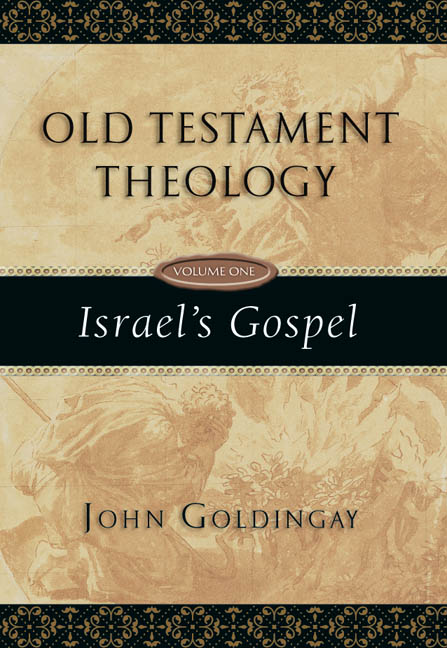
Old Testament Theology. Volume 1: Israel's Gospel. Downers Grove, Illinois: IVP, 2003
Old Testament Theology. Volume 2: Israel's Faith. Downers Grove, Illinois: IVP, 2006
At the moment, IVP are selling them at a 20% discount, for $36.00, and as I want to make clear in my posts today and tomorrow, and I mean this following sentence quite honestly: I have been enjoying these volumes more than any other books I have read in the last decade.
I am quite simply stunned, to be honest. They are, well, utterly brilliant, and I am at a loss as to how to draw attention to these books any more enthusiastically, even if I find myself in disagreement here and there (especially in the introduction) – and many will balk at his open theist tendencies (though I would encourage those who call open theists 'heretics', like apologist James White does, to deal with Goldingay's formidable exegesis!). I just can't put them down! I am literally giggling as I read it, lapping up the insight. Page after page has surprises for me. Again and again I find myself shaking my head with excitement and new realisations. In the future, if I recommend any books relating at all to the bible or theology, I will recommend these first.
Can I be any clearer? FOR HEAVEN'S SAKE GET THESE BOOKS!
I have a soft spot for Goldingay anyway. His book Models for Scripture was one of the most important I have ever read. It perhaps even gave me that extra added incentive to persue post graduate theological studies.
In the next few posts today, I will be citing passages, noting what others have said, and suggesting discussion points. I really want to draw your attention to these books! And a third and final volume is on the way! Flippin exciting!
Saturday, April 12, 2008
Speed Reading
I read a lot, and so I thought I would try to improve my reading speed and comprehension with the help of a book by Peter Kump. I started it today and took a number of reading speed tests. I came out at between 370-560 words per minute (w.p.m), though the upper limit was really as fast as I could go without the comprehension suffering. This puts me firmly in the above average category (which is about 210-20 w.p.m), but way below those who claim to read at thousands of w.p.m.
I'd be interested to hear from anyone who has experience of speed reading books or classes, and whether they helped at all. To be honest, I'm not too convinced that many deliver on their promises, especially the crazy claims for reading speeds of 2,000 w.p.m and such like, which I tend to think is more 'sell bunk' than reality. I'd also be interested to hear about reading habits that any of you have found helpful.
Quote of the Day
'Truth has always been a stranger and more versatile beast than that to which we moderns think we have domesticated it'
-Err, Chris Tilling, err, in the comments here (yes, in my intolerable hubris I am citing myself for 'quote of the day'! )
Friday, April 11, 2008
‘Creation out of nothing’ in Genesis 1?
Terrific discussion in the comments to the post below on 'Was Jesus Wrong?'. Though I haven't had the time to write my own responses yet, I'll do so tonight - especially as a couple of comments are literally begging for response!
Until then, I wanted to draw attention to an online article by Donald E. Hartley: 2 Corinthians 4:4: A Case for Yahweh as the 'God of this Age.' I read the title and thought, 'you have got to be kidding me!', so this is a note to self to give the article a read!
Here are a few useful responses to my 'Was Jesus Wrong?', though I may have missed some: Here, here and here (which has some amusing discussion in the comments).
(The following paragraph may annoy some folk, so be warned)
One final thought on 'creation out of nothing' (or 'cree-ayshun ää ov nuffin', if you are cockney; creatio ex nihilo, if you are clever): 'Given that Genesis 1 does not make explicit that God created the formless and empty earth, or the deep, the existence of both could be presupposition for what follows [in the Genesis creation account], like the existence of the primordial waters in the Babylonian story' (John Goldingay, Old Testament Theology. Volume 1: Israel's Gospel (Downers Grove, Illinois: IVP, 2003), 81). Right. The most 'explicit conviction regarding' creatio ex nihilo 'was first clearly formulated in the second century A.D.' (ibid., 78), not in Genesis 1 which simply states: 'At the beginning of God's creating the heavens and the earth, the earth was an empty void, and darkness covered the face of the deep' (Goldingay translation, ibid., 80). But did God create 'out of nothing'? Yes, I am happy to affirm so as it is the best way for moderns to grasp God's freedom and sovereignty in creation. But the metaphorical language of Genesis 1 arguably does not teach it. As Pannenberg writes: 'Tatian was the first to insist that God must have brought forth the primal matter (Or. 5.3)' (Pannenberg, W., Systematic theology 2:14).
Wednesday, April 09, 2008
Prayers remembering Dietrich Bonhoeffer
In the Anglican liturgy, today is a day to remember Dietrich Bonhoeffer, Lutheran Pastor, Theologian and Martyr (April 9th 1945).
Here is an Episcopal lectionary prayer:
Gracious God, the Beyond in the midst of our life, who gave grace to your servant Dietrich Bonhoeffer to know and teach the truth as it is in Jesus Christ, and to bear the cost of following him: Grant that we, strengthened by his teaching and example, may receive your word and embrace its call with an undivided heart; through Jesus Christ our Savior, who lives and reigns with you and the Holy Spirit, one God, for ever and ever.
I prayed:
Dear Father, thank You for Dietrich Bonhoeffer's bold witness in life and death, his determination to seek truth, and for his many writings that have deeply inspired your people for decades. Grant that we too, in life and death, may also passionately love Your truth, ready to give up all in costly discipleship of his master, and ours, Jesus Christ the Lord, who lives and reigns with You and the Spirit, one God, now and forever. Amen.
As the Evangelisches Gesangbuch cites (p. 192):
‚Herr Jesus Christus, du warst arm und elend,
gefangen und verlassen wie ich.
Du kennst alle Not der Menschen,
du bliebst bei mir, wenn kein Mensch mir beisteht,
du vergißt mich nicht und suchst mich' (Dietrich Bonhoeffer)
Was Jesus Wrong?
The discussion on my previous post about evolution has been a lot of fun. One commentator called Michael argues:
"My biggest issue with Christians who jump into bed with evolution is Jesus. How does your enlightened evolutionary stance understand a Jesus who clearly took the creation narratives (and other OT 'myths') at face value and taught them as truth, even as authority, to his followers. (Mk 10:16 Mt 19:4). Maybe he was contextualising and using the myths he didn't really believe to make a more important point??? Nope. It's all true, or none of it is true."
James McGrath chimes in, opining:
"As for Michael's comment, I'll just point out that if you believe the Bible, you have to believe that Jesus could be mistaken. If you are going to pretend that Matthew 16:28 or Mark 13:30 are not there, you can easily pretend the passages about the last Adam aren't either. Personally, I decided quite some time ago to stop trying to get the Bible to conform to my demands and let it be what it is."
A line of reasoning often used is this: 'Evolution is bad because Jesus believed the creation stories literally, therefore you evolutionists say Jesus is wrong'.
I think some operate under a christological error in these discussions, one that borders on the heresy of Doceticism. Jesus' worldview was in so many ways that of other 1st century Palestinian Jews. Had you asked him if the earth was flat, he would have almost certainly said 'yes' (cf. here on James' blog). Had you asked him if there was a literal Adam or Eve and serpent, I think he would have been puzzled by the 'literal' tag, but I suspect that if you had pressed him he would have said that he believes in a literal Adam and Eve (though I cannot prove these statements. I am making historical judgments, and I see no reason why he would not have believe these things – modern science did not develop for centuries. Though as noted, the whole metaphorical / scientific categorisation would have probably puzzled him). This is why, had you time travelled and asked 1st century Jesus to tell us about Michael or Chris or James, he would not have turned around and said 'Oh yes, Michael/Chris/James will be born in almost 2,000 years from now', and then proceeded to tell the details of your life to Peter and the disciples. He wouldn't have had a clue about you or me as he was fully human. You may know the song about Jesus hanging on the cross, and that when he was there he 'thought of me, above all'. But I really don't think he did think of me on the cross. He wouldn't have had a clue who you or I am. He was fully a first century man. This is why Jesus didn't tell the world about a cure for cancer, or instruct people on basic sanctity in relation to bacteria and such like, or detail the way to make penicillin, projects that would have saved thousands upon thousands of lives, many more than hundreds of his miracles put together.
God was in Christ reconciling the world to himself. I affirm the orthodox teaching of the incarnation, that Christ is fully God and fully man. Right now, Christ is exalted to God's right hand, and in his intra-trinitarian relationship with his Father and the Spirit, I believe he does now know me. And you. But as he grew as a man, Luke 2:52 tells us: 'Jesus increased in wisdom and in years, and in divine and human favour'. I can affirm what Luke says here, and at the same time affirm Hebrews 13:8, that Jesus is the same yesterday today and forever.
So was Jesus wrong about a flat earth, or about a literal Adam, Eve and serpent in the garden? Well, had we lived in the first century as Palestinian Jews, we would have all believed the same. So it is not really fair to judge Jesus on these matters in light of later pictures taken of the (spherical) earth from the moon, and so on. If one day someone proves that the world is not spherical but multi-layed across multi-dimensions, would I be wrong now to believe the world is spherical? Well, according to present day knowledge I would not be wrong, but at one level of factuality I would be wrong. But it would be unfair to judge me according to the later knowledge too strictly. So I would have to say, at one level of discourse, at the strictly factual, Jesus would have been wrong about a flat earth and about the serpent in the garden (though as I said, I cannot prove he believed these things literally, but I think he would have said he did – why shouldn't he – if we were to have pressed him with our modern categories that would have been largely alien to him). But Jesus was sinless, and whether he - as he very probably did - believed the earth was flat (cf. Matt. 4:8-9) does not change this. As my friend Josh McManaway pointed out, Origen and some of the other Fathers would say Jesus is 'ignorant' on certain matters, but they really mean that he was nescient (not knowing things you need not know.), which is to be distinguished from 'ignorance' as often understood (not knowing things you need to). He noted in IM chat: 'In talking about things like Matt. 24:36, certain Fathers (Basil, Irenaeus, Origen, and Gregory of Nyssa) said that Jesus was ignorant (they meant nescient) about the day. This position is to be contrasted with the Scholastics who generally follow Chrysostom in saying that Jesus actually did know, but chose not to disclose it with his followers'.
So to go to the gospels and to say 'Jesus didn't believe in evolution, he assumed the creation stories', is a questionable manner to reject the theory of evolution for a number of reasons.
Monday, April 07, 2008
From Creationist to Evolutionist - my story
You may not have heard these statements before, but 'only an evolutionist can be saved'; 'only an evolutionist can speak in tongues', 'evolutionists are God's special agents', 'evolutionists are generally holier and better people than creationists', 'Calvin predestined me to be an evolutionist' etc.
You know they are all true.
As we've been discussing evolution again in the comments on an earlier post, here is my own little story of how I moved from poor, unhappy and lonely creationist to revived happy, popular, wealthy, victorious and blessed evolutionist.
I actually became a Christian listening to a tape by Ken Ham (who, in retrospect, looks suspiciously like the missing link to me), and consequently 'creationism' was a very important topic for me, for years. Evolutionists were for me either atheistic naturalists or, if claiming faith, compromised to the core. However, a number of factors came together that have since caused a change in my view.
First, my doctrine of scripture changed such that I did not need to affirm a literal reading of Genesis 1 and 2 to still believe it was text inspired by God, a step precipitated by reading Goldingay's Models for Scripture. I believe that my doctrine of scripture became, in this phase, more scriptural, and I appreciated the differences in genre in scripture. A text could say something true without me having to read it literally (cf. Jesus' parables). At this point I could accept Christians who promoted an evolutionary view, though I had too long swallowed the teachings of 6-day creationism to suddenly become convinced by Darwin and his followers.
Second, while creationists were still perpetuating quasi-intellectual claims about dinosaurs living with humans and such like, I started to find myself convinced by the science of evolution, by how the theory could explain such diverse material from biogeography, palaeontology, embryology, morphology and genetics (for the last I refer to Sean B. Carroll's brilliant book, The Making of the Fittest: DNA and the Ultimate Forensic Record of Evolution).
Third, it became clear to me how the ancient world of creation myths had shaped the biblical material. Biblical cosmology operated, as did the other myths, with a flat earth, and the differences between the biblical accounts of creation and flood were of the same milieu as other Akkadian literature, such as the Enuma Elish, and the Atrahasis and Gilgamesh flood stories. I then started to see what the biblical text was trying to do in its context; I could hear the text again, unclouded by concerns with proving its supposed scientific worth, something I found very exciting. It was making subtle and creative theological points about God, humanity and the world that implicitly critiqued these other myths, and their idolatry (e.g. God just speaks and creates, other gods had to e.g. kill each other to form the landmass with a god's dead body). As Enns writes, 'To put it this way is not to concede ground to liberalism or unbelief, but to understand the simple fact that the stories in Genesis had a context within which they were first understood. And that context was not a modern scientific one but an ancient mythic one' (Inspiration and Incarnation, 55). I remembered that no one was there when God created, and the text does not present itself as 'prophecy'. Rather, it adopted and critiqued the myths of its ancient worldview. Had God inspired a text that told ancient Israel what happened at a scientific level, they would not have understood anyway. God was speaking in and through an ancient worldview.
As I wrote on this blog before: Yes, I believe evolutionary theory is correct. Yes, I believe in God the creator of heaven and earth. Yes, I believe Darwin, despite errors, was basically correct. Yes, I believe that Genesis 1 and 2 is the inspired Word of God. Yes, I believe humans evolved from lower life forms. Yes, I believe we are made in the image of God.
Sunday, April 06, 2008
Guest Book Review: God’s Rivals
God's Rivals by Gerald R. McDermott (Illinois, IVP: 2007)
A review by Kathrin Wanner, Student of Theology, Eberhard-Karls-Universität Tübingen, Germany.
"Why are there other religions at all?" This is the basic question of McDermott's book God's Rivals, and it is present on every page. After a careful and exact analysis of different historical items connected to this question, the answer can be summarized in one sentence: "Because god is a big god, he can use pagan thinking to influence biblical authors in such a way that the final results in the biblical text is still exactly what he wants." His concern is to ask the biblical authors themselves about their view, using many original texts and quoting the bible regularly.
The first part of the book refers to the question of "particularity" or, in other words, "Why has the true god come to only some people at some times?" The author shows how people have dealt with this question in the past and how it is answered today.
His next concern is to show how the Old and New Testament deal with other religions. He argues that not only people in Israel and the church knew a lot about God. A whole chapter researches what kind of heavenly beings the Old Testament knows and how they are easily referenced to as "other gods." In a further step, the author introduces different people who give evidence of how the world thought and lived during the development of the New Testament.
McDermott starts with Paul and shows that he believed in the existence of spiritual powers. He moves on to Justin Martyr and therefore to a philosopher's view on the Christian religion. With Irenaeus the author explains "how god uses the religions" and that revelation happens in different stages, having its "final culmination in Christ"; his conclusion that "God used many different teaching methods over thousands of years to communicate the truth" seemed to me a highlight of the chapter.
The words of Clement of Alexandria show that people and differences in religion are caused by the fact that God "called all equally" but at the same time "his gifts were distributed unequally". He divides people in different groups depending on their strength of belief with different relationships to the Lord and different ways of being taught by him, concluding that a "Mixture of truth and error is there by divine design." Still there is only one "cause of all": God. Finally, the author introduces the reader to Origen who reminds people that other religions are dangerous and at the same time useful to support the way of life of people who do not believe yet. Finally, the author summarizes the basic points of each chapter once more and draws a conclusion to the question: "Why did God permit other Religions?" based on the research made before.
One of the first things to be discovered is the strong belief of the author, something that can be sensed on every page; he happens to be an orthodox Christian and the large number of examples from the bible used leads to the impression that the "holy book" kept him company all the time while writing God's Rivals.
Every chapter starts with a short summarizing view on the chapter's topic or main protagonist; afterward, step by step, he describes the most important things to know, starting with an interesting example or invented dialogue that easily catches the reader's attention and offers him exciting access to the topic. Summarising headlines emphasise the most important ideas. He then introduces the chapter's main person, by drawing a picture of the historical setting, the person's life and his spiritual background. After this preparation he shows the person's view on the main question of the book: "Why are there other religions?" integrated in the knowledge of his time. Finally, he summarizes the chapter's basic content and offers a preview on the next chapter.
The author keeps including possible questions a reader might have. He makes an effort to explain happenings in the past with examples from today to illustrate issues for the reader with well known pictures.
God's Rivals is easy to read and understand, even for non-native speakers (like myself), without rows of technical terms, but still offers a solid basis of basic knowledge.
I learnt a lot about the different historical characters who have dealt with this question and feel that my knowledge about this topic has really grown a lot.