Monday, August 17, 2009

Ten reasons why you shouldn’t trust me


Now for a moment of self-indulgence


  1. I tend to think Christian Universalism has way more going for it than most think. Not a Universalist myself, but boy am I tempted.


  2. This one is terrible and I suppose I should repent. I have been known to swear in the sort of company that considers 'rude words' the worst of all sins. Actually, some swear words still make me chuckle like a 13 year old boy, hence my best friend, Simon, often has me in fits of laughter (he has one seriously contemptible gutter mouth)


  3. I am way more sacramental in my theology than I was a few years ago. I think celebration of Eucharist is at the centre of a Christian's relationship with God, and those who think otherwise are, I suspect, heading towards heresy.


  4. I tend to think many theologians have more confidence in answers than biblical scholars who are daily confronted with a deeply subversive text full of tensions and difficulties that often resists any systematising answers, never mind just simple ones.


  5. What is more, I find myself perplexed by so many different theological, historical and exegetical perspectives, I tend to think of my theology as a series of question marks left in the trail of God's presence in my life.


  6. My theological approach is accordingly comparable to the Socratic Method without, hopefully, falling into the sort of postmodern nihilism of Caputo (for example, I think it crucial to be able to confidently label false religion as false)


  7. However, I suspect there is a level of Christian maturity ahead of me that will significantly qualify my present celebration of unanswered questions – if for no other reason than the necessity of helping others find faith in God (if God 'accommodates', shouldn't we too?) That said, little would change my mind that plenty of 'Christian apologetics' is, at an epistemological level, an over-realised eschatology.


  8. I have (albeit very) occasionally smoked pipes, cigars, sheesha and cigarillos – and I have no intention of repenting. But I hate beer (Beelzebub's urine), and people who drink it are compromised to the core.


  9. I think Bultmann was an incredible exegete, perhaps the greatest NT scholar ever. His scope of vision was as majestic as it was mislead.


  10. Fundamentalists, wishy-washy liberals and 'secular' Christian-bashers (whether in the biblical studies, scientific or theological guilds) - all have the ability, more than any others, to utterly perplex and exacerbate me.

Eduard Schweizer on Universalism

There are passages in the New Testament describing the group of the blessed and that of the cursed ones (as in Matthew 25:34-41), and there are other passages declaring that "all men have been consigned to disobedience that he (God) may have mercy upon all" (as in Romans 11:32). We certainly need the warning of Matthew 25 that there is a dimension of eternity in which all our living on earth has to be seen. We also need, equally urgently, to be reminded of God's grace (as in Romans 11), from which nobody and nothing can separate us, which is stronger even than our disobedience. This twofold message is the word of God, as it has to live among us. But if we tried to build up a doctrine of an indispensable belief in hell or of universal salvation, we would put ourselves above God, since we would pretend to know exactly how he would have to act on the last day. How he will really act in the last judgment is beyond the threshold of human knowledge, and nobody is allowed to pass this threshold before it is revealed in the parousia of Christ.

From "Colossians 1:15-20", Review and Expositor, 87 (1990)

Sunday, August 16, 2009

A good read

Two friends have insisted that I read anything by James K. A. Smith, so I took up the challenge and purchased Introducing Radical Orthodoxy: Mapping a Post-Secular Theology, Milton Keynes: Paternoster, 2004, and Who's Afraid of Postmodernism?: Taking Derrida, Lyotard, and Foucault to Church, Grand Rapids: Baker, 2007, is in the post.

I'm only 90 pages into the first but I highly recommend it: deeply learned, clearly written and best of all I am having many 'aha!' moments.

Michael Bird's little book, Are You the One Who Is to Come?: The Historical Jesus and the Messianic Question, Grand Rapids: Baker, 2009, happily dropped through the letterbox the other day, which I really look forward to reading in more depth. I quickly purchased another roughly related book from a completely different perspective to add a bit of zest to the summer. Namely, Thomas L. Thompson's The Messiah Myth: The Near Eastern Roots of Jesus and David, London: Pimlico, 2007 which comes with back cover blurb stating 'the Jesus of the gospels never existed'. I might take this last one on holiday with me, actually.

I suppose I should look for the links to the other books, but I can't be bothered. Bung 'em in Google yourselves!

Wednesday, August 12, 2009

Bauckham comments on creation ex nihilo

I recently posted some thoughts about creation ex nihilo in light of 2 Peter 3:5, and offered three ways of dealing with what we are to make of the (later) doctrine of ex nihilo in light of such biblical themes.

In short I suggested: 1) reject ex nihilo, 2) claim ex nihilo came ex nihilo, but is still correct and 3) argue ex nihilo, while a later development, is consistent with seeds of truth already to be found in the NT and Apocrypha.

Richard Bauckham e-mailed me a fourth possibility that I had not even considered, one I find very appealing:

"Another possibility is that 'chaos' was a sort of mythological way of imagining 'nothing.' To imagine a pre-creation chaos and to say that God created all things was perfectly consistent, because no 'thing' existed until God formed it out of chaos"

What do you think?

David Bentley Hart on reading books

A friend recently drew my attention to Hart's new article on First Things, which made for amusing reading. Here he discusses his reading neurosis:

"Admittedly, this last judgment is based upon only a partial sampling of the work. I am, by nature, a neurotic "completist"; I feel I must finish any book I begin, no matter how great a torment it turns out to be. But I have to confess that, in two attempts to get through The Spiral Ascent, my will has proved unequal to the task. On both occasions, there came a point (and roughly the same point) at which the poor laboring beast of my attention span lay down in the dust and mulishly refused to move forward another inch, no matter how savagely I cursed and flogged it. Thereafter, I merely skimmed through the final pages, simply to confirm for myself that life—even a life as protracted as, say, Edward Upward's—is not long enough to make room for such an ordeal. Others, however, have found the books more inviting than I, and perhaps my failure to follow Upward's tale to the end bespeaks something shallow and dilettantish in my nature"

Sunday, August 02, 2009

Theological nutters

I've recently been busying studying the psychological areas of Transactional Analysis (TA) and Cognitive Behavioural Therapy (CBT) mainly because I'm a bit mad and thought I could do with a decent psychological thrashing to sort out the 'frothing mouth' aspects of my psyche. Fascinating stuff, actually, and in my humble opinion more so even than the psychoanalysis schools of Freud, Lacan and others who have managed to get some modern continental philosophers so excited.

But in my own general inclinations to lunacy, I am apparently in good company. For on the way, I read the plausible hypothesis that Luther, Teresa of Avila, John Bunyan, Ignatius of Loyola and others suffered from Obsessive Compulsive Disorder, and that this influenced many of their theological decisions. Of course, obvious to all, it occurs to me that many other theologians and biblical scholars were just plain simple bonkers, having fallen right out of the crazy tree onto the rabid-brain farm: Zwingli, for example. He had 'please lobotomise me' written all over him.

In TA there are three basic ego states: Parent, Adult and Child, and I can't help but reflect a little on such verses as these.

  • 'When I was a child, I spoke like a child, I thought like a child, I reasoned like a child; when I became an adult, I put an end to childish ways' (1 Corinthians 13:11)
  • 'For though you might have ten thousand guardians in Christ, you do not have many fathers. Indeed, in Christ Jesus I became your father through the gospel' (1 Corinthians 4:15)

Is this Paul evidencing Adult and Parent ego states? I don't think we will ever know.

Wednesday, July 29, 2009

Created out of water

I'm rather enjoying my break this summer, but I did want to share one thought on a NT understanding of creation.

A while ago I noted that (I think) most OT scholars think Genesis 1 – together with the other known myths in Akkadian literature – reflects a belief that creation was not there understood as creation ex nihilo, but rather as the command of order on chaos. This view reflects a more popular reading of Genesis 1:1 as 'In the beginning when God created' or 'in the beginning of God's creation, the earth being ...'. 'The narrative', as OT scholar John Goldingay argues, 'indeed presupposes the existence of matter, of raw material for God to use' (Old Testament Theology. Volume 1: Israel's Gospel [Downers Grove, Illinois: IVP, 2003], 80).

Rather interestingly, though many jump to passages in Paul to defend creation ex nihilo in the NT (which I suspect only suggest the seeds for a later ex nihilo doctrine), such as Romans 4:17, have you ever meditated on 2 Peter 3:5?

'They deliberately ignore this fact, that by the word of God heavens existed long ago and an earth was formed out of water and by means of water'

Richard Bauckham comments in his Word commentary:

'According to the creation account in Gen 1, and in accordance with general Near Eastern myth, the world—sky and earth—merged out of a primeval ocean (Gen 1:2, 6–7, 9; cf. Ps 33:7; 136:6; Prov 8:27–29; Sir 39:17; Herm. Vis. 1:3:4). The world exists because the waters of chaos, which are now above the firmament, beneath the earth and surrounding the earth, are held back and can no longer engulf the world. The phrase ἐξ ὕδατος ("out of water") expresses this mythological concept of the world's emergence out of the watery chaos, rather than the more "scientific" notion, taught by Thales of Miletus, that water is the basic element out of which everything else is made (cf. Clem. Hom. 11:24:1)' (Bauckham, R. J., Jude, 2 Peter, p.297).

I find it particularly interesting that the context of 2 Peter 3 links this to God's faithfulness to his promises, which once again links God's faithfulness to his covenant to the whole of creation. But in terms of creation, what are we to make of the (later) doctrine of ex nihilo in light of such biblical themes. One can either:

  1. Reject ex nihilo as a doctrine in light of scripture, which would, for example, perhaps help deal with the knotty problem of theodicy. 'God did not created chaos', it could be argued, his creation power was its limiting.
  2. Argue that ex nihilo is an entirely new doctrinal development, yet can be embraced as a correct doctrine on the basis of the Spirit's guidance of the church
  3. Maintain that ex nihilo, while a later development, is consistent with seeds of truth already to be found in the NT and Apocrypha. This the doctrine reflects a legitimate and further nuanced development of the understanding of creation (ex nihilo only being clearly formulated, so maintain I think the majority, in the 2nd century AD). Perhaps the church's developing formulations of Trinitarian faith is an inadequate potential comparison.

Saturday, July 11, 2009

Darwin and God

I'll deliver a lecture at our (rather large!) church week away at the end of the month, celebrating Darwin's 200th birthday. During my research I've used some useful introductory books on Darwin, such as Jonathan Howard's contribution to the Very Short Introduction Series, and Jonathan Miller's Introducing Darwin.

Both were helpful, but when they turned to matters of religion they tended to be disastrously naive and inaccurate. For example, Howard writes that it has become 'hard, perhaps impossible for the orthodox Christian to come to terms with Darwin' (106)! Let's give him a bit of slack; he is a Geneticist after all, not a theologian, but this is nevertheless an absurd claim! Some key Christians, both in the UK and in USA, were the first to promote Darwin's theories in the 19th century, while some 'secular' scientists opposed it! As for the whole creationism debate, Darwinism poses a problem only for a very culturally specific and dubious reading of Genesis. Where it does get trickier is in the magnification of the theodicy problem, which did not appear on Howard's radar. Darwinism is actually exciting, for traditional Christian dogma, in the way it helps the Church rethink some of its anthropological and philosophical assumptions, and regain a closer approximation to the more relational biblical intuitions.

Nick Spencer's little book, Darwin and God thus comes as a real breath of fresh air, and deals with the nature and development of Darwin's religious beliefs. Thanks to my kind American friend, David Vinson, for the copy! My colleagues recently interviewed Nick for our college podcast here, which makes for interesting listening.

Thursday, July 02, 2009

Quick notice

David Bentley Hart's Atheist Delusions: The Christian Revolution and Its Fashionable Enemies.

One word:

WOW

One of the most important books I have ever read. Utterly brilliant. Prophetic. Extremely lucid. Violently convincing.

And it is one of the most devastating critiques of anything, anywhere, never mind just the particular squabble it addresses. Daniel Dennett, for example, is absolutely shredded. My jaw was left on the flaw. But it is so much more than a simple critique of the silly New Atheist High Priests.

Please get this book. Seriously.

I stand rebuked

Innocently as you can imagine, white as the driven snow, pure as ... well, you get the idea.

But that's me, folks. Plain, old, simple holy.

Not all, however, seem to appreciate my generally elevated levels of sanctification, even though it shines in such wise forms as this post: A Biblical Guide to Dating.

Nevertheless, an 'Anonymous' (surprise, surprise) felt the need to chastise my winsome words in the comments:

"This is not funny. And the message of Yahweh Elohim and his Son, Yahshua the Messiah should not be taken lightly. Have your fun now, but I tell you the truth: it won't last long. You will regret ever putting your foolish advice on the web. Let me ask you this: If you have a daughter and she believes in the Word, would you want some perverted man to be misusing her belief for his own twisted sexual interests? Is that how you would want your daughter to be treated? Is that how you would want your mother or sister to be treated? Grow up, men. The world needs men who can lead nations and conquer kingdoms, not treacherous and deceptive men. We need honorable, valiant men in this world. We need leaders. Are you going to waste your life setting foolish traps for women? Is that what you call purpose? Arise, men of God. Arise to your position in the true Kingdom of Yahweh. Arise to honor. Arise to Truth. Arise to purpose. It is time"

OK, I cleaned up some of his grammar, but you get the idea: I've apparently pooped the holy pants, soiled the sanctity nappy.

So .... *takes a deep breath* ... I guess I had better say an apology:

"I am very sorry, Anonymous ... that you have no sense of humour".

I'll be the guy giving you a smarting wedgie in the in the New Jerusalem.

The New Church of England Logo


Wednesday, June 24, 2009

Wright’s badges

I do like Wright's approach to Paul. I especially like how he manages to plausibly explain the (narrative) structure which gives Paul's arguments fresh coherence. In this respect I think his commentary on Romans is an example of Wright at his lucid, most insightful best. That said, I find myself intuitively suspicious of the 'faith as a badge' proposal. And I get the feeling that if I pull that thread loose, quite a bit besides will potentially unravel. In a nutshell, it strikes me as an insufficiently relational understanding of faith (I have wondered if Wright's claim perhaps, in part, depends on an implicit pre-Heideggerian metaphysics of representation – but this is an underdeveloped thought).

Any of you ever had suspicious thoughts about the 'faith as a badge' business? Or do you think it makes sense, especially in light of the Dunn-Wright take on 'works of law'?

Friday, June 19, 2009

Facebook’s What’s on Your Mind?

Had a closer look at Facebook today. I uploaded a few pictures ages ago, but there is so much more to Facebook than that (not breaking news for many of you, I am sure). I actually keyed into 'What's on Your Mind?' today. For those of you who are technical numpties, you simply type in a sentence which follows your name – and your friends can read it and comment. Bit like Twittering, perhaps? A couple of the comments below makes a repeat run worthwhile!

* Chris Tilling is enjoying a new publication on Heilsuniversalismus/Apokatastasis/Universalism, namely Jens Adam's Paulus und die Versöhung aller, and he is flippin loving it - even if some if the German (especially relating to Christine Janovski) is a bit tricky and hence disheartening

* Chris Tilling thinks the USA should be invaded and recaptured for her Majesty, the Queen

Alastair Howard at 19:36 on 19 June

I think we should make more of Independence Day over here, but for different reasons to the yanks...

* Chris Tilling has changed his mind about the aforementioned invasion

* Chris Tilling is wondering whether squirrels squeak if lobbed over a fence with a 9-iron

Rick Brannan at 18:30 on 19 June

I think it would have more to do with the 9 iron than the fence. Presumably if the 9 iron whacked 'em into the fence instead of over it, they'd squeak (9 iron) and then splat (fence)

Alastair Roberts at 20:17 on 19 June

There is only one way to find out. Let us know what you discover.

* Chris Tilling is wondering what it would happen if he was mistaken for a huge leg at Battersea Dog's Home.

(I'm not sure this last one makes any sense beyond my own twisted mind)

Spock-like logic

I've recently been reading up on the history and nature of logic, with attention on Aristotle, Frege, Russell etc . So, my inner genius just came up with the following syllogism:

  1. The effect of violence on a person can be good for that person's soul
  2. Things that are good for one's soul are always good
  3. Therefore, violence is always good.

I thank you.

Friday, June 12, 2009

An introduction to a short ‘commentary’ on Romans

Here is a first draft – and it is already about 200 words too long! Your thoughts are, as always, appreciated.

In 1545, Martin Luther, the famous initiator of the Protestant Reformation, sat with pen in hand and mused upon his 'conversion' experience. Though 'a monk without reproach', he described his state as 'a sinner before God with an extremely disturbed conscience'. But upon reading a text in Romans 1 he started to understand the righteousness of God not as a threat but as 'the passive righteousness with which merciful God justifies us by faith'. Thus it was through a text in Romans that he felt he had 'entered paradise itself through open gates'. John Calvin likewise said that 'if we have gained a true understanding of this Epistle, we have an open door to all the most profound treasures of Scripture'.

Open 'doors' and 'gates' ... yet many find that Romans rather slams these doors shut, a matter all the more tangible these days given the contemporary debate in Pauline studies concerning the language of 'justification', 'law', 'righteousness' and 'the faith of Christ'. To help open doors for contemporary travellers into these Himalayas of Pauline theology, it will prove most useful to keep in mind two issues: i) the situation Paul addressed and ii) the place of Christ's life, death and resurrection in the story of Israel. This is important as Paul may well have been attempting to answer a different (even if overlapping) set of problems to those generated by Luther's 'extremely disturbed conscience'.

The situation: for reasons which are not necessary to examine here, Romans was likely written into a context of tension between Jewish and Gentile Christians. Indeed, it is likely that some Gentile Christians felt superior to Jewish believers, people who had probably only recently returned to the Roman Church after a temporary exile from Rome because of an Edict by Emperor Claudius.

The story: the bumpy narrative of the Old Testament (OT) Scriptures is as follows: it runs from creation, fall, God's redemptive solution for fallen creation in the covenant with Abraham, through Egypt, the exodus, conquest of the land, the judges and the monarchy, the inheritance of the curse of the law and the Assyrian and Babylonian exiles, and finally a partial, yet incomplete, restoration. So ends the OT. Yet the OT Prophets had spoken of a time when God's redemptive plans, through Abraham's family, would be fulfilled, a time when God would make a new covenant, pour out his Spirit, raise up a messianic leader, reunite the 12 scattered tribes, establish his people in the land, glorify his own name etc (see, for example, Isaiah 40:1-5, 10-11; 43:5-11; 49:5-13; 52:1-10; 56:3-8; 61:1-4; Jeremiah 16:14-16; 29:14; 31:8-11; 32:37-42; Ezekiel 11:17-20; 28:25-26; 34:1-3, 5, 10-24; 36:19-28; 37:12-28; 39:25-29; Zechariah 8). The centuries leading up to the New Testament period did not see the fulfilment of the prophetic promises; Israel rather experienced the (often brutal) rule of one foreign empire after another. So many asked when would God act to fulfil his promises. When would God be faithful to his covenant with Abraham, and what was God to do if his own covenant people continued in the sin which led them into exile in the first place?

This story awaiting an ending was summed up, in some OT texts (see Psalm 33:4; Isaiah 40-55; Jeremiah 32:41; Lamentations 3:23 etc.), with the phrase 'God's righteousness', which thus brings us to the heart of Romans. God's righteousness was the hope of Israel as it awaited the fulfilment of God's promises. Yet, as we shall see, God's righteousness judgment, in the sense of impartial justice (e.g. 2 Chronicles 19:7; Proverbs 24:23; Acts 10:34; Galatians 2:6), was also the reason they went into exile in the first place (cf. Isaiah 50:1; Jeremiah 15:13-14; Daniel 9:15-16). This tension in God's righteousness generated difficult questions, exactly the sort Paul sought to address in Romans – albeit with a special Christian twist: the righteousness of God is revealed in the life, death and resurrection of Jesus.

Let us then begin the journey into the letter itself and, as Karl Barth once described his experience of reading Romans, proceed with 'a joyful sense of discovery'.

Wednesday, June 10, 2009

I don’t usually get involved with this sort of thing, but ...

Prominent Young Earth Creationist, Ken Ham, writes on June 9th on his well-known webpage:

"In this newsletter and in my lectures over the years, I have insisted that Christians who compromise by accepting the idea of an earth supposedly millions of years old (or who are indifferent to whether or not that is even a problem) have greatly contributed to the decline of the church and its influence"

Creationists like this usually mean well and I actually became a Christian listening to a Ken Ham tape! Yes, I've now become an unapologetic Christian evolutionist, but that is another story. But this kind of argument does need a short, sharp 'no'. It is the brand of creationism represented here that is a danger to Christian witness, because it moves the historic Christian faith into the realm of completely implausible quasi-'scientific' subculture, in to a place mocked by a completely (and justifiably) unimpressed scientific community. And Ham's reading of Genesis is not 'the truth', with others 'compromising'. He not only fails to understand Genesis at a literal level (especially Genesis 1:1), he does not know how to read this biblical text i.e. not as scientific statement but as theological imagination meant to evoke worship. Genre is very important, folks.

No, I think true prophetic insight will suggest that, among other things, it is the church's lack of unity and our lack of love for our neighbours that has led to its decline in influence. Ham's proposal is to live in a strange dream world, and if ever Christians need to smell the coffee and live in the real world, now is the time.

Oh, yea, and despite what he says: dinosaurs didn't live at the same time as humans. Besides, once we make that kind of thing central to the Gospel, we have lost the plot.

Finally Wright gets to meet Tilling


He must have been honoured to stand next to me.

On being persecuted

First, Ben points out my recent drive-by-baptism fiasco where I was unfortunately caught by a camera. Second, Jim West continues to post lies on my good name, all under the rubric 'Where in the world in Chris Tilling now?'. And third, Scott Bailey, who really should know better, has posted a slur about me in a swimsuit – really a though worthy of a nosebleed if ever there was one.

I, of course, officially deny everything. That I am writing this from prison, with a very angry (and wet) freshly baptised 'believer' being restrained by four policemen from beating me, and that my swimsuit is starting to feel uncomfortable, is besides the point.

'Rejoice and be glad, for your reward is great in heaven, for in the same way they persecuted the prophets who were before you' (Matthew 5:12). Amen. Scott, Ben, Jim, your persecutory actions only prove I am righteous.

Monday, June 08, 2009

The Hermeneutics of Doctrine

My sincere thanks to Eerdmans for a review copy of Anthony C. Thiselton, The Hermeneutics of Doctrine (Cambridge: Eerdmans, 2007). What a delight it was to receive that in the post, I can tell you!

I consider Anthony C. Thiselton an academic role model. His commentary on 1 Corinthians is the best of its kind, his work on hermeneutics is jaw droppingly well researched, and he now shows how well read he is on theological questions. Essentially, Thiselton asks whether 'a more significant interaction between hermeneutics and doctrine [may] play some part in rescuing doctrine from its marginalised function and abstraction from life, and deliver it from its supposed status as mere theory' (xvi).

His new book, The Hermeneutics of Doctrine, provides all manner of important and original insights seeking to answer this question. The first section explores reasons to pursue the hermeneutics of doctrine, while part two answers possible objections to the project. Part three (the main part of the book) then examines a variety of major doctrinal themes, including anthropology, sin, the atonement, Christology, the Trinity and much more besides.

The book is simply superb, a real delight to read. And you know, when reading Thiselton, you will learn plenty for the time spent studying! So many points could be noted as demonstration of this, but for reasons of time I will limit myself to one: It seems to me that his hermeneutical critique of Bultmann in chapter 17 blows apart the justly famous German's claim that Easter is 'nothing other than the rise of faith in the risen one'. Yet he manages this critique at the same time as positively drawing from Bultmann's legitimate insight that to claim 'Jesus is Lord', for example, is a self-involving assertion involving existential language. The whole argument is penetrating, balanced, lucid and learned.

Here is Craig G. Bartholomew's essay, "Three Horizons: Hermeneutics from the Other End―An Evaluation of Anthony Thiselton's Hermeneutic Proposals," European Journal of Theology 5.2 (1996): 121-135. And here is Scot McKnight's glowing review. That's three witnesses, so: Buy it, study it, re-read it and enjoy it!

Tom Wright’s visit tomorrow

It is International Week at Holy Trinity Brompton, with over 1500 delegates from literally all over the world – plus almost (or is it now over) 100 bishops (or equivalent) from a huge number of denominations, including Orthodox, Roman Catholic, Pentecostal, Anglican, Salvation Army, Evangelical Free and many many more besides. It was moving to stand and worship together with so many Christians from such a wide variety of traditions today.

As part of International Week Tom Wright will speak tomorrow night at HTB. The title of his talk: 'Jesus and Tomorrow's World'.

Rather looking forward to that!

Thursday, June 04, 2009

A dubbed Jesus movie scene


Does that sound like your Jesus?!

Snuggie Parody

Thanks to our friend Stephie for pointing this one out:


Well, I thought it was funny! I especially liked the reaction to the "free flashlight"!

Friday, May 29, 2009

Quote of the day, or a public display of ignorance

At the end of an essay by Alain Badiou, 'The Transcendental' (in Badiou: Theoretical Writings), he writes that:

'[T]he equation ("The conjunction of the maximum and a degree is equal to this degree") is phenomenologically unimpeachable. But if this is indeed the case, the fact that the reverse of the supreme measurement of the maximum transcendental degree – is also the inapparent is itself a matter of course' (225-6)

Which leads to the punch line of the whole essay:

'It is thereby guaranteed that, in any transcendental whatsoever, the reverse of the maximum is the minimum' (226).

At which point, forehead wrinkled in depressed frustration, I put the book down and think 'what the hell does all of that verbal vomit mean?'. The 'reverse of the maximum is the minimum'? And that took a whole essay to figure?

The reverse of forwards is backwards, folks!

OK chumpy, here is good equation: 'the opposite of *&%llocks is something that makes sense, at least certainly after it has been slowly read more than four times' – surely also as 'phenomenologically unimpeachable' as it gets.

Please help me out, here! Anybody know of any 'obviously-utter-idiot-New-Testament-twit-and-out-of-his-domain' introductory books on Badiou?

Congratulations to Richard Bauckham

Phil Groom informed me this morning that Richard Bauckham has won the 2009 Michael Ramsey prize, for his brilliant book Jesus and the Eyewitnesses.

Our warmest congrats to Richard, who, besides getting this honour, also pockets a prize of £15,000!

It was tough competition too: David Brown, God & Grace of Body: Sacrament in Ordinary; Richard Burridge, Imitating Jesus; Sebastian Moore, The Contagion of Jesus; and Anthony Thiselton, The Hermeneutics of Doctrine.

Tuesday, May 26, 2009

Žižek book free online

Free is always an nice word when put next to 'book'.

Here you can have a read of How to Read Lacan (London: Granta Books, 2006). And anyone who has tried to get their head around Žižek will know how important Lacan is to his work. I'm hoping this will help me think through this talk of the 'grand Autre', 'objet petit a' and so on. Otherwise, reading Žižek it is possible to feel like you have stumbled into a conversation that started long before you arrived – and for a New Testament specialist that can be a real problem!

Two keys to unlock Romans

I’m presently writing a short commentary on Romans – the whole thing is just over 10,000 words! In my introduction, which cannot exceed more than 600 words, I have decided to highlight two key features which, in my view, are necessary to grasp what Romans is about. The first is not too controversial and involves the tension between Jew and Gentile in light of the return of Jews to Rome after the Edict of Claudius which temporarily expelled them. A lot in Romans, especially chapters 14 and 15, fits this situation perfectly and frames much of Paul’s concerns in the rest of the letter. The second is more controversial but equally important. To understand Romans one needs to understand the story of Israel in terms of the life, death and resurrection (here Kirk's thesis, is most helpful) of Jesus Christ – and vice verse. For example, the flow of thought in Romans 3 – from the question about God’s faithfulness and the problem of the unfaithfulness of the people of God, to the declaration in 3:21 that ‘now, apart from law, the righteousness of God has been disclosed, and is attested by the law and the prophets’ – can only be understood in terms of that story and Christ’s role in it.

Anyway, I thought I would share those two thoughts, especially given the need to educate all of you seething masses of dilettantes...

Friday, May 22, 2009

Improve your German with Heidegger and Wittgenstein

I've been enjoying a bit of Heidegger recently, and wanted to draw attention to this Youtube video of the man himself - in it he speaks slowly and deliberately, plus there are captions if you need help. Useful to dust off your German - alternatively, marry a German wife....


The second resource is the Blackwell 50th Anniversary edition of Wittgenstein’s Philosophical Investigations, containing the German text on one page, and a revised English translation on the facing.

When I started to learn German, a slightly mislead colleague suggested, with utter seriousness, that I watch 'Allo 'allo, and try to sound like the acted Germans! So, for ‘correct’ pronunciation carefully study the following:

Sunday, May 17, 2009

Link

Our friend Ed Babinski sent this cartoon link along, which made me smile.

Beautiful and sexy

I recently started an absolutely fascinating book, namely David Brown's God & Grace of Body (Oxford: OUP, 2007). The title of this post is that of his first chapter, in which he begins the project of examining 'the ways in which bodies might open human beings up to the possibility of experiencing God or the divine through them' (11).

Having roomed with Jim West at the San Diego SBL, my first critical thought was, of course, "he has obviously never seen what I have seen!" – but then I turned to his fourth chapter, 'Wasted and Ugly', and waited for references to jwest.wordpress.com.

But seriously, this is a very engaging and arguably important book, offering ways to expand our horizons on how we experience God. By the way, his chapter on dancing even discusses belly dancing! Interesting also was the link made, in an analysis of the dance of Martha Graham, between Jonathan Edwards' 'dogmatic denouncements' and the employment of an 'absolutely rigid upper body' in her movements.

It made me think: what sort of dance would best express my theology and faith?!

To get personal: What sort of dance would best express your own worldview, faith or theological tendencies?

As Rowan Williams wrote: this book opens doors 'into all sorts of fresh insight'.

Thursday, May 14, 2009

Remonstration of the day

Arguably it makes little sense to qualify a postulated Pauline covenantal nomism on the basis of certain variety in the second Temple literature (cf. so-called variegated nomism) if it can be shown that:

  1. the evidence paints a typical – even if not uniform – covenantal nomist picture of second Temple Judaism
  2. the texts Paul typically drew upon can be better categorised as covenantal nomist.
  3. a covenantal backdrop to Paul is important*

On a) Has not Sanders already made the point? b) their shape and major themes (e.g. deliverance from Egypt before Sinai) would suggest so and c) is, I think, virtually certain. And the old sleight of hand, playing 'creation' against 'covenant' (in Paul or in second Temple texts), is a bizarre mistake.

However, Paul could of course develop new worlds; he was not bound to a second Temple Jewish covenantal nomism. So some may want to extract Paul from his context in an effort to save confessional face. But would this tactic be as readily employed for other areas of Paul's theology? For example, surely all conservatives would want to (correctly) emphasise Jewish modes of thinking when it comes to elucidating his Christology over against the mistakes of the Religionsgeschichtliche Schule...

* This point needs to be developed, of course, but hey ho - this is only a blog post.

Tuesday, May 12, 2009

Rowan Williams lecture

Recently, St Paul's Theological Centre had the privilege of hosting Archbishop Rowan Williams on the Saturday School of Theology. He spoke on John's Gospel and the talk can be downloaded here. Enjoy!

Jim had a dream from which he reluctantly awoke

And sadly realised that the man in the leotard was not Zwingli, nor real.

Thought of the day

I was reading the other day how C.S. Peirce called himself a 'contrite fallibilist' because he recognised the provisional nature of all human scientific knowledge. And it occurred to me: what a great way to describe other NT scholars and theologians.

Sunday, May 10, 2009

Provocative quotations of the Day

The first is from Slavoj Žižek, The Parallax View, London: MIT Press, 2006, p. 256, italics his:

'[T]oday's Zionism itself, as embodied in the State of Israel's predominant politics, is already "anti-Semitic", that is to say, it relies on anti-Semitic ideological mapping. Remember the typical newspaper caricature of Yassir Arafat: the rounded face with its big nose and thick lips, on a small rounded clumsy body ... looks familiar? No wonder: it is the old cliché drawing of the corrupt Jew from the 1930s! Another confirmation of the fact that Zionism is a species of anti-Semitism'.

I wonder if he perhaps oversimplifies matters, but this jarring (at least for me) statement certainly deserves pondering.

The second cheery number comes from a bland A2 poster on the window of a (very) conservative Christian bookshop not far from where I live:

'Be sure your sin will find you out!'

And that's all that is said! No, 'and believe in Jesus' or something that could be called Christian. Just an A2 sized wagging finger. They also had, for good measure, a 'Repent ye' poster – note the important and anointed King James English 'ye'. We will leave the fact that this statement, from Numbers 32:23, was made in the context of an explicit communal covenant with God, one that, Ephesians Paul would say, Gentiles 'without God and without hope in the world' do not share.

Maybe it is me, but I feel such a statement suggests a final word, one that seems to capture the tone of its proposal: 'Be sure your sin will find you out, bitches!' I wonder what they think they are achieving with such messages? Perhaps (a few) people really do respond well to that kind of talk? More likely, perhaps more people did once upon a time hear themselves addressed by such language, but it is reused in today's world more as a matter of pious religious duty. Yet sadly it probably relies more on 19th century 'ideological mapping' and older clichés, which simply make the A2 message predominantly a species of rudeness. The actual message of the poster is more than the sum of its words. Likewise, the Arafat pictures are more than just caricature; they potentially echo something far more sinister.

Alain Badiou on Youtube

A BBC HARDtalk interview in three parts (1, 2, 3)

Some of you may know that Badiou (how is that correctly pronounced, by the way?) has written a book relating to the Apostle Paul (Saint Paul: The Foundation of Universalism). Not far into that one yet, but it is odd to read my man Paul in the hands of this famous French atheist 'screaming leftie' philosopher. When I last read around the world of 'modern continental philosophy', Derrida, Luce Irigaray and such like were all the rage. Having only recently picked up works by Badiou (and Slavoj Žižek), I realise I have a lot to learn!

Actually, as I’ve mentioned the compulsively nose-wiping Žižek (one Youtube comment runs: “Check out his sexy deep-v. He can wipe his nose all over me”!), do check out this series of 2007 videos entitled “Slavoj Zizek. Materialism and Theology”. Clearly a brilliant mind flavoured with humour and deep insight, I look forward to engaging with his work in more depth. For those less interested in grappling with his dialectical materialism, do at least listen to enjoy the way he pronounces “mysticism” – something like mish-ti-shish-em! Well, Anja and I thought it was funny.

Wednesday, May 06, 2009

Greek: A Language in Evolution - An International Symposium in Honor of Antonios N. Jannaris

From the 14-17 June, 2009 at St Andrews University, Scotland. It is organized by the key expert himself, Chrys Caragounis.

Do click here for more information, including the symposium program. With fifteen international scholars coming to St Andrew, all experts in the various periods of the Greek Language, this is not one to miss.

Three tips for studying the New Testament (for beginners)

Not necessarily the most important nor in order of importance:
  1. Purchase a couple of NT Introduction books and make sure that they represent two different perspectives. For example, you could try the Carson & Moo volume, An Introduction to the New testament (conservative evangelical - inerrancy, Peter wrote 2 Peter-or-our-faith-is-in-vain sort). But if you get that one also purchase David deSilva's volume of the same title (moderate evangelical - wouldn't want to cause offence sort) or even try Raymond E. Brown's equally imaginatively titled book, An Introduction to the New testament (foaming mouthed Catholic with a liberal bent sort).
  2. This will sound trite but is more important than anything else that could be said here: read the New Testament! An old German NT scholar, Adolf Schlatter, used to say that people tend to miss what is right in front of their eyes (the NT!). It is best to start there before darting to commentaries, word studies, pseudepigraphal parallels etc. Prayerfully read the NT of course, but don't just get hung up in holy meditation on your favourite verse. Also read thinkfully! I believe God loves it when we seek to love him with all our minds.
  3. Start to learn the habit of enjoying NT related books that are more informed about matters of exegesis, historical background, hermeneutical subtelty etc. Have a look at catalogues of such publishinghouses as, e.g., T & T Clark, Eerdmans, Hendrickson, IVP Academic, Paternoster, SPCK, Baylor, WJK, etc.

So many more points could be added. But what other tips would you offer (for beginners)?

Tuesday, April 28, 2009

A thought

I've listened to a few lectures recently which critique aspects of the New Perspective. And in each case the speaker was careful (either consciously or unconsciously I am not sure) to generate a strong hermeneutic of suspicion with regards the arguments proffered by NP proponents. This was done by starting with either ad hominem, misrepresentation or the employment of (unfair) scare tactics.

The thought: I wondered if these speakers felt they had to do this, i.e. start with spin, because they are deep down unsure that the evidence speaks for their own case?

So, when you hear a speaker try to manage the way data will be heard by enforcing not a hermeneutic of love or generosity, but one of suspicion, perhaps they do this precisely because they realise their opponent's argument makes sense.

Friday, April 24, 2009

Seifrid comments on Wright’s new book

Have a listen to the recent Boyce College conversation on Wright's new book, Justification: God's Plan & Paul's Vision. I think it was a great idea to provided response in such a forum setting like this. From what I have managed thus far, a couple of decent points have been made, especially by Schreiner. Though, in my judgment, plenty of bad arguments hit the fan too. Mark Seifrid got started with this beauty:

"I suspect (I could be wrong) that the poor man [i.e. Wright] doesn't know what he's talking about. . . He's very good on the historical Jesus, but here he is absolutely horrid"

Riiiiight...

Okey dokey then.

Absolutely horrid, no less.

Somebody touched a nerve there, me thinks...

Anyone for another serving of patronising to go with that order of curious ad hominem?

Nah, me neither.

By the way, two thoughts on this picture of the panel:

(cf. http://www.boycecollege.com/diablogue/index.php/2009/04/16/assessing-the-piper-wright-debate-on-justification/)

First, Schreiner (second from right). I've read some of his stuff and have appreciated not only his learning, but also his gracious and polite 'tone', if you know what I mean. But his head ... how does he pack all that learning into such a small head?

Second, Mark Seifrid (second from left). It occurred to me that Seifrid, at least in this picture, looks a bit like a James Davila with blond hair dye.

For those who live in the south of England

(click to enlarge)
I personally know two of the guys on the speaker line up (Mike Lloyd and Graham Tomlin) , so I can really recommend this.

Monday, April 20, 2009

The fear of God

No, not the sort that is the beginning of wisdom. No, I mean God's own fear, the fear he feels.

But God doesn't fear anything...

From at least Deuteronomy 32:19 onwards it is clear that the one speaking is YHWH ('The LORD saw it, and was jealous').

  • 'He said' (v20);
  • 'They made me jealous' (v21)
  • 'For a fire is kindled by my anger' (v22)
  • 'I will heap disasters upon them' (v23)
  • 'The teeth of beasts I will send against them' (v24)
  • 'I thought to scatter them' (v26)

Which brings the reader to Deuteronomy 32:27, where Yahweh says:

'but I feared provocation by the enemy, for their adversaries might misunderstand and say, "Our hand is triumphant; it was not the LORD who did all this"'

God doesn't merely not desire or not like this provocation. This verse tells us that he fears (NRSV) or even dreads it (NIV).

I couldn't find a comment on this verse anywhere in my OT Theologies, but the internet turned up a reference to Nahama Leibowitz who said of Deuteronomy 32:27, that it contains a "very daring anthropomorphism indeed, attributing to God the sentiment of fear." (Studies in Devarim: Deuteronomy, 328). Daring? No kidding!

Of course, the reader knows that God, not Moses, says this, so the picture is hardly of scared old god, with a beard, quaking in a corner. It is language meant to convey how strongly God feels about the defaming of his name, here provocation by the enemy. But Deuteronomy does this by telling us that God fears provocation.

Saturday, April 18, 2009

A memorable thesis typo

I'm glad Anja picked this one up!

It was argued that the singleness (ἁπλότητος) and the language of one husband indicated the necessary 'unswerving commitment' of the Christian to Christ, or, as Harris put it, of the 'singleness of mind and purpose that finds expression for Christians in an exclusive preoccupation with pleasing Chris' !!

Sadly, having checked Harris' book, the mistake was mine. That would have made an amusing 'sic'!

Thursday, April 16, 2009

Schreiner, Seifrid and co respond to Wright’s new book on justification

There is an mp3 to listen to, and Mike Bird has the link. I'm honestly looking forward to listening to this. I found Wright's book quite brilliantly convincing, which I think is a big warning sign I need to hear some criticism – and Seifrid and Schreiner surely won't let me down!

I recently tried listening to a three-part critical review of the New Perspective (again, audio) by Don Carson which, while good enough in places, was ultimately so irritating I didn't make it to the end – at least not yet. Of course Carson has a brilliant mind, but he knew exactly how to play his evangelical crowd, forcing a strong hermeneutic of suspicion on his audience against all the major representatives of the New Perspective (note how he speaks of Wright's 'presupposition when he comes to the text' that Jesus didn't consciously think he was himself God... I imagine these evangelicals i. missing the nuance in Wright's argument on this point because it hasn't been explained to them, and ii. dropping their pens in shock so that they can't possibly agree with this 'heretic' Wright - exactly the idea, me thinks!). Carson's rhetoric also involved some misrepresentation (playing off justice against the covenant ... why oh why?) and enough patronising waffle to leave me feeling a bit sick.

That said, even when it is difficult to agree with him, he is sometimes a key voice and worthy of a careful hearing. His amazing energy, hard work and obvious natural intelligence makes for a formidable combination. I recommend his NT introduction (written with Moo) to my students, together with Brown's and deSilva's.

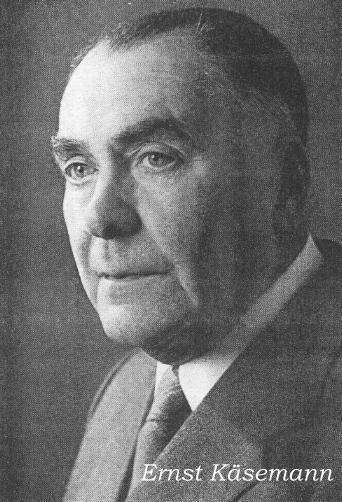
Käsemann on harmonisation

Ever feel the urge to harmonise apparently contradictory biblical 'voices'? Tempted to level out various New Testament teachings that seem in tension?

Käsemann, ever the polemicist, writes:

'Every simplification which forces the original variety of voices [of the biblical text] into a well trodden path, is sin against the Spirit'!

(from his essay "Justification and salvation-history in Romans" in Pauline Perspectives – my translation from the German original, p. 118)

Honestly, this guy entertains even if he seems a bit nuts sometimes.

Wednesday, April 15, 2009

Quote of the day

'The purpose of revelation is to give life'

- a comment on John 4:13f in Rudolf Bultmann, The Gospel of John (slightly altered)

Tuesday, April 14, 2009

The www: world wide wackiness

Who wouldn't want a bagful of dirt posted to them?

Even better, how does a sack of Holy Land mud sound to you, to aid your devotions?

As they say on their webpage, "We are sorry we can't transfer the breathtaking scent of Holy Land soil via the Internet, but we can promise: There is no scent like it!"

Indeedy, especially if a wandering Bedouin just relieved himself on the patch that lands on your doorstep a week later.

Actually, while I am at it I am glad to announce that CTRVHM are now selling bags of Holy Land air ($24 per bag, plus post and package). Please leave the bag sealed, and if it is accidentally opened and suspiciously smells like a few of us lads got together, swilled bear, ate baked beans, laughed and quickly farted into an airtight container, we deny everything. It's all 100% Holy Land air, straight from the offices of CTRVHM.

From the strange to the downright disturbing (depending, of course, on whether you actually open our bag of air – in which case it will already be quite distressing enough): the wack-job self-flagellating crazy man in Dan Brown's novel, The Da Vinci Code need not remain solely on the page of fiction. Now you can buy the products necessary to whip yourself good and proper and scratch the flesh from your own back, all for the sake of personal holiness or penance of course - with your very own cilice. For a tasteful selection of chains, belts, hair vests and whips, click here.

What is more, their "handmade cat-o-seven discipline (seven tails to remind us of the seven deadly sins)" is now selling at an affordable price. In fact, the simple "cord Discipline" (made by Italian Nuns) is selling at a $24 reduction, so you may have enough to even buy one for a friend / spouse.

People, if this stuff can be sold, so can anything. So I'll give it a shot: anybody fancy buying our deluxe collection of used teabags? $50 post and package, and the experience of holding a selection of our old teabags can be yours.

Thursday, April 02, 2009

Negotiating tensions in the Bible

The following is taken from a handout I penned for some students recently. I'd be interested to hear any thoughts.

'Yet another tension', she thought, keeping conscious distance from the more uncomfortable word 'contradiction'. 'How on earth am I to make sense of the bible, and to believe it is God inspired with all of these difficulties?' If that or a similar thought has flashed through your mind during this course, the following is offered to help you, as a Christian, think that thought through with confidence.

One popular strategy for dealing with biblical tensions is to slot them away in the 'mystery' box, hoping they won't come out to haunt you at night. While there is some half-grown wisdom here, you'll end up cramming quite a lot of the bible into that box before long...

Another strategy is to claim that the bible is a secure stash of stable proposition. 'Jesus is Lord', for example. Safe and secure; truth to stand on. This approach is often coupled with the assertion that all tensions in the bible are ultimately reconcilable; that none really exists when you study them properly. Certainly this is often true and many supposed 'contradictions' do indeed vanish on closer inspection. But while this is a wise move sometimes, it does not always work and it is noteworthy the bible itself seems unconcerned to apologise for very real tensions and, yes, contradictions. Indeed, perhaps too much time (and paper) has already been wasted trying to prove the occasional circle has four edges. But must one then always live with tensions in the bible, contradictions without any hope of reconciliation? How does a bible full of tensions help? Will it do any good to tell young converts that the bible is, for want of a better word, confused?

So another approach is to pretend the bible is unconcerned with revealing truth in propositions, that it merely witnesses to God's saving actions or true religious experience and is not itself a channel of God's revelation. Scripture is just human, nothing special about it except that to which it points. But why bother reading and preaching from the bible if that is the case? Does it really encourage us to handle it with care, as text itself fully inspired by God?

Here are some things to bear in mind, which have helped me when thinking through this complex of sticky issues:

If the history of philosophy, science and theology have taught us anything it is this: truth is a multifaceted complex beast, not easily domesticated, tamed or boxed. I once heard a profound argument in a Richard Hays lecture. He was quoting Rowan Williams who was himself quoting novelist Anita Mason: 'There is a kind of truth which, when it is said, becomes untrue'. Even our language, yes even the language of the bible, is sometimes not able to say the full truth, for to say it would be to domesticate it, and because we are in the business of speaking about God, to domesticate such truth is thus to refute it.

That said, biblical propositions are important – arguably so is 'propositional revelation', though it remains a disputed concept – and the bible is full of them. However, while we may agree on certain propositions being true, what matters is what they mean. And that is when things get more complicated! For example, what 'Jesus is Lord' means will depend on who is saying it, when, why and so on. But this complexity need not scare us: it is part of the process of wrestling with truth. If we come away with our faith limping, we may have just seen the face of God (cf. Jacob's wrestling at Peniel in Genesis 32)

The world is 'fallen', our lives, minds and relationships are fractured, broken. And of course, real life is full of contradictions and paradoxes. Here is the point: if the Bible is not merely a collection of abstract philosophical propositions but a collection of books written from the context of and about real life in all its grit and joys, grim and rapture, why, then, should there be no tensions and, yes, contradictions? Where does the bible ever claim to be without tensions, especially as it is not a collection of philosophical propositions, but largely a bumpy narrative? Perhaps it will help us if we judge the bible according to what it is, not what it is not.

Truth is eschatological. Biblical statements often stake a claim in a reality that is yet to come, one that is in the hidden future and coming of God. The Apostle Paul famously wrote: 'For we know only in part, and we prophesy only in part; but when the complete comes, the partial will come to an end' (1 Cor. 13:9-10). He continued: 'For now we see in a mirror, dimly, but then we will see face to face. Now I know only in part; then I will know fully, even as I have been fully known' (13:12). Notice who wrote these words, including himself in this 'we know only in part': the Apostle Paul, the author of much of the New Testament! The text of the New Testament, while inspired by God, partakes in the partial nature of human knowing as we await the full and future disclosure of truth. Perhaps if we could grasp this more profoundly we would be unleashed to develop our doctrinal thinking with more boldness, freshness and truthfulness, in a way that is more accustomed to walking on the water, less disturbed by the waves and wind of a world still yearning for its eschatological reality to materialise. And recognising this, maybe we would also judge our own theological statements (whether Calvinistic, Arminian, Reformed, Open Theistic or whatever) with more humility, as always penultimate truth, prior to God's glorious advent. For more on truth as eschatological, cf. Jürgen Moltmann, Theology of Hope: On the Ground and the Implications of a Christian Eschatology, trans. James W. Leitch (New York: Harper and Row, 1967).

Truth is relational. In 1 Corinthians 13:6 Paul writes that love 'does not rejoice in unrighteousness, but rejoices in the truth'. Notice that truth is contrasted not with falsehood, but with unrighteousness. To live truthfully is to live justly, to walk with God. As is well know, Jesus claimed to be himself 'the truth'. Truth is ultimately this person, and the word 'person', it should be noted, is relational. In Christ's life, relationships, acts of mercy, kindness, death and resurrection we find Truth. To claim that 'the Bible is true' is a proposition that may thus need to be reframed more relationally. For more on truth as relational, cf. J.D. Zizioulas, Being as Communion: Studies in Personhood and the Church (Crestwood, NY: St. Vladimir's Seminary Press, 1985)

'All scripture is inspired by God' (2 Tim. 3:16), and we can confess this statement with utter conviction. But one potentially problematic sleight-of-hand needs to be guarded against. Those who claim, on the basis of this passage, that the Bible must therefore lack all contradictions are using a deductively logical wringer on the text. That is, it has been argued that i) God inspired the text, ii) God cannot lie and iii) therefore scripture cannot contradict itself. This sounds fair enough, but if we are going to take the phenomenon of scripture itself more seriously in our formulations of the doctrine of scripture, we must work more inductively, working from the nature of the scriptures themselves. When that is done, the deductively logical step itself needs to be questioned in light of scripture. We can affirm both i) and ii), without heading to the choppy waters of iii). For more on not applying a deductive wringer in our formulations of the inspiration of the bible, cf. J.E. Goldingay, Models for Scripture (Carlisle: Paternoster, 1994).

That said, it is useful to bear in mind the words of Karl Barth who once wrote 'Is not every doctrine of Holy Scripture as such a superfluous saying of "Lord, Lord"?'(Church Dogmatics I/2, 461)! To answer Barth's question, a 'high view' of scripture ought perhaps to say more than what we think about the historicity of certain biblical events and our feelings about supposed or real biblical contradictions. As some of our comments above about the nature of truth suggest, it ought also to embrace our personal and communal scripture reading practices, attitudes and 'stance' towards the biblical text, unencumbered by deductive logical wringers. To this end I penned a different sort of statement on the trustworthiness of Scripture, one that emphasises our reading practices and posture toward the text. I have written an article justifying the theology behind this 'statement', providing crucial qualifications, which I will perhaps publish at some stage.

Peter Enns has written a useful book called Inspiration and Incarnation, seeking to help Christians think through the inspiration of scripture in terms of the incarnation. Just as Christ is 'true God from true God' so we can confess the full (or plenary) inspiration of scripture. However, Christ was also fully human, a fact that early church heretics were prone to deny (the heresy of docetism). Jesus got hungry, wept, felt strong emotions, he was 'crucified under Pontius Pilate; he suffered death and was buried'. Likewise, the scripture is fully the product of humans, who inhabited the worldviews, language and concerns of their days. As the early church attempted to conceptualise: in Christ, the human and divine natures were united in one person, 'without confusion or division' (cf. the statements made at The Council of Chalcedon, 451). It was only the various heretics who tried to amalgamate the human and divine natures into a confused hybrid. Christ truly grew in wisdom, learning obedience through what he suffered (cf. Luke 2:52; Mark 13:32; Heb. 5:8). Perhaps we sometimes do the same with the bible, treating it as a confused God-human hybrid. Thinking of scripture as fully human yet fully inspired by God has, an albeit imperfect, correspondence to an entirely orthodox definition of the relation of the divine and human natures in early christological formulations. For more on this model, cf. Peter Enns, Inspiration and Incarnation: Evangelicals and the Problem of the Old Testament (Grand Rapids: Baker Academic, 2005).

That said, the incarnation of God in Christ is utterly unique - scripture is not another incarnation - and so even as an imperfect correspondence it perhaps confuses more than it illumines. So another way to think through this matter is offered by Nicholas Wolterstorff in his book Divine Discourse: Philosophical Reflections on the Claim that God Speaks (Cambridge: CUP, 1995). His arguments runs like this: We can understand the concept that a particular piece for writing or language can be the work of one person yet convey the authority of another. The example Wolterstorff uses is that of a secretary writing a letter for her boss. Imagine a secretary who knows the mind of her boss very well and who writes a letter on his behalf, she then passes it to him and he signs the letter and it goes off in his name and with his authority. The letter has been written entirely by the secretary; it is her work and in one sense has come solely from her own mind and pen. However, because i) she knows the mind of her boss and ii) it carries his signature, it actually becomes his letter and not just hers. In the same way we can understand scripture on one level as being entirely the human writing of the scripture's author, yet at the same ut carries the authority of God and in a sense is also God's writing. This is an image which convey the relationship between the human authorship and divine authority of scripture quite well, without some of the theological complications involved in the incarnation image above.

With these points in mind we can turn to tensions in the bible.

  • If we struggle with tensions in the bible, we may need to examine our expectations in light of the eschatological nature of truth. We may need to reframe our concerns according to the relational nature of truth. Put this way, we can perhaps avoid the scissors approach to the bible, one which early church heretic Marcion attempted, as he sought to exorcise all Jewish elements from the bible (talk about a doomed project!)
  • If truth is a complex beast, one not easily pinned down, we may need to move beyond a simple treatment and comparison of 'biblical propositions' to an appreciation of the living complexity of truth.
  • Perhaps our struggles with biblical tensions can help us to reformulate our thinking about the nature of the bible, one that takes more seriously our commitment to the practice of bible reading.
  • The longing for the bible to make sense, for tensions to be explained away, is entirely legitimate, perhaps reflecting something of our longing for the coming of the Lord when we will 'know fully'. Yet we must guard against an over-realised eschatology, one which thinks the things that will happen at Christ's return have already happened. Acceptance of an over-realised eschatology will tend to end in discouragement, and Paul had therefore to combat it occasionally (2 Thessalonians).
  • Thinking of the inspiration of scripture in light of the secretaries letter may help us to embrace a fully human and occasionally contradicting text while at the same time fully embracing the text as written under the authority of God.

A prayer

With all such questions that cause us problems and disquiet our faith, the best place to go is to God in prayer, to unload our concerns, pray for wisdom, protection and deepening of our faith. Our struggles can be an opportunity to deepen our relationship with God. Here is a prayer you may like to pray with me:

"Father, there is so much that we do not understand, so much that confuses us
in the Bible. We surely only know in part. So we pray for wisdom, for a closer
walk with you, for deeper maturity in our faith, that we would be passionate
lovers of truth. Protect, strengthen and develop our faith, that it may bear
fruit in our lives, that we truly play our part in the evangelisation of the
nations and the transformation of society, remembering always that it is you who
carries us; you are our foundation, not we ourselves, not our understanding of
biblical tensions nor the strength of our often failing faith. We give you glory
for hearing our prayer for the sake of your Son, our Lord Jesus Christ. Amen"

Further useful resources:

  • David Law, Inspiration (London: Continuum, 2001)
  • Craig D. Allert, A High View of Scripture?: The Authority of the Bible and the Formation of the New Testament Canon (Grand Rapids: Baker Academic, 2007)
  • Kenton L. Sparks, God's Word in Human Words: An Evangelical Appropriation of Critical Biblical Scholarship (Grand Rapids: Baker Academic, 2008)
  • Kevin J. Vanhoozer, "A Person of the Book? Barth on Biblical Authority," in Karl Barth and Evangelical Theology (Grand Rapids: Baker Academic, 2006), pp. 26-59
  • N.T. Wright, "How Can The Bible Be Authoritative?" Originally published in Vox Evangelica, 1991, 21, 7–32, free online at http://www.ntwrightpage.com/Wright_Bible_Authoritative.htm

Wednesday, April 01, 2009

Is Robin Parry a real man?

After this post, the jury is presently out.

Right, I'm off to drink a Babycham.
‘Busy’ doesn’t get close

It has been a manic last few weeks, actually. Still, I am beginning to see a light at the end of the tunnel; my work is not too far from completion. If any of you would like to proof read a few chapters of my thesis then do drop me a line.

Ed Sanders on Youtube

Wednesday, March 25, 2009

Where’s the Wally?

You've no doubt seen "Where's Wally?" or, for some of you, "Where's Waldo?".

Well ....

Where's Zwingli?


The first to spot Zwingers wins a free bag of 'Holy Land Air' (cannot be guaranteed nut free)

Link of the day

The title of this blog post does not strike me as particularly good news.

Woe is me

Wednesday, March 18, 2009

A thought about pneumatology in Luke-Acts

Preparing a lecture on Luke-Acts recently it struck me how many of the pneumatological debates between charismatics, Pentecostals and non-charismatics can be dealt with by recognising that pneumatology, in Luke-Acts, is a subset of restoration eschatology. Of course, my own supervisor, Max Turner, is the main man on this subject (cf. his classic Power from on High: The Spirit in Israel's Restoration and Witness in Luke-Acts) so this realisation should have hit me sooner! The cure for the endless logic chopping in terms of one's own experience and the allowing of inappropriate driving questions (e.g. was I filled [or baptised] with the Spirit after or at the same time as I was 'saved'?) is to wrestle with the eschatological-geographical-restoration shape of Luke-Acts.

By the way, regarding the artwork for this post, that I used a Maronite icon instead of a picture of Benny Hinn or a crass Jehovah Witness style picture of a dove, will hopefully make people think I am a bit more cultured than I actually am. Which is a good thing. *Reaches for a second Sugar-Puff Sandwich*

Your collective wisdom

I wonder if any of you kind folk could help me with a reading list for the question "How should the apocalyptic language in the Olivet Discourse be understood?"

Tuesday, March 17, 2009

St Patrick’s Day

All the more significant as this evening was spent with a direct blood descendent of Arthur Guinness, the originator of the now famously named drink.

But just so you know, Guinness is filthy black vile slop straight from the blocked u-bend of Satan's own kitchen sink. I just don't understand why people willingly swallow the stuff. This raises a whole set of doubts in me about humans made in the image of God, epistemological realism etc. Pass an empty pint around a pub and ask people to spit in it, add black ink and crumble dandruff on the top = Guinness.

Right, I feel better now that I got that off my chest.

Happy St Patrick's Day!

Saturday, March 14, 2009

A thought about the NIV

I'm not one to bash the NIV, especially not in the 'KJV 1611 only' sort of way, nor do I think of it is the Nearly Inspired Version as if the KJV was somehow purer. That is just silly. In fact, I most enjoy reading biblical prose in the NIV.

But reading through Paul in the NIV recently it struck me that the translators often side with an anthropocentric-individualistic reading. So at key points it has 'a righteousness from God' instead of God's own righteousness, 'faith in Christ' instead of the faithfulness of Christ, 'if anyone is in Christ, he is a new creation' (2 Cor. 5:17) instead of 'if anyone is in Christ, there is a new creation', 'put to death … whatever belongs to your earthly nature' (Col. 3:5) instead of 'earthly members' (where did the NIV get the word 'nature' from? – Paul thinks of the death of the whole person, not just a bit of the Christian) etc. This is not to say the NIV is wrong about these exegetical judgments (though I think they are), but it is the consistency that gives pause for thought.

So I ask, did the translators of the Pauline sections of the NIV function with a restricted anthropocentric-individualistic hermeneutic, one that Paul would perhaps say has insufficiently grasped the wide creation-to-new-creation scope of the gospel?


Well I think they're funny!

Just finished

... preparing a ton of lectures.

As much as I enjoy lectures and learning in preparation I've been so busy I haven't made time for almost anything else the last couple of weeks. So it's time to put my feet up and drink a glass of sherry (sorry, read 'grape juice' if you're a Southern Baptist - but Ephesians 5:18 only says not to 'get drunk with wine' and doesn't say anything about not getting drunk with sherry!)

I have learnt something about books introducing Paul of late. There are too many good ones out making it difficult to recommend only one to students. There is Tom Wright's What Saint Paul Really Said; Paul: Fresh Perspectives, Michael Gorman's Reading Paul, Mike Bird's A Bird's-Eye View of Paul and a recently discovered gem by David Horrell, An Introduction to the Study of Paul which was enormously useful ... and others could be mentioned. Which to recommend to students? A difficult choice. Perhaps start with Gorman, move into Bird then Wright, then Horrell, before dipping into Dunn (The Theology of the Apostle Paul)? But that is way too much introduction level material so I need to choose one. It is going to be tricky.

Monday, March 09, 2009

Thanks to Richard Bauckham

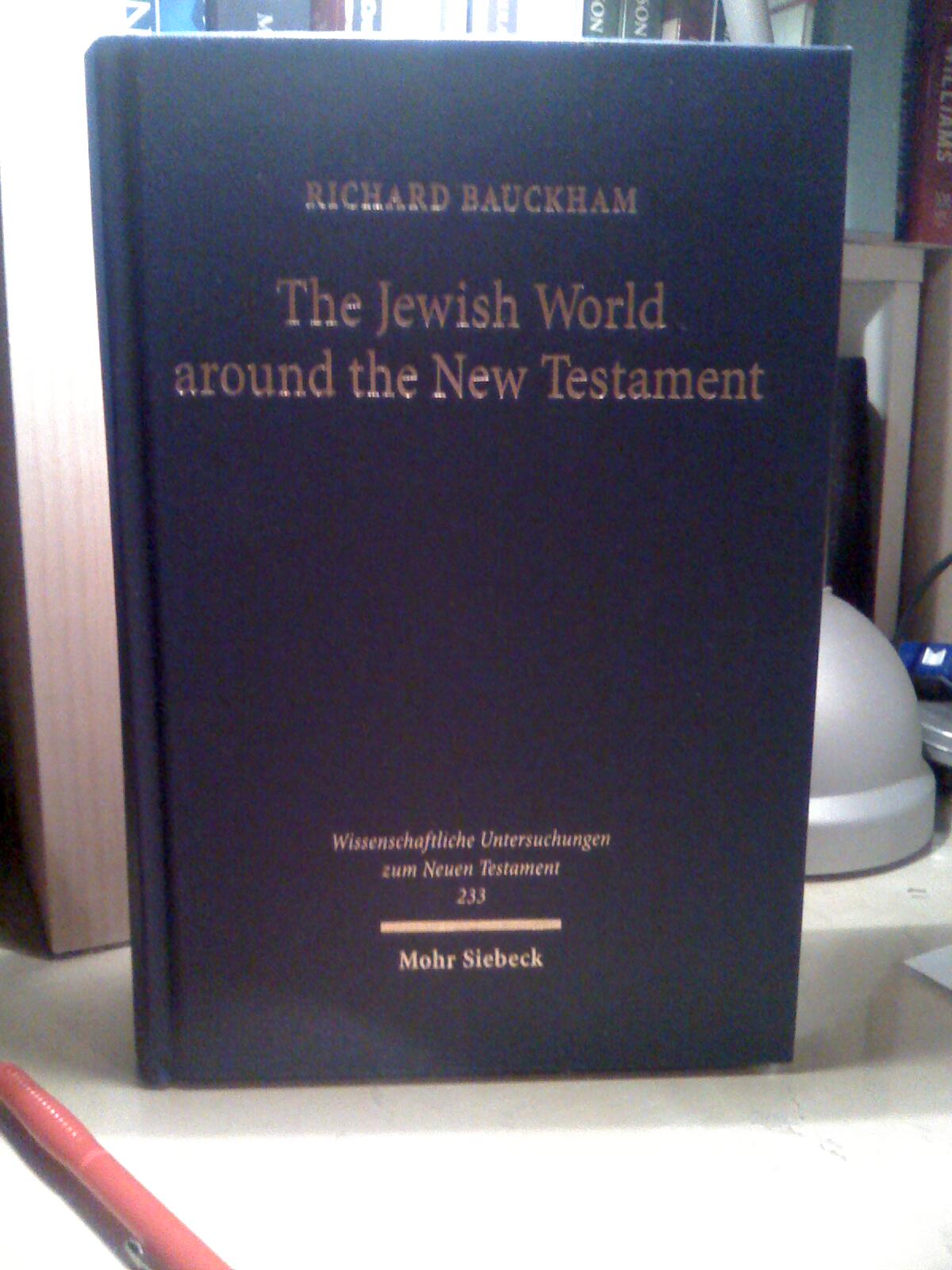
A huge thanks to Richard Bauckham for kindly sending me a signed copy of his new Mohr Siebeck collection of essays, The Jewish World around the New Testament – a book I mentioned previously here.

It is almost all I've been reading for the last few days ... it makes for hundreds of pages of immensely stimulating reading, and not a few 'aha' moments.

Sometimes the depth of Richard's scholarship is quite intimidating for those of us who spend hours every day in research but still know we are light years behind in knowledge. But I noticed that the oldest essay in this collection was published in 1976 – just a year after I was born! Somehow that comforted me!

My thanks again, Richard. Not sure if the "I'll send you my book when it is published" line really carries too much significance, but I will do!

Your essay reading list suggestions

Boy oh boy I am working through a VERY busy period at the moment, so any thoughts on the following will be appreciated. The essay titles are for second year undergrads.

  • Jesus said that 'the kingdom of God has come near'. What might he have meant?
  • Why is the resurrection of Jesus so important for the first Christians?
  • How should the apocalyptic language in the Olivet Discourse be understood?

Bear in mind that obscure or expensive books may not be at the top of my list to order for our library!

Seriously, your thoughts are much appreciated as ever.

UPDATE: As this post was completely unclear (I was very tired when I wrote it!) let me try again: the essay titles are already fixed (not related to the previous but one post) and I wanted suggestions for a reading list for each essay. Help is appreciated!

Sunday, March 08, 2009

Tübingen Symposium update

I recently blogged about an up-coming Tübingen Symposium, 'The Septuagint and Christian Origins'. Scott Caulley e-mailed me a couple of days ago to announce that Prof. Hengel will sadly not be participating in the conference. The updated programme can be viewed here and here.

Monday, March 02, 2009

Essay titles for an undergraduate NT course

  • You think Paul actually wrote Titus? BWHAHAHAHAHAHAhahahahah. Why is it pseudepigraphal?
  • What Would Jesus Do? and other hermeneutically sensitive questions: Should we always choose twelve disciples, curse fig trees, enter Jerusalem on a donkey etc.?
  • How many full-stops in the whole of the New Testament? Don't proof text in your response.
  • Carson and Dunn in a boxing ring. What happens next?

I would actually appreciate any thoughts you have on good essay titles for a first year degree course (introduction to the NT).

The relevance of Eschatology

Thanks to Paternoster for a review copy of What are we Waiting For? Christian Hope and Contemporary Culture, ed. by Stephen Holmes and Russell Rook.

Few things make for as much fun as bashing certain forms of crazy popular evangelical eschatology with a decent bit of scholarship. This volume includes essays, under the section headed Hopeful Word by Stephen Holmes ("Introduction: The dangers of being Left Behind"), John Goldingay ("Eschatology in Isaiah"), I. Howard Marshall ("Eschatology at the Heart of New Testament Theology"), Richard Bauckham ("Eschatology in the Book of Revelation"). Under the heading Hopeful Church there are essays concerning eschatology and the Church Fathers, evangelical history, mission, hell and heaven. Under the heading Hopeful Culture there are essays on eschatology and such themes as imagination (by St Andrew's Trevor Hart), pop culture and politics (by Luke Bretherton of King's College), including other issues. The final section, Hopeful Word, deals with environmental issues, among other matters.

In other words, there is a wealth of helpful information here all rightly motivated by the claim eschatology rightly conceived is of profound relevance for contemporary life. Some will find essays in this book provocative yet it could just be the best inoculation against the various whack-job eschatologies on the market, especially those haunting the evangelical bookstalls.

Speaking of eschatology, I am rather excited that we have Andrew Perriman (author of RE:Mission; The Coming of the Son of Man, Otherways) guest lecturing at St Mellitus next week.

Saturday, February 28, 2009

Book notice

Thanks to the kind folk at Wipf and Stock for a review copy of Paul by W. Wrede originally published in 1904 (Eng. trans. 1908)

Yes, not exactly hot-off-the-press, but in the field of biblical studies 'new' does not necessarily mean 'better'. Of this little book Schweitzer opined:

'It belongs, not to theology, but to the literature of the world'

I'm hoping for similar comments on the back of my first book...

Wright: "Chris' book makes the rest of us look like we didn’t purposefully write our books at all, but merely randomly jabbed at a keyboard for a while"

If you read Schweitzer's classic, The Mysticism of Paul the Apostle, you will start to get a feel for the importance of Wrede. You can find an able summary of Wrede's Paul in a chapter of S. Westerholm's Perspective Old and New on Paul.

Yes, of course, Wrede's book is seriously dated in many respects and some of his conclusions will seem naive to many modern readers, but if you wish to attempt a history of research on Paul in the 20th century, there is no better place to start than with Wrede's Paul.

By the way, against those scholars who emphasise the importance of social-scientific categories and social developments as if this should stand over against Paul's theology, as if concerns with Paul's theology were merely the preoccupation of a 'history of ideas' separated from the real stuff of scholarship, think on Wrede's words in his author's preface:

'[I]t is in [his] theology, to a very great extent, that the historical importance of Paul is to be found' (vii).

Saturday, February 21, 2009

CTRVHM Music Ministry

You surely know the catchy old techno classic "happiness" *umpf* *umpf* "and lonliness" *umpf* *umpf*? Namely Dj Tomcraft's 'Loneliness'

Simply replace every occasion of the word "happiness" with "holiness" and every "loneliness" with "righteousness", and hey presto we have another CTRVHM Music Ministry classic.

My Jesus and the Eyewitnesses summary

I've finally put it on my server so it can be downloaded as a pdf here.

I wrote this rather extensive summary and short critical reflection on Richard Bauckham's Jesus and the Eyewitnesses quite some time ago, largely adapted from my earlier blog series. I ended the essay with these words:

'Time will tell whether [Bauckham's] thesis comes to exercise a similar influence on New testament scholarship as the speculations proffered by Bultmann and co. Whether co-opted by conservative Christians in the cause of defensive apologetics-at-any-cost, or whether denounced or dismissed by critics as the work of intellectually dishonest confessionalism, the depth of Bauckham's scholarship is incontrovertible. His arguments are here to stay and, I hope, will profoundly shape the unfolding debate.'

Thursday, February 19, 2009

A stonking game of chess

Well done Topalov (presently the highest rated player in the world) for this impressive game!

http://www.chessbase.com/newsdetail.asp?newsid=5218

I'm no Kasparov but I enjoy chess, and the following blitz game is one of my favourites. I was White (click here to play through my game)

1.e4 d6 2.d4 g6 3.Nc3 Bg7 4.h3 Nf6 5.Nf3 c6

6.Bc4 0–0 I didn't know this opening but I could see that 7...Nxe4 8. Nxe4, d5! was a threat. So I slid my bishop out of harm's way.

7.Bb3 d5 8.0–0 dxe4 9.Ng5 e6

At this point I realised I had lost a pawn after the exchanges on e4, but it was too late to back out of it.

10.Ngxe4 Nxe4 11.Nxe4 Qxd4 My opponent captures with the Queen no doubt hoping that I would exchange Queens and thus head into a quieter position a pawn down. Of course, being a pawn down I needed to keep things lively, so I kept Queens on the board.

12.Qe2 Na6 13.c3 Qd8 14.Rd1 Qc7

But by this point I realised that the lost pawn, which lured his Queen into the middle of the board, had actually won me quite a bit of time. I could simply develop pieces attacking his Queen and he had to waste moves getting her out of harm's way. Now I was well ahead in development and started to feel very comfortable with my position, despite being a pawn down.

15.Bg5 b6 16.Qe3 Bb7

I enjoyed playing my 16th move, Qe3. Its straightforward logic appeals to my eye. It coordinates my attack on the weak squares around his King. My lead in development has given me the initiative; I get to make concrete threats.

17.Nf6+ Kh8 18.Rd7 Qc8

My Rook enters the heart of his position and things are looking great until ...

19.Rad1?

If I remember rightly, the second I played this one I saw it was a mistake. He can now play 19...Nc5 forking my Rook and Bishop, and after I retreat my Rook I lose that beautifully placed Bishop for Knight.

19...Nc5 20.R7d6 h5??

But 20...h5 by my opponent is a real blunder and I have no idea what he was thinking. I get to keep my Bishop and his King's position becomes even more fragile, as the following attack shows.

21.Bc2 Qc7 22.b4 Na6

I loved playing 22. b4 which showed my total control of the whole board.

23.Rd7 Qc8 24.Qe5 c5

By this point I had seen a sacrificial idea with my Bishop. I strengthened the variation by putting the Queen in the middle of the soon-to-be unveiled plan of action, with 24. Qe5. Now everything was set for the attack

25.Bxg6! fxg6? 26.Rxg7! Qc6

His move 26...Qc6 alows a mate in one, but every move ultimately leads to a forced mate now. If 26 ...Kxg7 then 27. Ne8 Kf7 28. Qf6 Kxe8 29. Qe7 mate.

27.Rh7# 1–0

Of course, even my mistakes turned out well so a fair amount of luck was involved in the above. But I like the sort of games where I have a rolling initiative in an uncluttered position, where I get to make threats and develop an attack without worrying about my own King. So this is one of my all time favourites.

Out of the New Testament writers, I would put my money on Paul winning against the rest. Although I sometimes wonder if he would get himself into unnecessary complications...

The Jewish World around the New Testament: Collected Essays I

Mohr Siebeck have published a volume of Richard Bauckham's collected essay with, if I remember rightly, one more volume to follow.

Richard Bauckham, The Jewish World around the New Testament: Collected Essays I (548 pages worth!). Here are some of the articles:

  • The Rise of Apocalyptic
  • The Delay of the Parousia
  • The Son of Man: 'A Man in my Position' or 'Someone'?
  • The Apocalypses in J. H. Charlesworth's Old Testament Pseudepigrapha
  • Pseudo-Apostolic Letters
  • The List of the Tribes of Israel in Revelation 7
  • The "Parting of the Ways": What Happened and Why
  • The Messianic Interpretation of Isaiah 10:34
  • The Relevance of Extra-Canonical Jewish Texts to New Testament Study
  • What if Paul had Travelled East rather than West?
  • Covenant, Law and Salvation in the Jewish Apocalypses
  • The Restoration of Israel in Luke-Acts
  • Paul and Other Jews with Latin Names in the New Testament
  • Tobit as a Parable for the Exiles of Northern Israel
  • The Continuing Quest for the Origins of the Old Testament Pseudepigrapha

Boy oh boy do I want this book, especially as there are quite a few articles that I have not yet read. Some of them are well known, and I will never forget reading 'The Restoration of Israel in Luke-Acts' which helped a lot of mental cogs finally click into place.