Tuesday, June 19, 2007

Chris VanLandingham interview Part 2 of 3

Chris VanL: After this, your readers posted some comments. Let me respond to a few.

Kevin Davis finds that Matt. 25 agrees with my thesis. He is certainly correct. But Luke's comment to the criminal/brigand is not contradictory to my thesis. Jesus is the judge; he determines who is righteous. Jesus has determined that the brigand's repentance demonstrates his righteousness. What happens in this scene is much like a death-bed conversion—the person has no time to perform good works. Otherwise, Kevin, I don't find it necessary to reconcile one Biblical author with another. Moreover, I don't think Jesus uttered the words in either Matt 25:31-46 or Luke 23:44, but that's another matter, isn't it?

Kevin Bywater: With regard to the Testament of Abraham, this text is pretty clear. The T.Ab. supports my thesis primarily for two reasons: only 1 in 7000 saved at the Last Judgment at 11:12 (A) and judgment according to deeds at 13:9-14 (A),. Even the judgment of the soul with equally balanced righteous and wicked deeds in chapter 12 supports my thesis. Your post doesn't convince me that these texts should be read differently. And, as I state, 14:15 (A), whatever it means, shouldn't supplant the straightforward readings of these three passages.

Monday, June 18, 2007

Chris VanLandingham interview Part 1 of 3

In three posts I will share Chris VanLandingham's response to a number of questions I sent him last week about his book, Judgment and Justification in Early Judaism and the Apostle Paul. In part 1 I will share his answer to my questions. I attempted to be more general in my questions, as the really interesting questions of substance were best posed by Mike Bird, I thought, especially as he has just written a book on Paul and justification, and written a lengthy review article of Chris' book. Chris' response to Mike's questions will appear in part 3. In part 2, Chris responds to a couple who left comments on my blog review of his book.

Chris VanL: First of all, Chris, I am delighted that you have found my book worthy of some attention.  It is a pleasure to answer a few questions about it.  

Chris Tilling: 1) What or who was the biggest influence in the development of your thesis? Was there any passage of scripture that promoted an 'ah ha!' moment for you?

Chris VanL: As you probably know, Judgment and Justification is simply the published form of a dissertation I wrote at the University of Iowa under the supervision of George Nickelsburg. For years I intended to write a dissertation in the area of Christology, but just as I was preparing a proposal, I discovered a recently published book by Larry Hurtado that already stated everything I was thinking.  Feeling pressured to find another dissertation subject so that I could take my comprehensive exams on schedule, I decided almost by default to do something along the lines of what E.P. Sanders did in Paul and Palestinian Judaism.  For some time I had been troubled by Sanders's reading of the post-biblical Jewish texts as well as his approach to the earlier Second Temple texts from the vantage point of later Rabbinic texts.  As I recall, I decided to include a treatment of Paul simply because this is what Sanders did in his book.  In this regard, I was troubled by how easily Romans 2 was ignored by interpreters of Paul, and so decided to treat the Pauline judgment texts in light of similar Jewish texts.

Chris Tilling: 2) What do you hope your thesis will achieve?  

Chris VanL: When I sent the manuscript to Hendrickson four years ago, I had hoped that a book-length publication on my résumé would lead to an interview for a tenure-track position teaching in my field of early Judaism and Christian origins.  By this time I had applied for over 250 such positions, but had not been invited to a single interview.  I am still waiting for that first interview.  So, my hopes are actually quite mundane.  Otherwise, my book is one of 100,000 published this year, so in reality I don't expect my thesis to achieve anything of significance.  Personally, though, it sure feels good getting one's thoughts down on paper.

Chris Tilling: 3) How has your thesis affected your own religious and theological life?

Chris VanL: Although my studies have affected my religious/theological life a great deal, the research and writing of this book has not changed it at all.  My approach is entirely secular; I write as an historian, not a theologian.  Nevertheless, I don't think my conclusions are anti-Jewish or anti-Christian at all.  But, and this is an important point, if my conclusions happened to be anti-Jewish or anti-Christian, I would still be willing to let the chips fall where they may.  I do exegesis as if nothing is at stake.  If I can't do this, then I need to find another occupation.  I intend to seek the truth despite the consequences of what that truth may hold.  Such intent doesn't mean I will find the truth, but my chances of finding the truth are better than those who think they already know the truth before they seek to find it.  By analogy, the archaeologist who a priori is unwilling to admit that the bones he or she may find belong to Jesus is not really an archaeologist, but a blind apologist.  I am aware that many who read my book cannot do history or exegesis as if nothing is at stake because they are being paid by a church or religiously-oriented university that mandates certain theological positions.  Thus when a professor signs a "statement of faith" as a precondition for employment, one wonders how credible that person's research is that always supports that signed "statement of faith."  When our livelihoods depend on us not seeing the moons of Jupiter through Galileo's telescope, how can we expect to have 20/20 vision?

Chris Tilling: 4) Are there any issues you would like to address in response to the second part of my blog review of your book? (It was posted here)

Chris VanL: As you suggest, allow me to respond to the points you make in Part 2 of the review of my book. First, the theses in Chapters 1 and 2 are about post-biblical Judaism, not the Hebrew Bible.  As I state on page 65 where I admit Ezekiel 16 may be an exception, the purpose of discussing the Hebrew Bible is to establish a pattern, that is, the Deuteronomic formula as I put it.  Elsewhere I cite the Hebrew Bible in order to compare it to later Jewish texts, as for example what I do when I show what post-biblical texts do with the call of Abraham.  (Chris, you also mention 1 Esdras, but don't explain how this text is problematic for my thesis.  Perhaps after I read Michael Bird's review, I can respond.  For now, I should state that even though 1 Esdras is a post-biblical text, I treated in depth only those texts that deal with the Last Judgment or the assigning of a certain eternal destiny in the afterlife.  The compiler of 1 Esdras doesn't show a belief in the afterlife or the Last Judgment.)  Second, "being made righteous" in response to faith is a gift from God based on Jesus's sacrificial death.  It is not that Paul disagrees with the Jewish milieu, but that Paul treats Jesus's death as a sacrifice on behalf of others.  Let's be clear: good deeds are a rewarded with eternal life at the Last Judgment—good deeds are not rewarded with righteousness at the time of faith. On this point, Chris, I think you misread my argument.  Alas, I wish that Paul was clearer on the difference between "works of the law" that don't lead to righteousness and good deeds that do lead to righteousness, but he wasn't.  Third, after this, Chris, you have quite a bit of theological reflection to which I'm at a loss as to how to respond without going on for pages.  Obviously, however, I find being made righteous (i.e., "justification," which I find is a gross mistranslation) by faith and judgment by works impossible to reconcile if "justification" refers to an acquittal at the Last Judgment (as most scholars assert) and if the purpose of judgment by works is to assign an eternal destiny (which I think Paul believes).  Fourth, you question whether I really explain the fierce nature of Paul's rhetoric against 'works of the law' in Galatians (Gal. 2.6; 3:2, 5, 10, 12). For Paul, the issue with regard to 'works of the law' was a de facto way of negating the purpose of Jesus's death.  Jesus died to make people righteous.  If it is possible to be made righteous by 'works of the law' as some asserted, then why did Jesus die?  Paul's fierce rhetoric is explained because he does not believe Jesus died in vain (Gal 2:21).  Last, with regard to 1 Cor 5:5, you will need to explain your point further.

Forthcoming posts

In the next post I will post Chris VanLandingham's response to questions I sent him last week. He has done a magnificent job engaging with the issues, and I think almost all of my visitors will really enjoy reading his offering. In it he responds to a number of questions posed by myself, Mike Bird and a few others who have commented in my blog review of his book. To remind you, my review of his book, Judgment and Justification in Early Judaism and the Apostle Paul,
was posted in two parts: the first here and the second here.

Second, I will have a stab at answering why I think the 'Tilling Statement' (!) is really about inerrancy, and I would love to hear what you think when the time comes. I have found your responses to my previous two posts extremely helpful. Thank you.

Sunday, June 17, 2007

Yet more ad hominem

The blessed faithful one at Triablog shares his extremely critical opinions about my recent posts on inerrancy, calling me in the process, among other nasty things, a 'faithless demagogue'!

I found his acidic rant really quite sad, actually, but I won't reply in like manner as that would be sinking to his level.

Friday, June 15, 2007

A new statement of biblical inerrancy – part 2

As I mentioned, I would love to hear any thoughts about this approach - it's only my first draft but you'll get the general idea of what I want to do. And very important, this statement must be read in light of the first post, or misunderstandings will inevitably result.

----

This statement of biblical inerrancy is a faith confession not simply about the precise nature of God’s inspiration of the scriptures (and even less when squeezed through a deductive logical wringer, through which the stricter versions are forced), but also a statement about our daily practices and posture as we read and study scripture.

The confessions below are not to be understood as statements about the entire canon all of the time (to confess something about the prophets doesn’t necessarily include all of the Proverbs, or Ecclesiastes, for example). The confessions in their original contexts did not refer to the different Christian canons as we now know them. However, these confessions provide an orientation (or trajectory) in our confession and provoke the practices and posture aimed at in the second part of the statement.

Until I’ve thought of a better name ... here is The Tilling Statement of Inerrancy!

Part 1.
I believe
that all scripture[1] is inspired by God and is useful for teaching, for reproof, for correction, and for training in righteousness, so that everyone who belongs to God may be proficient, equipped for every good work.[2]
I believe that the prophets were moved by the Holy Spirit and Spoke from God.
I believe that God speaks in many and various ways,[3] and most definitively he speaks about God’s Son.[4]
I believe that as we read scripture, we are invited to approach Christ,[5] and hear the final and definitive Word God speak to us in his Son.[6]
I believe that as we read and study scripture seeking Christ, we are addressed by God, that through scripture God speaks to us.
I believe the word of God is living and active, sharper than any two-edged sword, piercing until it divides soul from spirit, joints from marrow; it is able to judge the thoughts and intentions of the heart.[7]
I believe that humans do not live on bread alone, but on every word that comes from the mouth of God.[8]
I believe that the words of the LORD are flawless, like silver refined in a furnace of clay, purified seven times.[9]
I believe scripture is trustworthy and precious, deserving of my study, love, time and energy.

A bridge to part 2.
I believe scripture is true.
What do you mean ‘scripture is true’?
This question cannot always be precisely answered at a propositional level. But we rejoice in the truth,[10] the gospel,[11] and the truth of scripture will be honoured in our practices and posture towards scripture. I seek to explain what I mean by inerrancy through my daily practices and inner and communal posture towards scripture.

Part 2.
Because of the above confessions of faith, and to make this confession meaningful, I purpose my heart for the following:
I purpose to call out to God’s Spirit for insight and understanding as I seek to understand the words of scripture.
I purpose to look for wisdom therein as one would for that which is the most precious, as a poor man would for hidden treasure
I purpose to apply various creative means of impressing scripture to my heart[12]
I purpose to regularly meditate upon and memorise scripture,[13] and hide God’s word in my heart,[14] expectant that God will speak a gracious word to me.
I purpose to divide scripture wisely, and to seek to understand scripture in its variety of levels of reference.
I purpose to be a discerning doer of God’s word, not just a hearer.[15]
To do this I purpose to seek the help of others in every way possible, and I pledge all of my intellectual, creative, emotional and physical faculties to the process, and offer them today to God’s sanctifying Spirit.[16] Amen.

[1] Again, these confessions do not specify the extent of the canon. [2] 2 Tim 3:16-17
[3] Heb 1:1 [4] John 5:39
[5] John 5:40 [6] Heb 1:2
[7] Heb 4:12 [8] Matt 4:4
[9] Psalm 12:6 [10] 1 Cor 13:6
[11] Col 1:5 [12] Deut 6:6-9
[13] Josh 1:8; Ps 1:2; 77:12; 119:15 [14] Ps 119:11
[15] Jam 1:22 [16] Prov 2:1-4

Thursday, June 14, 2007

A new statement of biblical inerrancy – part 1

At the risk of more personal abuse from certain conservative quarters, in two posts I want to suggest a new statement of inerrancy. I am thinking of writing an essay about this, actually, and would appreciate your feedback as I test my thoughts here. In this post I will give my introductory blurb and reasoning. In the second post, things will get really interesting! This first post is a little negative, I admit, but the second is so positive that I'm sure I'll be forgiven. Besides, it's a first draft ...


The following statement assumes that the church has a long tradition of affirming inerrancy, and that it is a valuable tradition. However, it also asserts that modern – and especially stricter – formulations are either misleading, ineffective or both. Furthermore, one model for scripture, one title, whether it be 'Word of God', 'Witness', 'Inerrant', 'Infallible', or whatever, cannot capture or adequately signify the variety and importance of God's gift of scripture to us. It is beyond any simple definition, and must be titled by the churches practices, posture, and through a variety of different faith confessions. By inerrancy we mean to say something about scripture itself, but at the moment it simply identifies a high view of scripture, one that is manifested in healthy practices and an expectant faith-filled posture towards scripture.


Why a new statement?

  1. Stricter formulations of inerrancy do not necessarily foster appropriate and healthy practices and an expectant posture towards scripture.
    • Believing the flood 'actually happened', for example, as posited in the Chicago Statement, doesn't guarantee orthodoxy, or an appropriate posture towards scripture, nor healthy scripture reading habits. Believing that inerrancy simply affirms all in scripture necessary for salvation is without error also doesn't guarantee orthodoxy, or an appropriate posture towards scripture, nor healthy scripture reading habits.
    • The proclamation of a strict definition of inerrancy – such as the Chicago Statement – is meaningless if one does not live life in such a way that reflects a high view of scripture, by which it is meant that one doesn't maintain and pursue certain practices, nor come with expectancy and faith that God will speak in scripture.
    • If you confess the Chicago Statement of inerrancy, this is no promise that you actually have a high view of scripture. It may simply mean that one is wallowing in self-righteous anti-intellectualism, and loveless, close-minded, aggressive, needlessly defensive dogmatism. It must not mean this at all, and doesn't for the majority that confess the Chicago Statement (I hope), but the point is that such a definition doesn't affirm the important and the worthwhile, that which inerrancy does at its best, namely encouraging a daily practice and an internal and communal posture that treats scripture as if God speaks through it.
    • What is lacking in many doctrinal formulations of scripture, as well as in the various formulations of inerrancy, is a practical fostering of meaningful practices and faith-filled expectancy in one's posture as scripture is read.

  2. Stricter formulations of inerrancy tend not to acknowledge the limitations of naked propositional formulations.
    • While propositional statements are important, an obsession with precise and strict formulations of inerrancy can simply foster the playing of meaningless metaphysical word games. One can no more define, for example, 'childhood' in a proposition than 'inerrancy'; it needs to be lived and experienced or it is meaningless. Inerrancy cannot be boiled down to propositional truth claims without violence being done.
    • Propositional statements are important and should be formulated so as to 1) facilitate the establishing of concrete meaning in one's practices and posture towards scripture, 2) correspond to witness of scripture, and resists the temptation to employ a deductive wringer.
  3. Stricter formulations of inerrancy do not necessarily facilitate healthy interpretation. It is a hermeneutical stance without facilitating a hermeneutical skill and healthy hermeneutical habit. It may even hinder healthy, responsible interpretation with its harmonisation tendencies.

  4. Stricter formulations of inerrancy do not correspond with reality and are demonstratably false on the basis of nothing but scripture.

  5. Stricter formulations of inerrancy go beyond scriptures witness
    • The stricter versions of inerrancy take the worthwhile and valuable tradition of inerrancy formulations beyond scripture's own witness.
    • For more on this cf. my earlier series.

What is needed is a statement of inerrancy that makes clear propositional statements (that nevertheless avoids deductive logical wringers) to provide an orientation for appropriate church practices and posture towards scripture. It the following post it will thus be formulated as a varied faith confession (in part 1), and a statement of purpose (in part 2).

Wednesday, June 13, 2007

The JWFC

(Sorry about this one, Jim. It will no doubt embarrass you so just skip it)

Last week, Jim West was much discussed and I wanted to simply point something out (honestly not intended as a polemic against anybody - just to make that clear):

There are few people who give as much time and effort to furthering and facilitating biblically related academic exchange, debate and development in the World Wide Web as Jim West. No, I don't agree with his cessationist position, and I thoroughly discredited his Bultmann business here, but not only did he create the biblical studies discussion list which now serves 760 members in biblically related discussion as well as hosting various colloquiums with top scholars about their works, but he also maintains the extremely helpful biblical studies resources page. On top of that there is his blog. I don't mean this as a sideswipe at anybody, just to say 'gratitude where it's due'.

Tilling’s Fame

The Tilling Society?! There's even a 'Tilling Pig' for crying out loud.

Don't ask. I have no idea.

Monday, June 11, 2007

Piper and Race

While I don't agree with all he says, I cannot help but respect the preacher John Piper.

In a recent sermon he argues:


"1. Evolutionary theory of human origins encourages racist thinking about human groups.

Evolutionary theory: Humans came from lower life forms.

Why does this tend toward racism? It can cause you to think that other groups of humans can be explained by saying they are less evolved".

However, I've got to disagree with this reasoning.

I quoted Hans Küng, during my review of his Der Anfang aller Dinge a while back, the following:

"Never to forget: Aborigines, Bushmen, Asians, Europeans or Americans – these are not different kinds of humans, they all present one single kind of human, the same family of humans. And even if we are very different in our outward appearances, we probably all have, as molecular genetic analysis shows, one common origin. Under our skin we are all Africans" (184)

Indeed, surely much of the biblical narrative implies sinfulness at a corporate, racial level. Hence nations suffer under judgment for persecuting God's chosen people (cf. Joel 3:2 for example). Of course, for Paul all are sinners, but some may want to suggest that some are more sinners than others - as 'Paul' appears on first reading to do in Titus (Titus 1:13-13). Given Küng's point above, I think evolution may help prevent racism actually. Besides, the summary: "Evolutionary theory: Humans came from lower life forms" perhaps forgets the following: "Biblical narrative: Humans came from the dust". Besides, what's this 'less evolved' business? Evolution says that we are all part of the same family of humans.

Friday, June 08, 2007

Still more ad hominem

A Tribute to the Poet

Oh Chris, your verse is clear
as brass,

And sweet as music from my arse;

No one else rhymes
quite like you,

Nor reads such volumes on the loo.

So writes another antiChris here.

People were burnt at the stake for this sort of thing in the good old days.

Review: Judgment and Justification in Early Judaism and the Apostle Paul. Part 2 of 2

See the first part of this review here.

(Some of my points below have been informed by Michael Bird's helpful review article of VanL's book, forthcoming in BBR. I heartedly recommend it to all interested in this book. I will keep detail out of this reflection on the book as Mike has rather stolen my thunder!)

Having summarised VanL's argument we can now ask: What is one to make of his bold thesis? To be honest, I cannot really give a final definitive statement about my reaction to his thesis for quite a while; it will need to sink in and then be tested over a longer period of time together with a close examination of the primary material. Indeed, whatever one finally makes of VanL's reading of the second Temple Jewish texts and Paul, his thesis drives one back to the primary material, and this is always a good thing. Furthermore, his argumentation throughout has been one of clarity and focus and it impressively covers a wide range of material. This is a book that one will not be able to simply quickly dismiss, and it is one to which I will return to on a regular basis as I seek to understand Paul. Indeed, I admire VanL's courage and the sweep of his paradigm disrupting vision. May his clan increase!

Having said that, I have some misgivings which at the moment I can really only formulate as questions I need to take back to the primary material. But let me try to spell them out anyway.

First, one wonders if he rather neglects to seriously deal with texts that would appear to fly in the face of his of view of the Jewish literature. Off of the top of my head, not only Ezekiel 16, but also Deut 7:7, a passage I suspect he doesn't entirely convincingly 'explain away'. Following Bird's review article, I also note 1 Esdras. There is also the significance of the broader scriptural narrative (the Exodus comes before the giving of the law, i.e. grace comes before the law), a matter that the focus of his study perhaps wasn't best suited to encompass. While it may be responded that these few 'problem texts' are just blips compared to the rather consistent picture VanL paints, it may be wise to hold these other texts in play and not force all second Temple Judaism in one direction. Hence 'variegated nomism' has been pursued by Carson and co in response to Sanders' 'covenantal nomism'. Besides, I'm not yet persuaded that VanL's thesis best explains the nature and variety of Jewish material, so these 'problem texts' may well not just be infrequent blips. As I said: I need to sit on this for a while!

Second, a reason to keep a more variegated notion in view is that Paul arguably embodies a different type of Judaism to the one described by VanL. For example, my present reading of Rom 4 and Abraham has Paul making a point that would very much set him at odds with his Jewish milieu, if VanL's reading is to be believed. There it speaks of the 'one who without works trusts him who justifies the ungodly' (4:5). Besides, Paul's rhetoric in Rom 1-3 is largely to demonstrate that all have sinned; yet it is these sinners who are now dikaioed by God's grace as a gift (3:23-24). Quid pro quo?

Certainly VanL's focus on the 'day of the Lord' texts and the 'Two-Ways, Two-Spirits ideology' in Gal 5-6 are important points, yet my feeling at the moment is that VanL dissolves the texts in only one direction. I tend to see these matters as part of the logic of the content of the new covenant and the promise of the Spirit (and the shape of Rom and Gal and the point of 2 Cor 3), and so would want to posit a logical coherence between these matters and a covenantally framed justification. This means that I presently see no need pit an eschatological and forensic justification by faith against judgment according to works in the sense urged by VanL.

Naturally VanL's reading is in strong variance not only with all Reformation theology, but also present day Catholic scholarship which by and large accepts a forensic meaning of the dikai- terms. He is well aware of the boldness of his thesis at this point, but it is also the one that may prove to be the most unsuccessful. I refer people to Mike Bird's review article for more on this point.

While VanL's thesis explains much of the evidence well, one needs to be able to answer all of the pertinent questions to understand Paul. For example, earlier reformed exegesis could explain certain passages in Paul rather well with their more anthropological focus. However, where they lacked explanatory power was with the concrete social Jew-Gentile relationships in relation to the matter of justification in Paul's letters, a matter the 'New Perspective' has done a fine job of thrusting back onto stage. Could it be that VanL's thesis explains only some of the Pauline material leaving big questions unaccounted for? In this respect it could be asked if VanL's thesis can really explain the fierce nature of Paul's rhetoric against 'works of the law' in Galatians (Gal. 2:16; 3:2, 5, 10, 12). I suspect VanL's thesis cannot, and this causes me to wonder if the whole thesis is problematic, despite its explanatory power with regards other matters.

Furthermore, but without going into exegetical detail, it is likely that Paul's words in 1 Cor 5:5, that 'you are to hand this man over to Satan for the destruction of the flesh, so that his spirit may be saved in the day of the Lord', would cohere more plausibly with an understanding of justification with direct eschatological implications. To that one could make mention of Rom 10:10.

VanL's thesis leaves me with numerous unanswered questions, a desire to get back to the primary material and a fresh enthusiasm to grapple with Paul's teaching concerning righteousness. While many of my points above are critical, I do not pretend to have grasped the issues as profoundly as VanL. I write these issues down in order to think aloud through VanL's bold and challenging thesis. This is one of the most exciting and stimulating books on Paul and justification I have had the pleasure to work through in a long time.


Thursday, June 07, 2007

Guest post: James Mendelsohn

Since I started my Christian Zionism series, James and I have kept in touch and he has kindly sent me all kinds of links, book recommendations and material about that subject. And now he has decided to start his own blog which I asked him to introduce with a few words here:

AND NOW FOR SOMETHING SLIGHTLY DIFFERENT

Have you ever asked...

... why Jewish Christians/ Messianic Jews can't just call themselves Christians like everybody else?

... what happened to the Jewish remnant in the church after the New Testament was written?

... whether or not today's Messianic Jews are theologically kosher (so to speak)?

... what God is doing in Israel, behind the headlines?

... what indigenous Israeli congregations look like?

... what implications the chilling resurgence of antisemitism around the world has for evangelicals?

... whether it's possible to be pro-Israel without being a loopy American Christian Zionist? What a genuinely Christian approach to the Middle East conflict might look like?

If so, my nascent blog may be of interest. I'm a 30-year old conservative evangelical, non-dispensationalist, British Messianic Jew (yes, such people do exist!). I'm hoping to bring something slightly different to the world of Christian blogs. All comments gratefully received!

http://largebluefootballs.blogspot.com/

Quote of the day

"The evangelical tradition at its best encourages critique from within. It sends us back to the Scripture which stands over against all traditions, our own included"

- NT Wright (here)

Wednesday, June 06, 2007

Forthcoming interview with Chris VanLandingham

I'm thrilled to announce that Chris VanLandingham has kindly agreed to an interview, here on Chrisendom, about his exciting book, Judgment and Justification in Early Judaism and the Apostle Paul!

I will be sending him some questions within the next few days, soon after I have completed my two part review of the book. As Mike Bird has written an extremely helpful review article of VanLandingham's work (forthcoming in BBR), I will give particular space to a few questions Mike has already suggested I pose. However, if you have any burning questions you think I should ask Chris V, then please let me know in the comments (though I can't promise I will send all to him - I'll do the moderator thing and make a selection in a few days).

A Huge Thanks

I opened my letter box yesterday to find a package from Amazon. I knew I hadn't ordered anything so I was clueless as to what was inside. I opened the box and found a book I've been wanting for ages, one I had put right at the top of my Amazon Wish List, namely Thomas Talbott's The Inescapable Love of God! As I looked into things it became clear that someone purchased this book for me from my Amazon Wish List! Amazing!


From the receipt that came with the book, I know your name and address in London. I tried to find out your phone number to give you a call to say thanks but you appear to be ex-directory. So if you read this blog then I wanted to say a sincere thanks for your generosity! What a delightful surprise, and I'm loving the book already. Many thanks!

Tuesday, June 05, 2007

Review: Judgment and Justification in Early Judaism and the Apostle Paul. Part 1 of 2

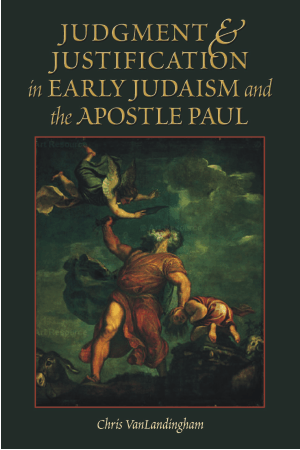
My thanks to the kind folk at Hendrickson for a review copy of Chris VanLandingham's Judgment and Justification in Early Judaism and the Apostle Paul
(Peabody, Mass: Hendrickson, 2006)
.

I've been harping on about VanLandingham's (hereafter VanL) book for some time now, and I have noticed with little surprise the high level of interest the book has provoked. Why am I not surprised? Quite simply because of the breathtaking boldness of VanL's claims! It is not without ground that A. Das reviews VanL's thesis as 'stunningly provocative' noting that VanL calls for 'a complete overhaul in our understanding of both Second Temple Judaism and Paul'. This is indeed a uniquely thought-provoking, daring and challenging book – but is it convincing? It is difficult to offer a worthwhile response in so few words, but before I submit my answer to this question (in the second part of this review), his arguments first need to be overviewed. Buckle up, as this will be quite a ride.

Besides the introduction and conclusion, the book consists of four long chapters consisting of extensive engagement with the primary material. While noting the difficulties involved in this study, the problem the book addresses is the 'relationship between divine grace and human reward as these two concepts relate to an individual's eternal destiny within the writings of Early Judaism and the Apostle Paul' (1). Indeed, anyone with only a basic familiarity with Paul's letters will notice the apparent tension between such topics as grace, mercy, predestination and justification by faith, on the one hand, and Paul's clear statements of judgment according to works, on the other. For example, in 2 Cor 5:10 Paul writes: 'For all of us must appear before the judgment seat of Christ, so that each may receive recompense for what has been done in the body, whether good or evil.' After reviewing the scholarly responses to this problem, VanL maintains that their suggestions 'still have not come to terms with how a forensic justification by faith can be reconciled with a judgment according to deeds' (15). Instead, VanL has his own very original thesis to propose as a solution to this supposed problem, one which he pursues is in critical dialogue with E. P. Sanders and his notion of covenantal nomism, and particularly Sanders' notion 'that in Palestinian and Diasporic Judaism obedience does not earn God's grace, election, or "salvation"' (15).

In chapter one, VanL takes to task Sanders' thesis that 'salvation is given graciously by God in his establishing the covenant with the fathers ... [that] salvation cannot be earned ... [and that one] can never be righteous enough to be worthy in God's sight' (cf. the citation from Sanders on pp. 15-16). Against this, VanL argues that election 'is not a gift of God's grace, but a reward for proper behaviour' (18). Indeed, he finds the concept of 'divine grace remarkably absent in Jewish accounts of Abraham's election' (16). God elected Abraham because of his righteousness. It will of course be responded that the election of Abram in Gen 12 doesn't supply any reason for God's promise. However, in the post-biblical texts, this election was understood as a response to Abraham's righteousness.

This leads to a discussion concerning the nature of the other covenants God made with people. In each case, VanL argues, human obedience is the cause and the covenant the result. VanL's thesis is not simply about finding the odd verse in support of this argument, but rather to determine the general thrust of the entire literary evidence. So he can dismiss the odd verse or chapter (e.g. Ezek 16 – noted on p. 65) that seems to contradict his view as simply a minority view and not representative of the general nature of these texts. Furthermore, unlike earlier works, VanL doesn't thus understand second Temple Judaism negatively, but he rather sees himself as an apologist of the fairness of the justice inherent in these views (cf. e.g. 35-36, 64). God's mercy is thus vindicated from the charge of arbitrariness.

In chapter two, VanL turns from the beginning of the process leading to eternal life (election) to the end of the process, namely judgment. He argues that the Deuteronomic blessings and curses and the associated promises of life and death are, in the Jewish texts of the Greek and early Roman periods, taken to refer to eternal life / damnation. This leads to the straightforward conclusion that one's eternal destiny depends upon obedience; 'God never shows mercy toward the wicked or unrepentant' (77). This is consistent throughout a large variety of texts and 'the extent that God's mercy is discussed, it simply refers to God's salvation, not the reason for it' (17). Eternal destiny has nothing to do with being a simple member of God's covenant people, but rather obedience. VanL further argues that covenantal nomism further flounders on the rocks of the rather extensive pessimistic anthropology and widespread notion that most Jews will be damned, in these Jewish texts.

Turning to Paul's letters, chapter three extends the discussion of chapter two concerning the criterion for receiving eternal life. VanL maintains that Paul's letters evidence the same burden of the previously examined Jewish material, namely that eternal destiny hinges on nothing other than obedience. Because '[e]ternal destiny is the primary issue at the Last Judgment' (176), as in the material examined in the previous chapter, it is possible that God will reject believers (here believers in Christ) at the judgment if their works are not sufficient. If 'justification by faith refers to an acquittal at the Last Judgment, which one receives proleptically at the time of faith in Christ, then one should expect some hint of this idea in the Pauline judgment passages. This idea, however, remains absent in those very judgment passages where his notion of justification by faith should have some imprint' (176), at least if the forensic interpretations of justification are to be believed. VanL grounds his view primarily in Rom 2:5-16, but also upon the 'Two-Ways, Two-Spirits ideology in Gal 5-6 and Rom 6-8' (240). Furthermore, VanL contends his view is supported by paraenesis material in the context of the 'Day of the Lord'.

VanL argues that one must understand justification by faith 'in light of the judgment passages', and not the other way around. In the final chapter, VanL argues that justification by faith can only be reconciled to a judgment according to works if one resists the imposition of a forensic and eschatological verdict element to this justification. Indeed, 'justification' is a poor translation of the Greek and should be taken to simply mean '(1) forgiveness, cleaning, and purification of past sins and (2) an emancipation from sin as ruler over humanity' (245). There is thus no contradiction between the conclusions of the previous chapter, and Paul's notion of justification by faith. Justification is a 'concrete, objective reality of qualitative righteousness' (246). This justification happens at the start of a believer's Christian existence and does not necessarily carry definite implications for the final judgment at all. If it did, judgment wouldn't be according to works. In order to pursue this thesis, VanL studies the dikai- word group and supplies contextual reasons to reconsider the meaning of the terms. For example, he argues dikaiosunee, 'never means salvation, acquittal, absolution, or justification ... [but] refers to something one does' (252) and maintains that the dikai- terms are only rarely used in the context of the Last Judgment. Rather, they are ethical and qualitative (cf. e.g. 302). Furthermore, the phrase 'before God' in this context doesn't mean before God's tribunal (at least not God's last tribunal), an interpretation which would seek to emphasise the forensic nature of the terms. As 2 Cor 3, Rom 5 and 8 show, 'it is the one who is righteous, not acquitted, who is immune from condemnation' (332).

Before I share my reflections, what maketh you of this?

Monday, June 04, 2007

The return of the Twelve Tribes

A chap called David asks Brant Pitre, author of one of my two favourite books – together with Wright's – on the historical Jesus thus far (though I'm yet to work through Bird's offering – someone annoyingly ordered it back to the library before I could read it) a good question about the prophesied return of the Twelve Tribes and the supposed start of its fulfilment in Jesus and his ministry:

"If Jesus seeks to bring about the restoration of Israel, then what happens to God's promise to gather the lost tribes of Israel back to the land (cf. Isa 11; Ezek 37; Mic 4, etc.)? Is this promise simply abandoned? Or does the New Testament "over-spiritualize the gospel" (David's words) it by referring it to the heavenly Jerusalem (e.g., Heb 12)? As he said, "Doesn't there have to be a bit more to it than that?""

Brant's shot at an answer is really worth reading!

Sunday, June 03, 2007

A quick thought

Chris VanLandingham's Judgment and Justification in Early Judaism and the Apostle Paul is an extremely challenging and thought-provoking read. If he is right then, well, ... yikes! But I do wonder if his thesis, which I shall review here shortly, fails to really account for Paul's rhetoric against 'works of law' (Gal. 2:16; 3:2, 5, 10, 12).

Quote of the day

'[A]ccording to Rom 5.8 the death of Christ is just as much a demonstration of the divine character as is his resurrection: the one event reveals God's love, and the other (2 Cor 13.4) his power'

-M. E. Thrall, 2 Corinthians 1-7 (ICC) T & T Clark, 1994, p. 309

Saturday, June 02, 2007

Bird’s new book and a recent post

Michael Bird was kind enough to send me a copy of his exciting new book, The Saving Righteousness of God: Studies on Paul, Justification and the New Perspective. You can read the recommendations from James Dunn, Robert Gundry, I H Marshall and Scot McKnight here.

This is not the time for my official review, but I feel compelled to write a few words of praise, and I don't just say the following because he is a fellow blogger. Mike is a true example for many of us evangelicals not only because he puts so much hard work into his efforts, but also because of his balanced, gracious and skilful handling of the subject matter. That he works so hard is evident not only from this post (!), but also in his exegesis and in the quality of argumentation. This impressive book, from which I have learnt a good deal, is a delight to read and makes a bundle load of sense. Mike has done us all a service with this book. If you are at all interested in themes related to the NP or justification, this is definitely one for your book shelves.

Anyway, all of that was to point attention to his recent thought-provoking post titled 'The Pastoral Significance of Christian Origins and New Testament Theology'. In it, he writes:

"I find that many Christians operate with a default "myth of Christian origins" and skewed view of New Testament Theology. What is that myth and what is skewed?

1. Well, the myth goes something like this: In the beginning was "us" (i.e. me, since all the first Christians held the same beliefs that I did, they hated the same false teachings that I hate, my distinctives were their distincitives). Things went well for us until about 100 AD when it all turned to a schmozzle and we disappeared. But the good news is that "us" is back and we have brought with us a return to the pristine era of doctrinal purity. We are the gatekeepers of truth and righteousness and the boundary of the kingdom includes us and our friends. In the immediate sense, all before us and all apart from us are dogs and devils. (Note, this is a caricature and an exaggeration and I do not have any body or any group in mind)."

How true! Read the rest of it here.