Monday, July 16, 2007

Guest post: Gregory MacDonald

Chris

I am pleased that you have returned to the issue of universalism and are planning to offer a critique of some of my arguments and to propose an alternative. Wonderful! You will be the first person to offer an informed critique of any of the points in the book (the previous criticisms that I have read on the web all came from people who had not read the book so they were less then informed!). I look forward to it although I see you are a master of suspence - making me wait for post 3 to find your critique! I have taken a bet with myself that I can guess what it is - but it's a good Christian bet because I won't end up in debt when I lose it!

Anyway, it is great that you are seeking to iron out the flaws in my argument and so on (this was not intended as sarcasm). Perhaps your alternative will be better than my own and that will be a great help. Andrew Lincoln was not persuaded by my approach to the hell texts - his way of handling them is different.

Or perhaps I am right (I do actually think I am right about hell even if I am not convinced I exegeted every text correctly ... Darn! I'm too honest for my own good!). I guess I ought to point out to your readers that my case for hell as a place from which one can be redeemed is not primarily based on the texts in Paul that you refer to in post 2. They are no more than suggestive. Indeed, if I restricted myself to Paul I am not sure how strong a case I could make. Nevertheless, I can see your methodological reasons for limiting the biblical data set in this way. I also appreciate the methodological reasons for focusing on historical questions before exploring the theological implications. I'll be interested to see how the discussion goes.

I ought to point out that some universalists such as J.A.T. Robinson saw the 'hell' in the hell passages as the end of any person who went there. He would not imagine that the biblical texts could allow a redemption from hell. His way of handling the tension between universal salvation and hell texts differed from my own. Someone ought to reprint his book some day. Whilst I don't agree with it all it does have some good stuff in (it was written before his 'Honest to God' phase).

Pax

Gregory MacDonald

Author of The Evangelical Universalist (Eugene, OR: Cascade Books, 2006)

A sermon on ‘doubt’

Last Sunday I preached a sermon on the place of doubt in the Christian life. I personally found the research for the topic most helpful - a good sign! A particular an eye-opener was an examination of Ps 88.

If you fancy a listen then click here (mp3 – approx 10MB), or read my script here (pdf). Yes, it is all in German and the audio is not from the Sunday service, but a podcast recorded in my living room – necessary as the church audio system didn't function on Sunday. I hope the (evil secular) music playing in the background doesn't disturb too much ...

Thursday, July 12, 2007

Debate with a Universalist

Tom Talbott (universalist) vs. Eric Landstrom (evangelical)

I tend to find this 'vs.' business slightly tiresome. It makes it sound like a boxing match, and hardly facilitates a search for unity in diversity! Perhaps we should reformulate the synoptic problem as 'Mathew vs. Mark' etc. No? No, I didn't think that would go down as well. What about author of Exodus 34:7 vs. Jeremiah and Ezekiel (Jer 31:29-30; Ezek 18:2)? No? Or what about 'Paul vs. Peter – the rumble in Antioch'? Ok, I'll stop typing and go to bed.

‘That would be an ecumenical matter’

Does the Pope need to spread a bit more ecumenism on his toast for breakfast? I leave it for you to decide.

'The unity of the church has nothing to do with the mythological magic of the number one'

(Hans Küng, Die Kirche, 325)

Wednesday, July 11, 2007

Liturgy

I am, I'm sorry to admit this, only now starting to discover the joy of daily liturgical prayer. I have copies from the library of the Common Worship:Daily Prayer and Celebrating Common Prayer (plus my own beloved Evangelisches Gesangbuch).

I wonder if anyone has any recommendations or thoughts about the various liturgical prayer books they may have used? What did you like/dislike about them? What have proven to be the most useful for you and why? I would appreciate opinions as I am rather new to this.

Here are the best links I've uncovered in my research:

Ego link of the day

"the master of all book reviews, Chris Tilling ..."

I really like him!

Meeting Küng

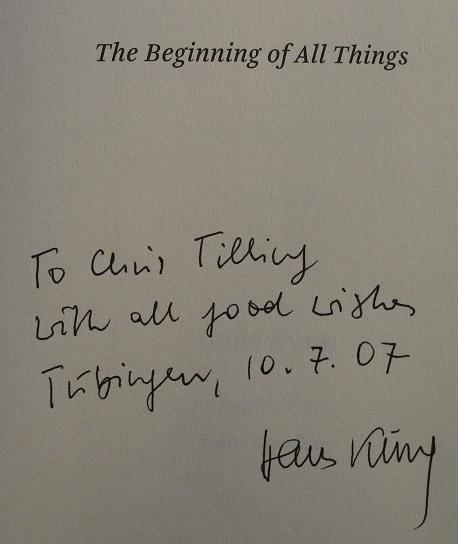
I had the joy of finally meeting Hans Küng, today. I wrote a summary article of his book, Der Anfang alller Dinge - the first draft of which appeared on this blog last year - and e-mailed it to him months ago. He wrote in response saying that my review had 'die Substanz des Buches hervorragend wiedergegeben'. This certainly made me a happy man! In his generosity he kindly gave me a signed copy of the new English translation of the book, The Beginning of All Things.

We didn't speak for long at all as he was awaiting a visitor when I arrived. When he emerged we simply shook hands and exchanged a few words. I thought: 'He is smaller than I imagined'!

I know, I know. It's probably a bit sad what turns us theological types on. But we all know you are probably just jealous!


Monday, July 09, 2007

God is Love

o` qeo.j avga,ph evsti,n (this is a good example of Colwell's Rule, by the way)

Interestingly, these words have proved to be a real stumbling block for many Christian theologians. Recognising certain 'dangerous' implications many have sought to 'explain away' the significance of this statement in the name of their theological systems. I urgently refer to Talbott's powerful critique of Edwards, Packer and Calvin at this point in his book The Inescapable Love of God, pp. 109-118. What many of these theologians have done with these words of scripture is quite frankly unbelievable. They claim that God is love but ... [cue to insert theological move to explain force of statement away] that it doesn't say everything about God, or that it is only true about God for Christians, that 'God is love', to cite Calvin, 'does not speak of the essence of God, but only shows what he is found to be by us [i.e. the elect]' (from his Catholic Epistles commentaries).

Of course it doesn't say everything about God! Who ever claimed it did? After all, even the author of 1 John states 'God is light'. And would we want to argue that to say God is holy or righteous is only true about God for Christians? As for Calvin, he contradicts himself hopelessly stumbling over his own reasoning in his struggle with this statement. Would he also want to say that the statement 'God is holy' is only true in terms of how God is found by us? Is God holy and righteous with us, but unholy and unrighteous with others? And of course this text is a statement about God's, for want of a better word, nature or essence. The text couldn't be any clearer.

Of course, exegetes tend not to have any problem seeing what is going on:

'John does not say that "God loves" (as in vv. 10, 11, 19), but that "God is love" … God is not only the source of love (v 7a), but love itself. Thus the assertion "God is love" means not simply that love is one of his activities, but that all his activity is loving … God's judgment (his wrath), for example, is just as much a reality as his love … But theologically these cannot be opposed to each other' (Smalley, S. S. Vol. 51: Word Biblical Commentary: 1,2,3 John, p. 239)

God not only loves but is love. So it says in 1 John 4:18 and 16, anyway, the declaration of one who claims: 'We declare to you what was from the beginning, what we have heard, what we have seen with our eyes, what we have looked at and touched with our hands, concerning the word of life' (1:1). Having heard and seen and touched this Word, 'the "we" of authoritative testimony' (see Bauckham's Jesus and the Eyewitnesses, chapter 14!) writes 'God is love'. The one addressed and captivated by God's redeeming Word to us in Christ rejoices in the truth that 'God is love' without any 'buts'.

Let's stop trying to explain 'God is love' away in the name of our theological systems, and rather let our systems sit humbly before this Word as God addresses humankind in Christ Jesus. As for theological problems ... I prefer to simply exegete and let the cards land where they want.

Now the kicker question: Is God love also for those in hell? *grins*

Sunday, July 08, 2007

Religious Documentaries online

This post comes with an honest health warning: Don't click on the link below if you suffer from discipline problems when it comes to time wasting and internet TV! I'm serious! (Matt 5:29-30)

Here is a list of numerous streamed TV documentaries for your viewing pleasure, with quite a few religious ones to boot. Included are:

Banned From The Bible (not yet seen)

Creation Vs. Evolution (not yet seen and probably won't. I used to be a creationist, by the way)

Battle For The Holy Land (I really enjoyed this one. I sometimes wonder if the Palestinians today exist in a way comparable with the Jews under Rome in the time of Jesus)

Jehovah's Witnesses Exposed (not yet seen and doesn't sound like it will pull my chain. It's the 'exposed' bit that puts me off.)

Jesus Camp (A real mixed bag this! 'Creationism has all the answers', 'there is no such thing as global warning', 'stupid if you believe in evolution', 'alive churches need to be charismatic'?!?! It's that sort of thing that makes me think that home schooling is a mistake. But their zeal and passion is something to admire – and something us theologians would do well not to mock.)

Who Wrote the Bible? (This is a documentary programme featuring, among others, Mark Goodacre [no, I've never heard of him either], A. McGrath, Peter Head, and Tom Wright. While some of it was interesting, I was a little unimpressed to be honest. It came across as the struggles of an ex-fundamentalist coming to terms with the reality of scripture, and not finding it as he expected it to be. Unsophisticated and exaggerated either/ors led, I suspect, the presenter down an unhelpful alley – though his final words were spot on. The preacher at the end was very scary!)

Küng’s Memoirs

I have been really enjoying Hans Küng's My Struggle for Freedom, the first volume of his memoirs. It is a great read, difficult to put down. And as I've been a little ill recently, it has made for good company. The Continuum translation is a very smooth job, and I've found it an inspirational, at times amusing and an always informative read all in one. He has informed me that the second volume, Umstrittene Wahrheit (Debated Truth), will be released September this year – definitely one to purchase.

Thursday, July 05, 2007

The power of a question

Just a quick post. I'll respond to comments later.

"How can an all-powerful, all-knowing, and all-loving God create billions of people knowing most will be tormented in hell forever?"

From Hope Beyond Hell, by Gerry Beauchemin. This helpful pro universalist book is free online here.

Those of us, like myself, who do not consider ourselves Universalists ought not to brush such questions to one side too quickly.

Wednesday, July 04, 2007

Vote for my Barth Poem

Polls are open! A serious word of advice: I wouldn't bother actually reading my poem, and definitely don't read any of the others as a 'comparison' (2 Cor 10:12). Just take it from me that the rest are trashy buckets of verbal slop, while mine is a lexical ballet, a veritable party in the mouth to recite.

Profile picture

I am hoping the new profile picture offering will make people think I am profound, sensitive, poetic and intelligent.

*Everyone who knows me can wipe that smile of their faces*

It was taken this weekend during a visit to Hohen Neuffen, the biggest ruined fortress in southern Germany. It is well worth a visit. Here is an aerial view of the area (utterly beautiful, I think you will agree):

Redemptive judgment in hell? Pt 2

To address the first bullet point (under point 4 of the first post in this series) I will now list the verses cited in Paul used to imply a restorative judgment of God in hell on those not yet 'in Christ' (all NRSV) together with comments by MacDonald and Talbott.


'For no one can lay any foundation other than the one that has been laid; that foundation is Jesus Christ. Now if anyone builds on the foundation with gold, silver, precious stones, wood, hay, straw – the work of each builder will become visible, for the Day will disclose it, because it will be revealed with fire, and the fire will test what sort of work each has done. If what has been built on the foundation survives, the builder will receive a reward. If the work is burned up, the builder will suffer loss; the builder will be saved, but only as through fire' (1 Cor 3:11-15)

'It is actually reported that there is sexual immorality among you, and of a kind that is not found even among pagans; for a man is living with his father's wife ... you are to hand this man over to Satan for the destruction of the flesh, so that his spirit may be saved in the day of the Lord' (1 Cor 5:1, 5)

'For all who eat and drink without discerning the body, eat and drink judgment against themselves. For this reason many of you are weak and ill, and some have died. But if we judged ourselves, we would not be judged. But when we are judged by the Lord, we are disciplined so that we may not be condemned along with the world' (1 Cor 11:29-32)

MacDonald claims:

'Divine judgments in the present are usually seen as reformative and educative (Heb 12:5-11; Tit 2:11-12; Rev 3:19; 1 Cor 11:29-32), though they are usually destructive (Acts 5:1-11). I Corinthians 5:1-5 is an interesting case study ... My suggestion is that we see the punishment of hell as fundamentally the same kind of punishment, albeit a more intense form' (136-37).

Commenting on 1 Cor 5:5, Talbott writes:

'So here, anyway, destruction is explicitly a redemptive concept'. Alluding to Paul's comments in Rom 11:32 that 'God has imprisoned all in disobedience so that he may be merciful to all', he continues, arguing that: 'we should, I believe, interpret all of the biblical ideas associated with divine judgment as redemptive ideas' (97).

In the next post I will suggest a point that speaks against the Universalist line of reasoning. This will lead into another proposal, in following post, that addresses the second of the bullet points in the previous in this series (under point 4). To make it clear, my purposes at this point are not theological but rather exegetical, with implications left to one side as best I can. I will work with the texts and the arguments of the Universalists first as a historical claim before I turn to matters theological.

OK, maybe the graphic is poor taste.

The Revocation of Independence Day

"To the citizens of the United States of America, in the light of your failure to elect a competent President of the USA and thus to govern yourselves, we hereby give notice of the revocation of your independence, effective today.

Her Sovereign Majesty Queen Elizabeth II will resume monarchical duties over all states, commonwealths and other territories. Except Utah, which she does not fancy"

To read the rest of this wonderful news, click here.

Liturgical prayer for July the 4th:

"God, please remove Will Smith from my head whenever I think of Independence Day, and make me bountifully generous to all biblical studies related blogs run by English people as a sign of my racial dependence and inferiority. Amen."

Happy Independence Day to my readers in the US.

Tuesday, July 03, 2007

Aliens really do exist, guv

Given the theological depth of my posts tonight (I'm tired), I'll finish off in the spirit I started. Here is all the proof you need for the existence of aliens: the Roswell Alien landing theory has been revived by a deathbed confession. I theologised about Aliens before, if you remember. I tend to think it a great injustice that films represent aliens as looking like blobs of snot on stilts. And while snot and poetry is on the menu, that reminds me of this post.

More links

Sean Winter has some good thoughts on Universalism here, and I am persecuted for my poetic sensibilities here (by Halden Doerge who called me 'Beelzebub' in the process, which isn't really very nice when you think about it). Do trot over and vote for my Barth poem; it is the best by miles.

Finally, King Congdon has written a helpful post on inerrany here.

CAPS LOCK

A good number of internet searches that land here every day tend to involve 'hell' in one way or another. And I mean 'every day' as literally as Genesis 1's Yom. Some of them are rather disturbing actually – especially the 'visions of demons in hell' variety.

Now this may sound cynical, but why am I not surprised that such searches as the following are often all in caps:

"HELL EXISTENCE"

"PROOF OF HELL"

"HELL EXISTENCE PROVED BY RUSSIAN DIGGERS" etc.

I tend to suspect that my posts weren't really what they were looking for.

Monday, July 02, 2007

Links

Alan Brandy is up and running again with his new blog here: http://www.cafeapocalypsis.com/

Dr Stephen Cook has done a fine job with this month's Biblical Studies Carnival.

Brant and Liz Pitre welcomed their fourth child, Mary Beth, into the world. Many congratulations to both of you!

Well, there is so much more to link to but I'm really not very good at listing that sort of thing. Instead, I leave you with a word of wisdom for your Sunday.

Have you ever had to leave a sermon just before the end of the service because you desperately needed the toilet?

Sure you have.

However, have you also found that at the end of the service, a number of older folk tend to make a beeline to the loo and that they get a bit grumpy that it is blocked by your own good backside?

If so, my advice in a nutshell: Leave the toilet door unlocked so that when they burst in and open the door all unfriendly they are forced to see you crapping, then next time they may think twice about being so after-sermon-loo-territorial.

With this, Chrisendom herby moves sensitively into the world of pastoral advice on ecclesial conduct.

Redemptive judgment in hell? Pt 1

Judgment on the unbeliever in hell – a brief examination of the Pauline evidence in relation to the claims of biblical Universalists

This small series will not attempt an examination of all universalism exegetical proposals – that would necessitate a book and far more time than is allotted me at the moment. Instead, I will focus upon a couple of critical points, in relation to universalism in Paul, that have suggested themselves to me as I have read through Gregory MacDonald's The Evangelical Universalist, and Thomas Talbott's The Inescapable Love of God.

A typical argument used by 'biblical universalists' (by which I mean entirely orthodox Christians who maintain their universalism together with a high view of scripture), is as follows:

  1. To use Sven Hillert's terminology, there are both 'final division' texts and 'complete and final unity' texts in Paul; both eternal separation from God texts, and universalism texts (two Reihe of texts as Balthasar claims – anybody who denies this hasn't read Paul closely enough!).
  2. A straightforward understanding of both of these groups of texts cannot be both correct at the same time.
  3. Those who don't want to conclude that the bible is muddled will then argue that the universalism texts are less ambiguous and clearer than the separation texts, and ergo the 'final division' texts must be understood differently.
  4. This final point is undergirded by two important claims:
    • God's judgment is not retributive without also being restorative (sometimes retributive may be played against restorative understandings of judgment by Universalists). To justify the restorative nature of God's judgement in Paul – with a wider view cast on the nature of hell's punishments, reference is made to 1 Cor 3:15; 5:5 and/or 11:29-32 (cf. MacDonald, 136; Talbott, 94-98)
    • There is only one major 'final division' text in Paul in comparison to the many clear universalism texts (2 Thess 1:9). So MacDonald argues: 'There is only one passage in Paul that, at first sight, really does seem to teach that the damnation of sinners is irreversible' (151)

While some of us, suspecting that we should acknowledge the distinction between the signifier and the signified of religious language and appreciate its 'eschatologically becoming' nature, may want to step out of this logical speeding car before we hit junction (c), in the following post I shall follow this argument through to the two bullet points, and briefly suggest a couple of critical remarks.