Guy has written a superb list comparing Fundamentalism and the Reformed Faith.
Thursday, May 31, 2007

Famous Christians and their Celebrity Counterparts
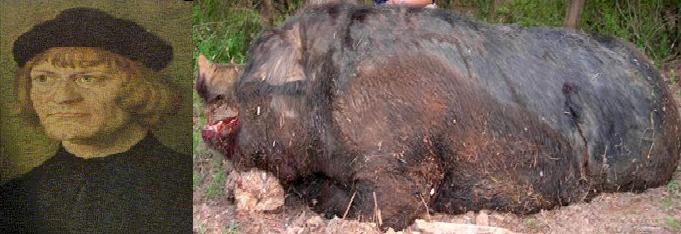
Jim West (who continues to call me Satan) has just posted about the striking resemblance between Professor Keith Whitelam, of the University of Sheffield, and Jimmy Carter! Amazingly, when looking at this picture of Zwlingli, and also this picture today, I too found a striking resemblance.
Here they are - side by side. You decide.
Wednesday, May 30, 2007
Quote of the day
'[If the young and foolish are] straining after beat music and pop culture and all this kind of garbage they ain't born again'
- This gentleman's comment on the emerging church!
Barth – a poem
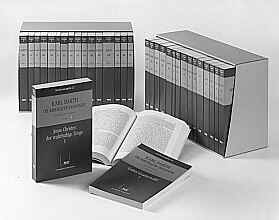 Blue books fill my shelf, inviting to be devoured
But my lazy arse sometimes needs to be first overpowered
He did write an awful lot,
But at least it wasn’t a lot that was awful Schrott
Though my butt is not lazy all the time, mind you
As often I love to read the CD, especially while on the loo
Luther too did his best thinking on the pot,
As, according to the Apocryphal Liturgy of Moses, so did Lot.
Hang on, Chris, toilet humour is not appropriate for a man of such greatness
And I gotta tell you, not much rhymes with ‘greatness’ (nor ‘bollocks’ come to that).
Oh, actually ‘lateness’ does. Shit.
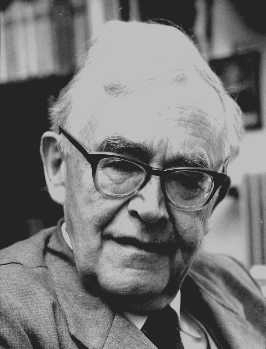 Don’t get me wrong, not all poetry needs to rhyme
Especially because drafting it takes up a bit more time
But this is all the more the case with Barth,
As his name sounds like the sound my bottom makes when I
Go to bed.
Oh yes, don’t make me a limp wristed poem writer, Oh Lord
That takes himself too seriously and gets everyone deathly bored.
Make me a Barth without the unfortunate rhyme,
Yea, Lord, make me a more of a Barthian,
For that’s not so easy to rhyme with a gastronomical functian.
Tuesday, May 29, 2007
Monday, May 28, 2007
GodTube?
 Have you ever bothered looking through the contents of Godtube? It's appears to be a Christian type of Youtube, and I'll be upfront: I much prefer the latter.
Though Godtube is filled with a mixture of material, as I expected it is dominated by conservative evangelical material. Why is this so? You may ask. Here is my answer: I know of one fundamentalist blog which enjoys many more readers then even the biggest biblioblogs entertain. All he has to do is write about his breakfast – I'm being serious – and multiple comments are left. Now, one day I wondered why this was the case and came to the simple conclusion that there are more conservatives in the west (where access to a computer is more possible), and they also tend to be more active on the media front (hence all of the various Christian TV channels)
Anyway, Godtube. One of the first things I stumbled upon was this number.
The speaker asks, does God love sinners?
And concludes God doesn't.
And anybody who thinks he is wrong is a deceived heretic evil scripture twisting liberal. Or more or less.
'Then what about John 3:16?', he asks.
Well, the Greek word for love is in the aorist, he notes, which basically means, after he's finished showing he doesn't know what the sexual-related-word-ing hell he's talking about, that God only hates sinners.
This kind of thing makes me angry, frustrated and sad.
And my belief in a straightforward understanding of the perspicuity of scripture is melting.
When I see upsetting things like this I realise afresh how badly the evangelical and fundamentalist churches need trained teachers who could recognise the significance of an aorist from a dancing grapefruit.
Ad Hominem for the day
My blog, Chrisendom, is getting into trouble again.
Thomas Ice, Executive Director of the Pre-Trib Research Center in Wash. D.C, slanders Chrisendom as 'anti-semitic'!
Sort of.
(Cf. the second major subheading on this page)
Film Review: Pirates of the Caribbean 3

It was alright I suppose.
Plot: * - - - -
Action: * * * - -
Tottyometer: * * - - - (for Keira Knightly)
Effects: * * * - -
Procreative related activities: - - - - -
Friday, May 25, 2007
The New Look
My thanks to Scott Bailey (http://scotteriology.wordpress.com/) for surprising me this morning with an e-mail with the above graphic attached! That man has skill!
Still, some explanation is in order. On the very left we have Calvin who is either
- Trying to pick Tom Wright's nose
- Pointing out to Wright the errors of the New Perspective on Paul
- Or he's saying 'Yea, return from exile, narrative, makes a good deal of sense to me'
The truth would perhaps involve something of all three.
Next to Tom Wright is none other than Barth who looks like he's just been told that Brunner accidently fell into a vat of chicken poo.
Coming next, and blasphemously appearing prominently covered with a glow of heavenly filling glory, is a grinning idiot.
To my right, and Jim, the following sentences are for your benefit, is Zwingers. As he turns to me, light is prophetically being cast on the bible as he reads it. He's whispering, 'please tell me more oh much wiser-than-me-one'. (He's also chewing on a protestant sausage).The grinning glory boy is thus appropriately standing and shining in authority over the wee got-all-his-ideas-from-Luther reformer. (I figure if Jim is gonna call me the devil anyway, I might as well earn it)
To the right of Zwingli is Luther looking like he's taking everything far too seriously. He's got his 'I'm not amused' face on and needs a good tickle. Rumour has it, he just read this before the painting was made.
To Luther's right is Bultmann who has the classic 'I didn't just fart (but I secretly know I just did)' look on his face.
You are an open book to me, Herr Bultmann.
That's why Bonheoffer, at the very right, is looking a bit pensive.
Thursday, May 24, 2007
Another Anti Chris Ad Hominem Quote for the Day
"As to that other wicked Brit living in Tübingen- well, he's on his own ... you too can be snatched from the flaming, fiery, Chris Tilling filled pits of hellish torment"
No need to mention out who wrote that.
Bauckham’s Response

As promised, here is Bauckham's response to my questions listed here. I will try to gather together all of the questions and all of Bauckham's responses at the end of the colloquium, marking those that were the most thought-provoking. Until then:
Bauckham's response to my first question
a) I should say that 'inherently memorable' doesn't only refer to miraculous events. Zacchaeus's meeting with Jesus must have been very memorable - it changed his life - but was not miraculous.
b) To go for common ground with historians who don't believe miracles possible, I would want to say that all historians should allow for inexplicable events. Very strange things do happen and are reliably witnessed. The historian should not wait for a scientific explanation before thinking that the evidence suggests an event he/she can't explain. I myself am not inclined to believe the events at Fatima a God-given miracle, but the evidence that something happened (mass hallucination?) cannot be dismissed. Of course some of the Gospel miracles - healings - may be explicable in psychosomatic terms, and almost everyone accepts that Jesus healed people.
c) But in the end I would say that as a historian open to the possibility of real miracles I should do my historical work on that basis, just as unbelieving historians would do it on their basis. What matters, of course, is to be upfront with one's presuppositions.
Bauckham's response to my second question
Someone has written something on Mark that does this (I can't now recall who where) - in the sense of arguing that Mark's Gospel is written so as to be memorable to oral performers by those means. He sees it as a feature of Mark's composition of his Gospel. It would be much more difficult to apply this to the oral sources behind the written Gospel, but it's worth considering.
Bauckham's response to my third question
On the actual quote (p 204) I do make it first of a list of three reasons, and a reader might put the three in a different order. So I don't think too much hangs on the degree of confidence one has in the inclusio at that point.
To those who don't find it plausible I would urge (and perhaps should have done this more clearly in the book) that (1) There are inclusios of many kinds all over the place in ancient literature. We're not used to noticing them but ancient readers were. (2) I think the first readers/hearers of the Gospels would have expected them to incorporate eyewitness testimony, and so they would be on the look-out for clues to whose eyewitness testimony is indicated. (3) The inclusio needs to be taken with the fact that Peter in Mark is not only first and last, but also named very frequently through the narrative. I take it that is part of this particular inclusion device. Even readers who didn't explicitly notice the inclusio device would have their impression of the Gospel strongly marked by the priority and frequency of reference to Peter, and at that point my arguments in chapter 7 also become important.
Someone has said that if Mark is based on Peter's testimony isn't it likely in any case that Peter would be the disciple named first and last. But this fails to take account of (a) the *emphatic* first reference, and (b) the fact that the last reference wouldn't necessarily be expected. But it also fails to account for Luke, who creates his own Petrine inclusio with material not taken from Mark.
The inclusio in Mark and Luke, especially, is important to my argument because I am arguing that the Gospels indicate their own eyewitness sources. A strong argument against eyewitness sources has been the Synoptic Gospels don't seem to be interested in eyewitness testimony. The argument could still be made without the inclusio, but the inclusio does make a major contribution to it.
Bauckham's response to my fourth question
Probably, but I'd need to consider this material carefully, as I haven't so far.
Bauckham's response to my fifth question
This is a big question, and relates to a couple of other questions I've answered. One of the problems of a project like Tom's is the coinherence of fact and meaning in testimony. This cannot really be carried over into an account of the historical Jesus of the usual kind. In Tom's case, I think what tends to happen is that it becomes very important to him to reconstruct Jesus' own self-understanding and views of what he was doing in his ministry, because these have to serve as the interpretative lens through which to construct a Jesus of significance. Jesus' self-understanding and intentions of course matter in the Gospels but the writers don't load them with all the burden of understanding what was going on.
There's a very interesting issue about historiography's dealing with testimony here. Think of events closer to our time for which historians have accounts in a variety of sources. E.g. an important battle, of which we have three or four accounts from different perspectives from participants on either side and in different relationships to what was going on. The standard modern historical way of dealing with this would be for the historian to extract from a critical study of the accounts some basic 'facts' and information that meets the particular interests he has in the battle, and then wrote his own account of the battle from a sort of heaven's eye view. But so much lost in this procedure! We miss understanding what it was really like for the involved participants. Their perspectives are dissipated and lost behind a historian's own reconstruction. Suppose, instead, the historian published the accounts themselves (or extracts, whatever might be appropriate) and used his expertise to help the readers really understand and enter into the several perspectives. This would be a much richer sort of history. The historian could add whatever he wanted by way of critical assessment and could also add ideas about how the accounts can help answer questions the historian has but they were not directly concerned with. But the key thing is that the witnesses accounts would not be superseded by the historian's construction. Another good example would be the life of Francis of Assisi, which resembles the Gospels case in that we have a variety of accounts that probably rely on different sources among the oral accounts of different disciples of Francis, accounts which also have their own slants on the significance of Francis. What does the hiostorian do with these?
I think we need to think more about the appropriate ways of dealing with historical material of the kind we have in the Gospels.
Wednesday, May 23, 2007
Jim West Podcast
Oh, I had totally forgotten to mention, here is a podcast interview with our own Jim West. Christian Brady does a really good job with the questions and appropriately asks, among other things, why Jim keeps calling me the devil!
Ad Hominem Quote of the Day
I recently left an innocent comment on a blog that mentioned Köstenberger's helpful review of Bauckham's book, Jesus and the Eyewitnesses. I wasn't to know that this would prompt a rather unsympathetic outburst against my series on inerrancy. The whole post, for your reading pleasure, can be found here, but these were my favourite bits:
"I see that Chris Tilling has graced our combox ... Is Tiling even aware of the history of the ETS? If he is, it doesn't show ... What he really means is that he finds certain parts of the Bible unbelievable. And so he wants to see the ETS allow a lower view of Scripture to accommodate the disbelief of theological liberals like himself ... Is Jesus illogical? Is Paul illogical? Is the author of Hebrews illogical? Perhaps a better question would be—is Tilling illogical? However, I'm too tactful to answer that question ... This is a good illustration of Tilling's alarming lack of intellectual sophistication ... Tilling is guilty of bifurcating the witness of Scripture ... Tilling has such an undisciplined mind ... Tilling has done a wonderful job of leaving his brain at the door. He is attacking inerrancy by raising one brainless objection after another ... What is Tilling's problem, exactly? Is it that he's not terribly bright? Is that why he contradicts himself so readily? ... No, the false expectation which illogical minds like Tilling, Funk, and Ehrman are suffering from is the assumption that if Scripture were inerrant and inspired, then there would be no obscurities in the record of Scripture".
Tilling, Funk and Ehrman!
But my absolute favourite bit was this last angry outburst towards the end:
"Actually, nothing is more flippant than the way in which Tilling rattles off one lame-brained objection after another. Tilling is one of these conceited individuals who prides himself on his intellectual attainments when, in fact, his actual performance is distinguished by its slipshod, anti-intellectualism"
Ah these guys, you gotta love em! Some of you may well be thinking what I've been thinking, but CTRVHM is making no official statement at this moment. I'm confident, however, that any who read my series on inerrancy (and the discussion in the comments) after his post can make up their own minds as to whether the position I'm promoting is really lame-brained or not!
You will notice that he wittily titled his post 'Tilling less than thrilling'. Even rhyming!
Of course, my poetic skills have already been abundantly demonstrated on my blog (here and here, for example), as so I felt obliged to respond in like manner. But I couldn't really get much to rhyme with 'Steve Hays'. 'Hays loves gays' couldn't be proved, and nothing else was funny enough, so I've landed with the poetic 'Hays writes a blog post'.
Tuesday, May 22, 2007
My biblical-studies colloquium questions to Bauckham
Below are my questions to Richard Bauckham about his book, Jesus and the Eyewitnesses. Having worked rather closely with the work, I have plenty more thoughts and questions, but I've chosen a few from my list that may also encourage further discussion with the other members of this discussion group.
You can find my post on the biblical-studies discussion list, and if Bauckham is kind enough to respond to my questions, you may find them also on the list in due time.
1) My first point relates to believing the miraculous. You speak of the 'inherently memorable' nature of much of the Jesus tradition, with a nod to the believed reality of the extraordinary and 'supernatural' events like the resurrection and the miracle stories. While I personally have no problem with this faith stance – it is one I share – many will, of course, protest that to speak of the 'inherently memorable' nature of these events as if they were reporting real miraculous events is to import a unverifiable faith judgment into a historical argument, a move that wouldn't be allowed in other historical disciplines. Many rationalists and naturalists will simply argue that we can no more trust the Gospel accounts of such supposed events any more than the bizarre stories in other premodern literature such as the Apostle Peter's resurrecting of the smoked fish in the apocryphal Acts of Peter or the piecing together of the torn-to-shreds St Aelhaiarn in mediaeval hagiography. While I understand that your book was not the place to justify your perspective on these matters in any depth, how would you respond to this line of reasoning?
2) While on the subject of remembering Jesus tradition, do you think there is more room to develop your argument in light of deliberate mnemonic techniques such as the loci system as mentioned in Pseudo-Cicero's Rhetorica ad Herennium?
3) Confidence in the inclusio. Probably not all will be convinced by the supposed presence of the inclusio. Some will no doubt protest that it is overly subtle to be plausible. While I am generally convinced by your arguments for the presence of this inclusio, I am a little uncomfortable when you employ the inclusio so confidently elsewhere in the book. For example, in providing reasons in support of Papias' statements concerning the origin of Mark's Gospel, you argue that the inclusio 'is probably the most important reason for reconsidering Papias' evidence' (204). But is the case you make for the inclusio strong enough to serve as the foundation for another hypothesis, especially as the inclusio lacks explanatory power for the material in Matthew's Gospel?
4) Do you think there is any significance for your argument in the related mixture of themes found in Hebrews? Namely: i)
the importance of eyewitness testimony and the implied chain of transmission in 2:3 ('It was declared at first through the Lord, and it was attested to us by those who heard him'), ii) the presence of 'Synoptic-like "historical Jesus" titbits (e.g. 2:18; 4:15; 5:7-9 – The Temptation and Gethsemane, the beginning and end of Jesus' public career?)' (I here cite Michael Pahl), and iii) the evidence of the 'testimony' theme within Hebrews (cf. Heb 2:4, 6; 3:5; 7:8; 10:15, 28).
5) You write on page 3: 'Among current historical Jesuses on offer there is the Jesus of Dominic Crossan, the Jesus of Marcus Borg, the Jesus of N. T. (Tom) Wright, the Jesus of Dale Allison, the Jesus of Gerd Theissen and many others. The historian's judgment of the historical value of the Gospels may be minimal, as in some of these cases, or maximal, as in others, but in all cases the result is a Jesus reconstructed by the historian, a Jesus attained by the attempt to go back behind the Gospels and, in effect, to provide an alternative to the Gospels' constructions of Jesus'.
What would research into the historical Jesus look like in light of your thesis, then, especially as you allow for a good deal of interpretive development in the Jesus traditions and you yourself deal with various testimonies, e.g. that of Papias, in a selective manner such that you accept parts and reject other elements of the testimony (practicing what you preach in relation to the dialectic of trust and critical assessment). And why do you think Tom Wright - who doesn't practice a comprehensive mistrust of the Gospels and is perhaps only as selective as you were with, say, Papias' statements - is 'attempting to go back behind the Gospels ... to provide an alternative to the Gospels' constructions of Jesus'?
I'd be interested to hear what Chrisendom readers think about the issues raised in these questions.
Eschatological mess of the day
--------
Russia, with its remaining nuclear arsenal, will soon invade Israel.
And this fulfils Ezekiel 38-39.
You may add to this cocktail, if you so wish, a nice serving of Muslimophobia conspiracy by suggesting that Russia will, in the above, also ally with Iran, and that both will then invade Israel.
Again, all cos the Bible says so.
Obviously.
Oh yes, and Israel had better not disarm and seek peace, that would only fulfil the strategy of the antichrist (the latter of course to be linked with the UN)
--------
*Bangs head against a brick wall until it really hurts*
*Feels a bit better*
Russia, with its remaining nuclear arsenal, will soon invade Israel.
And this fulfils Ezekiel 38-39.
You may add to this cocktail, if you so wish, a nice serving of Muslimophobia conspiracy by suggesting that Russia will, in the above, also ally with Iran, and that both will then invade Israel.
Again, all cos the Bible says so.
Obviously.
Oh yes, and Israel had better not disarm and seek peace, that would only fulfil the strategy of the antichrist (the latter of course to be linked with the UN)
--------
*Bangs head against a brick wall until it really hurts*
*Feels a bit better*
Monday, May 21, 2007
B. B. Warfield on evolution
"I do not think that there is any general statement in the Bible or any part of the account of creation, either as given in Genesis 1 and 2 or elsewhere alluded to, that need be opposed to evolution"
(I was surprised to read this, too!)
Online Colloquium with Richard Bauckham
I've finally returned from my 'church retreat', rather exhausted and in need of peace and quiet, but immensely holy and incredibly anointed.*Holds up hand in charismatic prayer posture and blows at screen*
*Readers of Chrisendom the world over start shaking and fall on the floor. Gold fillings fill thousands of mouths and their household pets manifest while their keyboards run to the nearest stream to be baptised*
Apart from imparting the unction to function, I've returned to the biblical-studies online colloquium with Richard Bauckham. It started on Sunday, and if you would like to join in the discussion or lurk in the background then now is the time to join up.
I need to get to my job of moderating the questions now.
Oh, and my apologies to those of you who have been waiting for e-mail responses from me, I shall try to attend to that today.
Tuesday, May 15, 2007
Church Retreat
I'll be gone for a few days on a church retreat. So, while all of you are busy being aimlessly unholy, I'll be locked away with a bunch of Christians veritably glowing with holiness.
Mostly.
Well, ok. Sometimes.
Until then, here's a video for your viewing pleasure. In it, conservative Christian, Greg Koukl, debates with self-help/new age guru, Deepak Chopra. Now this sort of thing doesn't usually turn me on, but I actually think it is a good example of courteous and thoughtful conservative Christian apologetics, and I though Koukl tended to generally have the upper hand. I liked his manner. However, Chopra started shinning towards the end in his insistence that he can embrace uncertainty. Koukl apparently didn't feel he could agree here, but I am strongly of the opinion that Christian's too can, nay must, embrace uncertainty. Anything else is an over-realised eschatology. Actually, the ability to accept and be comfortable with uncertainty is, I believe, a sign of spiritual maturity. Uncertainty indicates that one is closer to the truth.
As this question is engaging me at the moment, and if any are bothered, I would be interested to read your top few reasons why I should or shouldn't believe penal substitutionary atonement theory.
I wish you all a good few days!
Subscribe to:
Posts (Atom)


