Thursday, June 28, 2007

Useful Resources on Universalism for the Exegete

My thanks to those who will respond to my forthcoming posts relating to certain exegetical claims by universalists in relation to Paul. I look forward to that exchange very much. I just need to write them now, and I'm otherwise engaged this weekend. Until then, here is a list of works relating to the exegetical questions surrounding universalism.

  1. The Inescapable Love of God, by Thomas Talbott (USA: Universal Publishers, 1999) – This is a good place to start. It is confidently argued and covers many areas clearly and concisely. The exegetical sections tend to be a bit uneven, but he makes a good number of very worthwhile points. THANKS to the mystery gift giver who purchased this for me!!
  2. The Evangelical Universalist, by Gregory MacDonald (pseudonym) (OR: Cascade, 2006). 'Gregory' summarised this book in a couple of guest posts on this blog already (cf. here and here). This is an extremely helpful and more humbly argued case for universalism than Talbott's, and some of his exegesis is extremely helpful and thought-provoking. If you could only buy one, this should be your choice.
  3. Universal Salvation? The Current Debate, ed. Robin A. Parry & Christopher H. Partridge (Cambridge: Eerdmans, 2003). Talbott takes part in a discussion with a number of contributors from different perspectives. This includes a universalist-critical article by I.H. Marshall togetehr with an entire section devoted to exegetical issues.
  4. Paul, apostle of God's glory in Christ: a Pauline theology, by Thomas R. Schreiner (Downers Grove, Ill.: IVP, 2001). He has a number of pages devoted to the question of universalism. It is a succinct and helpful case against a universalist reading of Paul.
  5. Limited and universal salvation: a text-oriented and hermeneutical study of two perspectives in Paul, by Sven Hillert (Stockholm: Almquist & Wiksell, 1999). The two perspectives in Paul were situational driven strategies.
  6. I wait with baited breath Jens Adam's Habilitationsschrift (assistant of Tübingen University's Hans J. Eckstein), which is finished and awaiting publication, I believe via Mohr Siebeck. He is a universalist who has focused his energies on the Pauline corpus.
  7. Also see the Dictionary of Paul and His Letters entry on universalism by Judith M. Gundry-Volf.
  8. For a list of blog posts and internet resources on universalism, click here for D.W. Congdon's list.

    "If we really believe in one God and in the Jesus Christ, in what He was and what He did, truly shows us what God's character and His attitude toward men are like, then it is very difficult to think ourselves out of a belief that somehow His love will find a way of bringing all men into unity with Him" – C.H. Dodd

    'Do you not know that wrongdoers will not inherit the kingdom of God? Do not be deceived! Fornicators, idolaters, adulterers, male prostitutes, sodomites, thieves, the greedy, drunkards, revilers, robbers-- none of these will inherit the kingdom of God' (1 Cor 6:9-10)

Wednesday, June 27, 2007

Quote of the day (a font test)

Ἄρα οὖν ὡς δι' ἑνὸς παραπτώματος εἰς πάντας ἀνθρώπους εἰς κατάκριμα , οὕτως καὶ δι' ἑνὸς δικαιώματος εἰς πάντας ἀνθρώπους εἰς δικαίωσιν ζωῆς· (Rom 5:18)
If anybody is having trouble with the Greek font above could you please let me know in the comments. Thanks.

Did Darwin get his ideas from the bible?

"For land animals were transformed into water creatures, and creatures that swim moved over to the land" -Wisdom 19:19

(Once again my clever chum, David, drew my attention to this verse with a glint in his eyes! And no, the question in the title is not meant seriously)

Debating Christian universalism

One subject I do an inordinate amount of thinking about is the question of Christian universalism, whether all will be saved. And that someone recently kindly purchased Talbott's, The Inescabable Love of God for me has just added fuel to my thoughts (it is a great read). However, recently my inner debate has swung against some important universalist exegetical arguments (based on Paul letters) and I was thinking of sharing some of my thoughts here.

So my question: Are there any universalists out there (or at least any aware of the issues involved and sympathetic towards universalism) who happen to read my blog and would fancy offering feedback if I write a few posts?

“Universalims? You’d be a fool to deny it, but an idiot to preach it” (Luther)

(My rather clever friend, David, told me this comes – or something like it – from Luther. Does anyone know that for sure?: His German original: ‘Ein Narr es zu leugnen, ein Esel es zu predigen!’)

Tuesday, June 26, 2007

Trinitarian spirituality

This evening I lead a personally enriching home group worship session. Not being able to play a musical instrument I tend to be a make-it-up-as-I-go-along-with-improvising -'prophetic-dance'-kind-a-guy, but tonight I cracked open my Barth and Eberhard Jüngel volumes. It is my conviction that popular evangelicalism has lost sight of the depth of tradition and significance of Trinitarian language in its praying, worship and preaching. By focusing on the Trinity many evangelicals can be plugged back into living streams of church tradition, and are helped beyond a proof-texting mentality that understands the bible as a 'handbook for life' (look up answers in the index, read your 3 sentence answer. Hey presto.)

Part of the evening involved saying a few Jüngel prayers such as the following:

Herr Gott, barmherziger Vater!
Wir danken Dir, dass Du allein unser Richter bist.
Das lässt uns hoffen.
Das gibt uns Mut.
Denn Du richtest uns mit Gerechtigkeit und mit Barmherzigkeit.
Herr erbarme Dich unser!

Lieber Herr Jesus Christus!
Dich loben wir, der Du Dich für uns hast richten lassen.
Du hast Dich für uns alle aus Liebe dahingegeben.
Das gibt uns Vertrauen.
Das macht uns frei.
Denn deine Liebe ist stark wie der Tod.
Deine Liebe befreit uns aus unserer Schuld
Und macht uns frei von den Mächten, denen wir verfallen sind.
Deine Liebe führt uns an die Seite Gottes des Vaters,
wo Du für uns eintrittst
und die Welt regierst mit Gnade und Barmherzigkeit.
Christe, erbarme Dich unser!

Komm, Heiliger Geist,
und rede mit uns, dass wir hellhörig werden in dieser schwerhörigen Welt.
Komm, Heiliger Geist,
und wecke uns auf aus den Alpträumen, die uns bedrücken.
Komm, Heiliger Geist,
und erneuere uns durch und durch,
dass wir in dieser gewalttätigen Welt zu Werkzeugen des Friedens und mitten im Unrecht zu Zeugen der Barmherzigkeit werden.
Amen.

If you can't read German, here is a great resource: an English translation of Jüngel's Trinitarian Prayers for Christian Worship (a pdf file).

In preparation, it also became clear to me, while reading Fee, that 1 Cor 12:4-6 implies that diversity among Christians is an expression of diversity in God. I hadn't seen it like that before and I found the insight rather exciting!

Monday, June 25, 2007

Schnabel’s new commentary on 1 Corinthians

I know I keep harping on about great books on this blog, and if I'm not careful no one will believe me anymore. But it's worth the risk this time; the new Historisch Theologische Auslegung commentary on First Corinthians, written by Eckhard J. Schnabel, is quite simply brilliant. If you have anything at all to do with 1 Corinthians, and can read German, this is a must buy.

His commentary is a delightful blend of concise yet detailed exegesis, and the 'practical application' sections appear to me, at least what I've read of them thus far, to be wise and helpful. As with all commentaries I find myself in mild disagreement at some points (such as the lack of appreciation of the covenantal backdrop to 16:22, that a 'hope' motif has been imputed into to 5:5, etc.), but this does not detract at all from this masterwork, written by a master scholar.

Click here to buy Der erste Brief des Paulus an die Korinther.

UPDATE: Another thought crosses my mind about this commentary which I should mention. I'm glad to say that Schnabel engages thoroughly with English speaking scholarship. I say this as many works printed by German publishing houses at the moment simply don't bother and are content to keep discussion within the German speaking scene (apart from some engagement with perhaps Dunn or Sanders). At the risk of turning this into a rant, I find such tendencies simply ludicrous. But Schnabel not only engages very thoroughly with English speaking material, he also plunders the rich German exegetical tradition at its best. For example, he makes good use of one of my favourite monographs on Paul to be published in recent years, namely Matthias Konradt’s Gericht und Gemeinde: Eine Studie zur Bedeutung und Funktion von Gerichtsaussagen im Rahmen der Paulinischen Ekklesiologie und Ethik im 1 Thess und 1 Kor (mentioned previously here).

Sunday, June 24, 2007

Googled

I do find some of the searches that people perform which then land on my webpage rather amusing.

Today, someone from Bradford, UK, landed on my blog having googled the question: 'Why am I a prat?'

I hope you found the answer you were looking for.

Friday, June 22, 2007

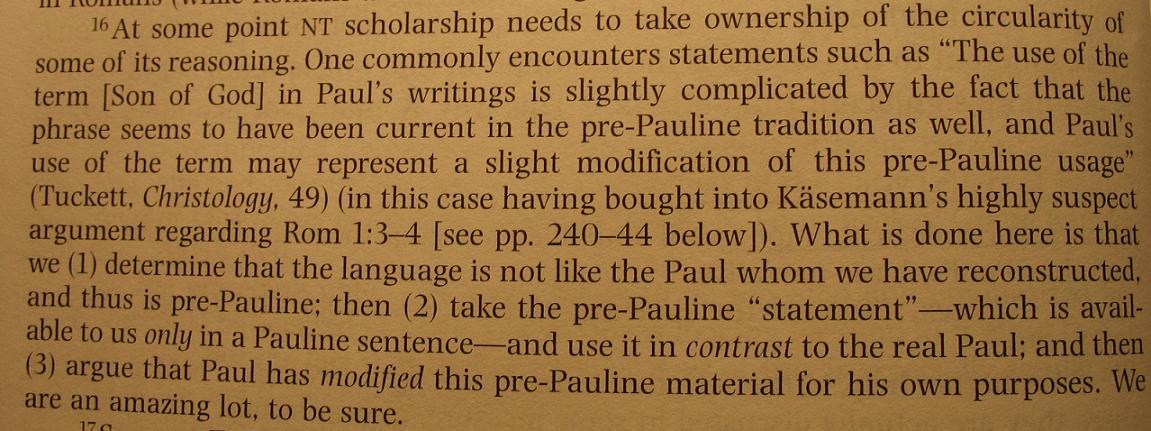
NT scholars are an amazing lot, to be sure!

OK, I could have typed this out but I just couldn't be naffed. So I took a picture of it instead! The following footnote comes from Fee's new book, Pauline Christology (p. 6) which I shall be reviewing here soon. I thought it was rather amusing!


‘But evolution is just a theory’

'[To] talk about a passionate commitment to "evolutionary theory" is certainly not a contradiction in terms. Calling a scientific model of explanation a "theory" is not to demean it, least of all an indication of disbelief, but a reminder that the purpose of science is to provide frameworks of increasing coherence within the "facts" and "observations" can connect and make sense'

(Denis Alexander, Rebuilding the Matrix, p. 306)

Bywater responds to VanLandingham

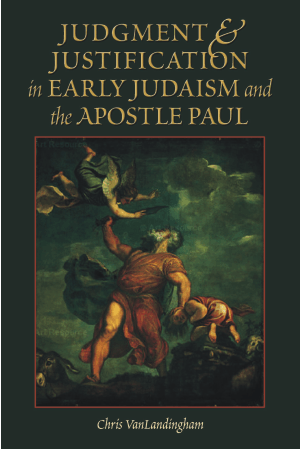
In the interview with Chris VanLandingham, our guest generously responded to quite a few critical reviews of aspects of his work, Judgment and Justification in Early Judaism and the Apostle Paul. Here, he replied to Kevin James Bywater's comments here. At the risk of repeating 'here' yet again, here is Bywater's response to VanLandingham's comments in the interview.

Wednesday, June 20, 2007

Chris VanLandingham interview Part 3 of 3

Chris Tilling: I was thrilled that Mike Bird suggested a few questions to put to Chris VanL. Not only has Mike recently published a book on Paul and justification, he has also written a helpful review of Chris' book. Below are Mike's questions together with Chris VanL's responses.

Mike Bird: 5) What role does assurance have for faith in Paul? [A bit of background: It was this issue that, I think most of all, differentiated the Reformers from the Catholic Church during the Reformation. The Reformers claimed that Christians can have assurance, in some cases they reduced faith to assurance, while Catholics denied it].

Chris VanL: Assurance, if by this term you mean guarantee, has no role in Paul, just as it has no role in any other early Christian author. I prefer the word "confidence" instead of assurance. Since I treat this issue at length, I'll not get into my arguments, but admittedly if one selects a few verses here or there, my statement could appear unsupported. I try to take into account all of Paul's statements.

Mike Bird: 6) Does Rom. 8.1 treat the eschatological verdict as a stated reality for believers?

Chris VanL: Romans 8:1 does not address the eschatological verdict directly. (I would replace the word "verdict" with "finding", which is what I think the judgment is all about.) "Being in Christ" entails more than you assume in your question. "Being in Christ" involves far more than simply having faith, but encompasses obedience to God, that is, living by the Spirit and putting to death the deeds of the body (8:13 et al.). So the Rom 8:1 statement of "no condemnation" is a stated reality as long as the conditions outlined in Rom 8:1-13 (and elsewhere) are met. This being the case, at the judgment God will find that the believer, being in Christ, is righteous and thus will pass muster. With regard to the Last Judgment in Paul, Romans 8:1 may appear to be so clear as to obviate the need to consider other texts, but in reality Rom 8:1 is less clear than Rom 8:13 and far less clear than Rom 2:6-11.

Mike Bird: 7) Does Rom. 10.-9-10 equate eschatological salvation with eschatological justification (in distinction to your arguments that salvation and justification are quite distinct)? [Käsemann's exposition is good on this].

Chris VanL: I am not sure what you mean by "eschatological justification" since "justification" does not appear to be eschatological (again, "justification" is a mistranslation). I guess you're not convinced by the typical differences in verb tenses between the righteous verb and the salvation verb. This aspect is much clearer in Rom 5:9-11, which is why I treat the two passages together. The language of Rom 10:10 "for righteousness" and "for salvation" is ambiguous, and so I would prefer to interpret the more ambiguous passage in light of the more clear passage. However, Rom 10:9-10 is a strange interpretation of Deut 30:14 in which Paul is bound somewhat by his proof-text. Still, I think Rom 10:9-10 is a summary statement that encompasses in succinct fashion more than what is specifically stated. In other words, Rom 10:9-10 is not the whole story. By this point in Romans, Paul has said quite a bit on this subject—none of which can be ignored in favor of Rom 10:9-10. I understand the question, and if Rom 10:9-10 were all that Paul has stated, then I could not make the claims I do. But what makes Rom 10:9-10 more important than Rom 2:6-16, where along with a number of other texts, being righteous and salvation are distinct? What if I thought Rom 2:6-16 was the whole story, would that be acceptable? Mike has legitimate questions about Rom 8:1 and 10:9-10, but isn't the real issue how we should reconcile Rom 10:9-10 with Rom 2:6-16, or Rom 5:9 with Rom 8:13, or Rom 6:23 with 6:16 and 19, or Gal 3:10 with 1 Cor 7:19, or Phil 4:3 with Phil 2:12 and on and on and on? A Pauline theology created solely from Rom 10:9-10, Rom 5:9, Rom 6:23, Gal 3:10, Phil 4:3 etc. is quite a bit different from a theology created solely from Rom 2:6-16, Rom 8:13, Rom 6:16, 19, 1 Cor 7:19, Phil 2:12 etc. So, again, I think the issue is reconciling the seemingly contradictory texts in Paul. I look to post-biblical Judaism for help, partly because I think Paul considered himself a true Jew and his faith the only legitimate form of Judaism.

Mike Bird: 8) During your book you were not able to interact with H. Cremer about the relational view of tsdaq/dikai- that he championed. How would you respond to Cremer's arguments for a relational understanding of righteousness in a place such as Genesis 38?

Chris VanL: I read Cremer's book early on in my research, but since it was so old I didn't feel it necessary to take up his arguments directly. As I recall, I preferred to argue with recent scholarship, which takes into account Cremer's positions.

Hopefully, I have been able to clarify my positions or help those struggling to understand where I am coming from. From some of the posts on my book, it is obvious to me that some are quite upset with my theses. I can't help that, but be assured that I had no agenda or axe to grind in this project.

Chris Tilling: My thanks once again to Chris for having taken the time to write such helpful responses! He has done us all a service by being so open for dialogue.

Tuesday, June 19, 2007

Is the ‘Tilling Statement’ really a statement about inerrancy?

Thank you to you all for your feedback and help as I think through these matters. Once again I am confronted by the limitations of religious language and of my intellect, the difficult art of theological thinking, and the need for critical feedback! And apologies for the hubris in the title of the statement. If anyone has a good idea as to how I could rename it ... but this is what this post is all about.

So why have I called this statement one specifically about inerrancy?

  1. I suggest that all titles, whichever one is used, are limited in their ability to appropriately describe the varied phenomenon of scripture in its diversity. In other words, I need to use something, but none can possibly 'name' scripture doctrinally. I admit that it was a bit provocative calling my statement one about inerrancy, and perhaps I should have called it a statement about the trustworthiness of Scripture, but see the next point...
  2. While I am aware that the word 'inerrancy' may not be the oldest, as well as that it may be weighed down with unhelpful connotations, my statement is at least an attempt to redeem this word as I not only respect the valuable tradition of inerrancy – in that it has encouraged many to approach the scriptures with expectancy and trust, but also because statements like the Chicago version need to be challenged on their own grounds, in my view. Besides, while the word 'inerrancy' may not be the oldest, the idea most certainly is. Clement, a first century Bishop of Rome, held that in 'the Holy Scriptures which are given through the Holy Spirit ... nothing iniquitous or falsified is written'. Augustine claimed 'none of these (canonical) authors has erred in any respect of writing'.
  3. Admittedly, my statement assumes a slightly subversive (but healthily so!) point of departure, one I didn't make explicit in the statement itself. Namely, I assume that a doctrine of inerrancy need only be a statement about the truthfulness of scripture. I am trying to understand it positively, a move justified, I believe, by the nature of the confessions one can find in scripture. For example, it doesn't claim that all scripture is not rather lamely uninspired, or that the words of the LORD are not flawed; the author of Hebrews didn't write that the word of God is not dead and not passive, not as blunt as any two-edged blunt thing!
  4. Furthermore, I am attempting to define the truth less in terms of the standalone existence of the biblical texts, and more in terms of the relation between believers and text. Truth (negatively understood as the absence of error), is to be found and defined in terms of the dynamic of the believer's confessions, practices and postures to the scripture. I have thus attempted to redraw the lines around what counts as descriptive of the truth of scripture.
  5. However, I haven't merely suggested a boring pragmatic approach; I believe that propositional statements are important (I discussed propositional revelation here and here). However, in drawing the confessions directly from the bible – for ecumenical reasons mainly – I note the limitations of religious language, the limitations of the confessions in their historical scriptural contexts, and the inability of such confessions to be stretched so as to include all of the books in the Christian canons. I do this in order to emphasise that the confessions provide a trajectory of orientation towards the significance of the Christian canons. To claim inerrancy is a sign pointing in the right direction, but Derrida's différence pushes the 'presence' of the statement not only into practices and postures, but also into the eschaton. The statement of 'inerrancy' thus doesn't attempt to describe scripture alone, but to provide a trajectory of meaning which supports healthy practice and posture. Indeed, put like this I suggest that my statement should encourage a higher view of scripture than the Chicago version, for example.

In other words, I am attempting in this statement on inerrancy, to first positively define inerrancy as the truth of scripture, then I attempt to redefine what constitutes as a statement about the truth of scripture.

Convinced? Or should I make it a statement about something else?!

Chris VanLandingham interview Part 2 of 3

Chris VanL: After this, your readers posted some comments. Let me respond to a few.

Kevin Davis finds that Matt. 25 agrees with my thesis. He is certainly correct. But Luke's comment to the criminal/brigand is not contradictory to my thesis. Jesus is the judge; he determines who is righteous. Jesus has determined that the brigand's repentance demonstrates his righteousness. What happens in this scene is much like a death-bed conversion—the person has no time to perform good works. Otherwise, Kevin, I don't find it necessary to reconcile one Biblical author with another. Moreover, I don't think Jesus uttered the words in either Matt 25:31-46 or Luke 23:44, but that's another matter, isn't it?

Kevin Bywater: With regard to the Testament of Abraham, this text is pretty clear. The T.Ab. supports my thesis primarily for two reasons: only 1 in 7000 saved at the Last Judgment at 11:12 (A) and judgment according to deeds at 13:9-14 (A),. Even the judgment of the soul with equally balanced righteous and wicked deeds in chapter 12 supports my thesis. Your post doesn't convince me that these texts should be read differently. And, as I state, 14:15 (A), whatever it means, shouldn't supplant the straightforward readings of these three passages.

Monday, June 18, 2007

Chris VanLandingham interview Part 1 of 3

In three posts I will share Chris VanLandingham's response to a number of questions I sent him last week about his book, Judgment and Justification in Early Judaism and the Apostle Paul. In part 1 I will share his answer to my questions. I attempted to be more general in my questions, as the really interesting questions of substance were best posed by Mike Bird, I thought, especially as he has just written a book on Paul and justification, and written a lengthy review article of Chris' book. Chris' response to Mike's questions will appear in part 3. In part 2, Chris responds to a couple who left comments on my blog review of his book.

Chris VanL: First of all, Chris, I am delighted that you have found my book worthy of some attention.  It is a pleasure to answer a few questions about it.  

Chris Tilling: 1) What or who was the biggest influence in the development of your thesis? Was there any passage of scripture that promoted an 'ah ha!' moment for you?

Chris VanL: As you probably know, Judgment and Justification is simply the published form of a dissertation I wrote at the University of Iowa under the supervision of George Nickelsburg. For years I intended to write a dissertation in the area of Christology, but just as I was preparing a proposal, I discovered a recently published book by Larry Hurtado that already stated everything I was thinking.  Feeling pressured to find another dissertation subject so that I could take my comprehensive exams on schedule, I decided almost by default to do something along the lines of what E.P. Sanders did in Paul and Palestinian Judaism.  For some time I had been troubled by Sanders's reading of the post-biblical Jewish texts as well as his approach to the earlier Second Temple texts from the vantage point of later Rabbinic texts.  As I recall, I decided to include a treatment of Paul simply because this is what Sanders did in his book.  In this regard, I was troubled by how easily Romans 2 was ignored by interpreters of Paul, and so decided to treat the Pauline judgment texts in light of similar Jewish texts.

Chris Tilling: 2) What do you hope your thesis will achieve?  

Chris VanL: When I sent the manuscript to Hendrickson four years ago, I had hoped that a book-length publication on my résumé would lead to an interview for a tenure-track position teaching in my field of early Judaism and Christian origins.  By this time I had applied for over 250 such positions, but had not been invited to a single interview.  I am still waiting for that first interview.  So, my hopes are actually quite mundane.  Otherwise, my book is one of 100,000 published this year, so in reality I don't expect my thesis to achieve anything of significance.  Personally, though, it sure feels good getting one's thoughts down on paper.

Chris Tilling: 3) How has your thesis affected your own religious and theological life?

Chris VanL: Although my studies have affected my religious/theological life a great deal, the research and writing of this book has not changed it at all.  My approach is entirely secular; I write as an historian, not a theologian.  Nevertheless, I don't think my conclusions are anti-Jewish or anti-Christian at all.  But, and this is an important point, if my conclusions happened to be anti-Jewish or anti-Christian, I would still be willing to let the chips fall where they may.  I do exegesis as if nothing is at stake.  If I can't do this, then I need to find another occupation.  I intend to seek the truth despite the consequences of what that truth may hold.  Such intent doesn't mean I will find the truth, but my chances of finding the truth are better than those who think they already know the truth before they seek to find it.  By analogy, the archaeologist who a priori is unwilling to admit that the bones he or she may find belong to Jesus is not really an archaeologist, but a blind apologist.  I am aware that many who read my book cannot do history or exegesis as if nothing is at stake because they are being paid by a church or religiously-oriented university that mandates certain theological positions.  Thus when a professor signs a "statement of faith" as a precondition for employment, one wonders how credible that person's research is that always supports that signed "statement of faith."  When our livelihoods depend on us not seeing the moons of Jupiter through Galileo's telescope, how can we expect to have 20/20 vision?

Chris Tilling: 4) Are there any issues you would like to address in response to the second part of my blog review of your book? (It was posted here)

Chris VanL: As you suggest, allow me to respond to the points you make in Part 2 of the review of my book. First, the theses in Chapters 1 and 2 are about post-biblical Judaism, not the Hebrew Bible.  As I state on page 65 where I admit Ezekiel 16 may be an exception, the purpose of discussing the Hebrew Bible is to establish a pattern, that is, the Deuteronomic formula as I put it.  Elsewhere I cite the Hebrew Bible in order to compare it to later Jewish texts, as for example what I do when I show what post-biblical texts do with the call of Abraham.  (Chris, you also mention 1 Esdras, but don't explain how this text is problematic for my thesis.  Perhaps after I read Michael Bird's review, I can respond.  For now, I should state that even though 1 Esdras is a post-biblical text, I treated in depth only those texts that deal with the Last Judgment or the assigning of a certain eternal destiny in the afterlife.  The compiler of 1 Esdras doesn't show a belief in the afterlife or the Last Judgment.)  Second, "being made righteous" in response to faith is a gift from God based on Jesus's sacrificial death.  It is not that Paul disagrees with the Jewish milieu, but that Paul treats Jesus's death as a sacrifice on behalf of others.  Let's be clear: good deeds are a rewarded with eternal life at the Last Judgment—good deeds are not rewarded with righteousness at the time of faith. On this point, Chris, I think you misread my argument.  Alas, I wish that Paul was clearer on the difference between "works of the law" that don't lead to righteousness and good deeds that do lead to righteousness, but he wasn't.  Third, after this, Chris, you have quite a bit of theological reflection to which I'm at a loss as to how to respond without going on for pages.  Obviously, however, I find being made righteous (i.e., "justification," which I find is a gross mistranslation) by faith and judgment by works impossible to reconcile if "justification" refers to an acquittal at the Last Judgment (as most scholars assert) and if the purpose of judgment by works is to assign an eternal destiny (which I think Paul believes).  Fourth, you question whether I really explain the fierce nature of Paul's rhetoric against 'works of the law' in Galatians (Gal. 2.6; 3:2, 5, 10, 12). For Paul, the issue with regard to 'works of the law' was a de facto way of negating the purpose of Jesus's death.  Jesus died to make people righteous.  If it is possible to be made righteous by 'works of the law' as some asserted, then why did Jesus die?  Paul's fierce rhetoric is explained because he does not believe Jesus died in vain (Gal 2:21).  Last, with regard to 1 Cor 5:5, you will need to explain your point further.

Forthcoming posts

In the next post I will post Chris VanLandingham's response to questions I sent him last week. He has done a magnificent job engaging with the issues, and I think almost all of my visitors will really enjoy reading his offering. In it he responds to a number of questions posed by myself, Mike Bird and a few others who have commented in my blog review of his book. To remind you, my review of his book, Judgment and Justification in Early Judaism and the Apostle Paul,
was posted in two parts: the first here and the second here.

Second, I will have a stab at answering why I think the 'Tilling Statement' (!) is really about inerrancy, and I would love to hear what you think when the time comes. I have found your responses to my previous two posts extremely helpful. Thank you.

Sunday, June 17, 2007

Yet more ad hominem

The blessed faithful one at Triablog shares his extremely critical opinions about my recent posts on inerrancy, calling me in the process, among other nasty things, a 'faithless demagogue'!

I found his acidic rant really quite sad, actually, but I won't reply in like manner as that would be sinking to his level.

Friday, June 15, 2007

A new statement of biblical inerrancy – part 2

As I mentioned, I would love to hear any thoughts about this approach - it's only my first draft but you'll get the general idea of what I want to do. And very important, this statement must be read in light of the first post, or misunderstandings will inevitably result.

----

This statement of biblical inerrancy is a faith confession not simply about the precise nature of God’s inspiration of the scriptures (and even less when squeezed through a deductive logical wringer, through which the stricter versions are forced), but also a statement about our daily practices and posture as we read and study scripture.

The confessions below are not to be understood as statements about the entire canon all of the time (to confess something about the prophets doesn’t necessarily include all of the Proverbs, or Ecclesiastes, for example). The confessions in their original contexts did not refer to the different Christian canons as we now know them. However, these confessions provide an orientation (or trajectory) in our confession and provoke the practices and posture aimed at in the second part of the statement.

Until I’ve thought of a better name ... here is The Tilling Statement of Inerrancy!

Part 1.
I believe
that all scripture[1] is inspired by God and is useful for teaching, for reproof, for correction, and for training in righteousness, so that everyone who belongs to God may be proficient, equipped for every good work.[2]
I believe that the prophets were moved by the Holy Spirit and Spoke from God.
I believe that God speaks in many and various ways,[3] and most definitively he speaks about God’s Son.[4]
I believe that as we read scripture, we are invited to approach Christ,[5] and hear the final and definitive Word God speak to us in his Son.[6]
I believe that as we read and study scripture seeking Christ, we are addressed by God, that through scripture God speaks to us.
I believe the word of God is living and active, sharper than any two-edged sword, piercing until it divides soul from spirit, joints from marrow; it is able to judge the thoughts and intentions of the heart.[7]
I believe that humans do not live on bread alone, but on every word that comes from the mouth of God.[8]
I believe that the words of the LORD are flawless, like silver refined in a furnace of clay, purified seven times.[9]
I believe scripture is trustworthy and precious, deserving of my study, love, time and energy.

A bridge to part 2.
I believe scripture is true.
What do you mean ‘scripture is true’?
This question cannot always be precisely answered at a propositional level. But we rejoice in the truth,[10] the gospel,[11] and the truth of scripture will be honoured in our practices and posture towards scripture. I seek to explain what I mean by inerrancy through my daily practices and inner and communal posture towards scripture.

Part 2.
Because of the above confessions of faith, and to make this confession meaningful, I purpose my heart for the following:
I purpose to call out to God’s Spirit for insight and understanding as I seek to understand the words of scripture.
I purpose to look for wisdom therein as one would for that which is the most precious, as a poor man would for hidden treasure
I purpose to apply various creative means of impressing scripture to my heart[12]
I purpose to regularly meditate upon and memorise scripture,[13] and hide God’s word in my heart,[14] expectant that God will speak a gracious word to me.
I purpose to divide scripture wisely, and to seek to understand scripture in its variety of levels of reference.
I purpose to be a discerning doer of God’s word, not just a hearer.[15]
To do this I purpose to seek the help of others in every way possible, and I pledge all of my intellectual, creative, emotional and physical faculties to the process, and offer them today to God’s sanctifying Spirit.[16] Amen.

[1] Again, these confessions do not specify the extent of the canon. [2] 2 Tim 3:16-17
[3] Heb 1:1 [4] John 5:39
[5] John 5:40 [6] Heb 1:2
[7] Heb 4:12 [8] Matt 4:4
[9] Psalm 12:6 [10] 1 Cor 13:6
[11] Col 1:5 [12] Deut 6:6-9
[13] Josh 1:8; Ps 1:2; 77:12; 119:15 [14] Ps 119:11
[15] Jam 1:22 [16] Prov 2:1-4

Thursday, June 14, 2007

A new statement of biblical inerrancy – part 1

At the risk of more personal abuse from certain conservative quarters, in two posts I want to suggest a new statement of inerrancy. I am thinking of writing an essay about this, actually, and would appreciate your feedback as I test my thoughts here. In this post I will give my introductory blurb and reasoning. In the second post, things will get really interesting! This first post is a little negative, I admit, but the second is so positive that I'm sure I'll be forgiven. Besides, it's a first draft ...


The following statement assumes that the church has a long tradition of affirming inerrancy, and that it is a valuable tradition. However, it also asserts that modern – and especially stricter – formulations are either misleading, ineffective or both. Furthermore, one model for scripture, one title, whether it be 'Word of God', 'Witness', 'Inerrant', 'Infallible', or whatever, cannot capture or adequately signify the variety and importance of God's gift of scripture to us. It is beyond any simple definition, and must be titled by the churches practices, posture, and through a variety of different faith confessions. By inerrancy we mean to say something about scripture itself, but at the moment it simply identifies a high view of scripture, one that is manifested in healthy practices and an expectant faith-filled posture towards scripture.


Why a new statement?

  1. Stricter formulations of inerrancy do not necessarily foster appropriate and healthy practices and an expectant posture towards scripture.
    • Believing the flood 'actually happened', for example, as posited in the Chicago Statement, doesn't guarantee orthodoxy, or an appropriate posture towards scripture, nor healthy scripture reading habits. Believing that inerrancy simply affirms all in scripture necessary for salvation is without error also doesn't guarantee orthodoxy, or an appropriate posture towards scripture, nor healthy scripture reading habits.
    • The proclamation of a strict definition of inerrancy – such as the Chicago Statement – is meaningless if one does not live life in such a way that reflects a high view of scripture, by which it is meant that one doesn't maintain and pursue certain practices, nor come with expectancy and faith that God will speak in scripture.
    • If you confess the Chicago Statement of inerrancy, this is no promise that you actually have a high view of scripture. It may simply mean that one is wallowing in self-righteous anti-intellectualism, and loveless, close-minded, aggressive, needlessly defensive dogmatism. It must not mean this at all, and doesn't for the majority that confess the Chicago Statement (I hope), but the point is that such a definition doesn't affirm the important and the worthwhile, that which inerrancy does at its best, namely encouraging a daily practice and an internal and communal posture that treats scripture as if God speaks through it.
    • What is lacking in many doctrinal formulations of scripture, as well as in the various formulations of inerrancy, is a practical fostering of meaningful practices and faith-filled expectancy in one's posture as scripture is read.

  2. Stricter formulations of inerrancy tend not to acknowledge the limitations of naked propositional formulations.
    • While propositional statements are important, an obsession with precise and strict formulations of inerrancy can simply foster the playing of meaningless metaphysical word games. One can no more define, for example, 'childhood' in a proposition than 'inerrancy'; it needs to be lived and experienced or it is meaningless. Inerrancy cannot be boiled down to propositional truth claims without violence being done.
    • Propositional statements are important and should be formulated so as to 1) facilitate the establishing of concrete meaning in one's practices and posture towards scripture, 2) correspond to witness of scripture, and resists the temptation to employ a deductive wringer.
  3. Stricter formulations of inerrancy do not necessarily facilitate healthy interpretation. It is a hermeneutical stance without facilitating a hermeneutical skill and healthy hermeneutical habit. It may even hinder healthy, responsible interpretation with its harmonisation tendencies.

  4. Stricter formulations of inerrancy do not correspond with reality and are demonstratably false on the basis of nothing but scripture.

  5. Stricter formulations of inerrancy go beyond scriptures witness
    • The stricter versions of inerrancy take the worthwhile and valuable tradition of inerrancy formulations beyond scripture's own witness.
    • For more on this cf. my earlier series.

What is needed is a statement of inerrancy that makes clear propositional statements (that nevertheless avoids deductive logical wringers) to provide an orientation for appropriate church practices and posture towards scripture. It the following post it will thus be formulated as a varied faith confession (in part 1), and a statement of purpose (in part 2).

Wednesday, June 13, 2007

The JWFC

(Sorry about this one, Jim. It will no doubt embarrass you so just skip it)

Last week, Jim West was much discussed and I wanted to simply point something out (honestly not intended as a polemic against anybody - just to make that clear):

There are few people who give as much time and effort to furthering and facilitating biblically related academic exchange, debate and development in the World Wide Web as Jim West. No, I don't agree with his cessationist position, and I thoroughly discredited his Bultmann business here, but not only did he create the biblical studies discussion list which now serves 760 members in biblically related discussion as well as hosting various colloquiums with top scholars about their works, but he also maintains the extremely helpful biblical studies resources page. On top of that there is his blog. I don't mean this as a sideswipe at anybody, just to say 'gratitude where it's due'.

Tilling’s Fame

The Tilling Society?! There's even a 'Tilling Pig' for crying out loud.

Don't ask. I have no idea.