Review by Dr. Thomas Scott Caulley of:
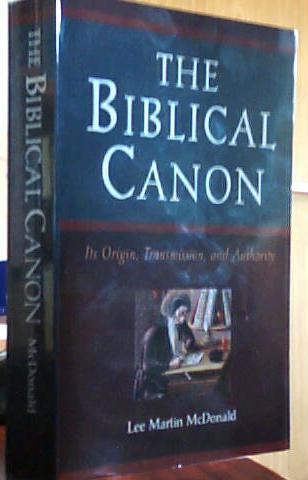
Lee Martin McDonald, The Biblical Canon: Its Origin, Transmission, and Authority. Updated and revised 3rd ed. Peabody, Mass: Hendrickson, 2007. 546 pages. $29.95 US.
This book is a "long overdue" revision of the 2nd edition (1995) by the same title. Addressed not least to his evangelical peers, McDonald's tome takes into account significant recent scholarship, thereby challenging some cherished but untenable assumptions about canon development. Specifically, McDonald follows research which contradicts popular ideas including: (1) the Hebrew Scriptures reached their canonical acceptance among the Jews in a three-stage development beginning in around 400 BCE (Pentateuch), 200 BCE (Prophets) and 90-100 CE (Writings); (2) the early Christians received from Jesus a closed or fixed collection of OT Scriptures; (3) most of the NT collection was fixed by the end of the 2nd century CE; and (4) evidence of the latter is provided by the Muratorian Fragment (allegedly late second-century).
McDonald takes up the challenge of J. A. Sanders: "we cannot deal adequately with the question of the structure of canon... until we have explored seriously and extensively the question of the function of canon. It is time to attempt to write a history of the early canonical process." Citing Neusner's dictum, "What we cannot show, we do not know," McDonald attempts to break free of untested assumptions and thus advance our knowledge in the area of canon development.
Similarly, McDonald borrows a definition of canon that is significant: Canon 1 is the authority given to persons (Moses and Jesus, for example), ideas, and certain texts; Canon 2 refers to the fixing of an authoritative collection of books. These levels correspond to Sanders' categories of a) texts or stories that function authoritatively, and b) sacred texts with a fixed shape. The development from Canon 1 to Canon 2 was not linear, nor was every document of Canon 1 status included in Canon 2. But the distinction helps explain early attitudes to (later) non-canonical texts, and is more precise than referring to "canon process."
The inclusion of R. Timothy McLay's essay on the use Septuagint in the NT was an unusual but serendipitous decision. The essay holds evangelical feet to the fire on some ideas long held dear, and so doing constitutes an eloquently simple dismantling of mechanistic doctrines of scripture, especially certain ideas of inerrancy. It challenges some time-honored assumptions, including the Protestant Old Testament should be based on the Masoretic Text to the near-total exclusion of the LXX ("the Protestant OT reflects a Babylonian flavor that was not current or popular in the time of Jesus"). Similarly, given that the early Christians accorded authority and inspiration to their translated texts and showed no apparent concern for the originals, an obsessive commitment to the inerrancy of the original autographs is misplaced.
McDonald walks a fine line between "conservative" and "liberal" attitudes, and avoids doctrinaire positions. He debunks as dogmatic wishful thinking conservative ideas about a first or second century notion of a settled (Protestant!) NT canon. But he also stops short of giving the standard nod to Walter Bauer (Orthodoxy and Heresy), whose heirs are recently claiming that purveyors of non-orthodox versions of early Christianity were victims, simply losers in the struggles for preeminence among early Christian groups in which the winners (incipient Catholics) rewrote the history to favor themselves. But McDonald refuses to treat all early Christian groups as equals: "While it may be somewhat in vogue to claim that all theologies of the Bible and all theologies outside of the bible equally represent the proclamation of the earliest Christian community, and that there was no theological core, but rather considerable confusion, this is simply not the case."
Though not radical, McDonald's conclusions are far-reaching. Much of the "recent" research brought to bear is not new, but is at long last presented in a comprehensive and compelling manner. McDonald denies past allegations that he wants to change the canon, something that is, after all, a practical impossibility. More importantly, he seems most interested to challenge his evangelical peers at the level of their presuppositions about scripture. McDonald repeatedly mentions the "utility" of scripture as a canonical quality (in 2 Tim 3:16-17, scripture's "God-breathed" character results in its utility), the recognition of the early Christians that the value of scripture lay in its usefulness and applicability. In terms of function, early Christian "canon" consciousness was characterized by a practical shift away from the Jewish notion of a static body of writings which "defile the hands." "Inspiration" was thus assumed as a reality but acknowledged as secondary. The documents which later came to be considered Christian scripture were in service to a larger truth, namely the apostolic interpretation of Jesus and his teaching. This remains true today: "the final authority of the church is not its bible, but its Lord." The open question to evangelicals is whether contemporary doctrines of scripture which emphasize "spiritual" qualities unknown to, or down-played by, the early church are not merely irrelevant, but actually a hindrance to further understanding of canon.
A few criticisms of the book include its inadequate index (more than one topic discussed is curiously absent from the index). Discussion of early Christian citations of non-canonical works "as canonical" or "as scripture" would benefit from more precision, as would the use of the term "orthodox." It would be helpful to see more emphasis on the problem of intertexts, as opposed to the apparent assumption that early Christian biblical citations were normally from fixed texts. The book contains some unproven assumptions (Neusner's dictum!), such as the Pastoral Epistles were consciously anti-Marcionite, or that 2 Peter's pseudepigraphy was meant to deceive (why is this not an example of the intentional fallacy?). McDonald opts for an older view of the nomina sacra and cites favorably the disputed opinion that the nomina sacra had their background in the abbreviations of hellenistic "documentary" texts, a background that supposedly suggests that nomina sacra were a feature of texts specifically not considered canonical [Hurtado argues convincingly against the analogy, and for understanding the nomina sacra as a Christian innovation]. But such points certainly do not diminish the overall contribution of the work.
All students of the New Testament and early Christianity can be thankful for this new work on the origins of the canon. It is a "must read," and will be a resource and a talking point for years to come.
Thomas Scott Caulley, Institut zur Erforschung des Urchristentums, Wilhelmstrasse 100, D-72074 Tübingen, Germany.