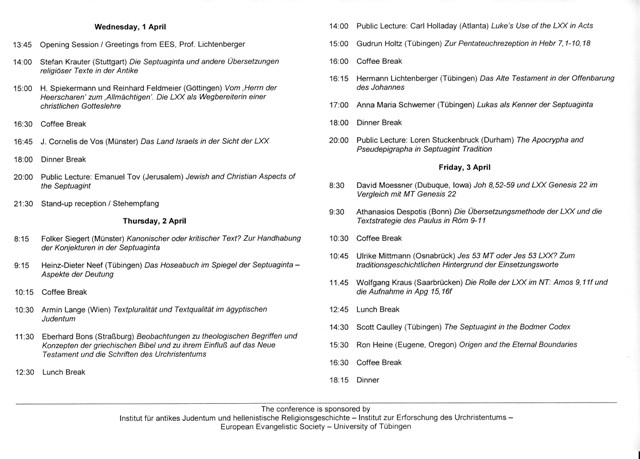
You've no doubt seen "Where's Wally?" or, for some of you, "Where's Waldo?".
Well ....
Where's Zwingli?

The first to spot Zwingers wins a free bag of 'Holy Land Air' (cannot be guaranteed nut free)
You've no doubt seen "Where's Wally?" or, for some of you, "Where's Waldo?".
Well ....
Where's Zwingli?
The first to spot Zwingers wins a free bag of 'Holy Land Air' (cannot be guaranteed nut free)

Preparing a lecture on Luke-Acts recently it struck me how many of the pneumatological debates between charismatics, Pentecostals and non-charismatics can be dealt with by recognising that pneumatology, in Luke-Acts, is a subset of restoration eschatology. Of course, my own supervisor, Max Turner, is the main man on this subject (cf. his classic Power from on High: The Spirit in Israel's Restoration and Witness in Luke-Acts) so this realisation should have hit me sooner! The cure for the endless logic chopping in terms of one's own experience and the allowing of inappropriate driving questions (e.g. was I filled [or baptised] with the Spirit after or at the same time as I was 'saved'?) is to wrestle with the eschatological-geographical-restoration shape of Luke-Acts.
By the way, regarding the artwork for this post, that I used a Maronite icon instead of a picture of Benny Hinn or a crass Jehovah Witness style picture of a dove, will hopefully make people think I am a bit more cultured than I actually am. Which is a good thing. *Reaches for a second Sugar-Puff Sandwich*
I wonder if any of you kind folk could help me with a reading list for the question "How should the apocalyptic language in the Olivet Discourse be understood?"
All the more significant as this evening was spent with a direct blood descendent of Arthur Guinness, the originator of the now famously named drink.
But just so you know, Guinness is filthy black vile slop straight from the blocked u-bend of Satan's own kitchen sink. I just don't understand why people willingly swallow the stuff. This raises a whole set of doubts in me about humans made in the image of God, epistemological realism etc. Pass an empty pint around a pub and ask people to spit in it, add black ink and crumble dandruff on the top = Guinness.
Right, I feel better now that I got that off my chest.
Happy St Patrick's Day!
I'm not one to bash the NIV, especially not in the 'KJV 1611 only' sort of way, nor do I think of it is the Nearly Inspired Version as if the KJV was somehow purer. That is just silly. In fact, I most enjoy reading biblical prose in the NIV.
But reading through Paul in the NIV recently it struck me that the translators often side with an anthropocentric-individualistic reading. So at key points it has 'a righteousness from God' instead of God's own righteousness, 'faith in Christ' instead of the faithfulness of Christ, 'if anyone is in Christ, he is a new creation' (2 Cor. 5:17) instead of 'if anyone is in Christ, there is a new creation', 'put to death … whatever belongs to your earthly nature' (Col. 3:5) instead of 'earthly members' (where did the NIV get the word 'nature' from? – Paul thinks of the death of the whole person, not just a bit of the Christian) etc. This is not to say the NIV is wrong about these exegetical judgments (though I think they are), but it is the consistency that gives pause for thought.
So I ask, did the translators of the Pauline sections of the NIV function with a restricted anthropocentric-individualistic hermeneutic, one that Paul would perhaps say has insufficiently grasped the wide creation-to-new-creation scope of the gospel?

Well I think they're funny!
... preparing a ton of lectures.
As much as I enjoy lectures and learning in preparation I've been so busy I haven't made time for almost anything else the last couple of weeks. So it's time to put my feet up and drink a glass of sherry (sorry, read 'grape juice' if you're a Southern Baptist - but Ephesians 5:18 only says not to 'get drunk with wine' and doesn't say anything about not getting drunk with sherry!)
I have learnt something about books introducing Paul of late. There are too many good ones out making it difficult to recommend only one to students. There is Tom Wright's What Saint Paul Really Said; Paul: Fresh Perspectives, Michael Gorman's Reading Paul, Mike Bird's A Bird's-Eye View of Paul and a recently discovered gem by David Horrell, An Introduction to the Study of Paul which was enormously useful ... and others could be mentioned. Which to recommend to students? A difficult choice. Perhaps start with Gorman, move into Bird then Wright, then Horrell, before dipping into Dunn (The Theology of the Apostle Paul)? But that is way too much introduction level material so I need to choose one. It is going to be tricky.
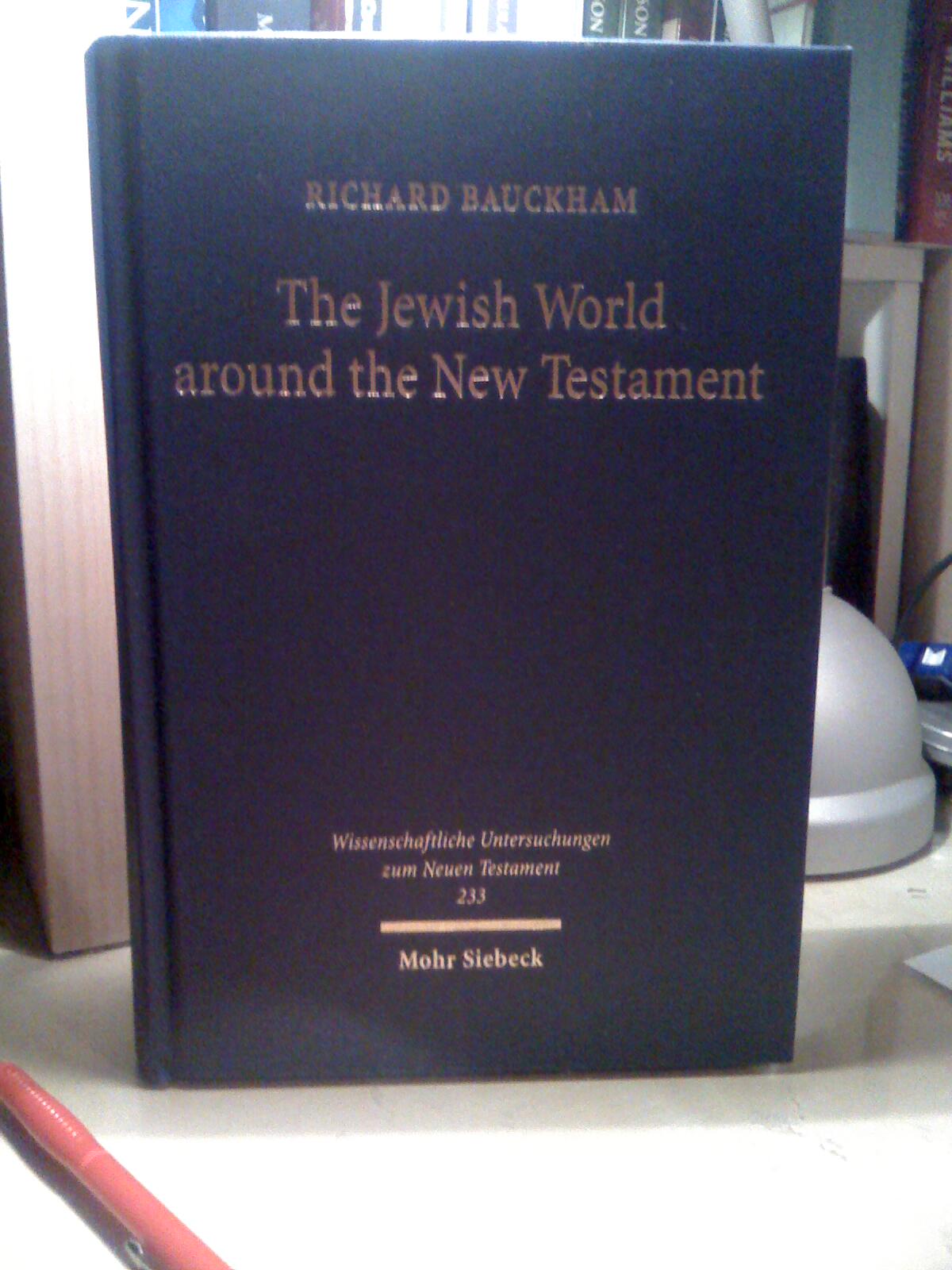
A huge thanks to Richard Bauckham for kindly sending me a signed copy of his new Mohr Siebeck collection of essays, The Jewish World around the New Testament – a book I mentioned previously here.
It is almost all I've been reading for the last few days ... it makes for hundreds of pages of immensely stimulating reading, and not a few 'aha' moments.
Sometimes the depth of Richard's scholarship is quite intimidating for those of us who spend hours every day in research but still know we are light years behind in knowledge. But I noticed that the oldest essay in this collection was published in 1976 – just a year after I was born! Somehow that comforted me!
My thanks again, Richard. Not sure if the "I'll send you my book when it is published" line really carries too much significance, but I will do!
Boy oh boy I am working through a VERY busy period at the moment, so any thoughts on the following will be appreciated. The essay titles are for second year undergrads.
Bear in mind that obscure or expensive books may not be at the top of my list to order for our library!
Seriously, your thoughts are much appreciated as ever.
UPDATE: As this post was completely unclear (I was very tired when I wrote it!) let me try again: the essay titles are already fixed (not related to the previous but one post) and I wanted suggestions for a reading list for each essay. Help is appreciated!
I would actually appreciate any thoughts you have on good essay titles for a first year degree course (introduction to the NT).

Thanks to Paternoster for a review copy of What are we Waiting For? Christian Hope and Contemporary Culture, ed. by Stephen Holmes and Russell Rook.
Few things make for as much fun as bashing certain forms of crazy popular evangelical eschatology with a decent bit of scholarship. This volume includes essays, under the section headed Hopeful Word by Stephen Holmes ("Introduction: The dangers of being Left Behind"), John Goldingay ("Eschatology in Isaiah"), I. Howard Marshall ("Eschatology at the Heart of New Testament Theology"), Richard Bauckham ("Eschatology in the Book of Revelation"). Under the heading Hopeful Church there are essays concerning eschatology and the Church Fathers, evangelical history, mission, hell and heaven. Under the heading Hopeful Culture there are essays on eschatology and such themes as imagination (by St Andrew's Trevor Hart), pop culture and politics (by Luke Bretherton of King's College), including other issues. The final section, Hopeful Word, deals with environmental issues, among other matters.
In other words, there is a wealth of helpful information here all rightly motivated by the claim eschatology rightly conceived is of profound relevance for contemporary life. Some will find essays in this book provocative yet it could just be the best inoculation against the various whack-job eschatologies on the market, especially those haunting the evangelical bookstalls.
Speaking of eschatology, I am rather excited that we have Andrew Perriman (author of RE:Mission; The Coming of the Son of Man, Otherways) guest lecturing at St Mellitus next week.

Thanks to the kind folk at Wipf and Stock for a review copy of Paul by W. Wrede originally published in 1904 (Eng. trans. 1908)
Yes, not exactly hot-off-the-press, but in the field of biblical studies 'new' does not necessarily mean 'better'. Of this little book Schweitzer opined:
'It belongs, not to theology, but to the literature of the world'
I'm hoping for similar comments on the back of my first book...
Wright: "Chris' book makes the rest of us look like we didn’t purposefully write our books at all, but merely randomly jabbed at a keyboard for a while"
If you read Schweitzer's classic, The Mysticism of Paul the Apostle, you will start to get a feel for the importance of Wrede. You can find an able summary of Wrede's Paul in a chapter of S. Westerholm's Perspective Old and New on Paul.
Yes, of course, Wrede's book is seriously dated in many respects and some of his conclusions will seem naive to many modern readers, but if you wish to attempt a history of research on Paul in the 20th century, there is no better place to start than with Wrede's Paul.
By the way, against those scholars who emphasise the importance of social-scientific categories and social developments as if this should stand over against Paul's theology, as if concerns with Paul's theology were merely the preoccupation of a 'history of ideas' separated from the real stuff of scholarship, think on Wrede's words in his author's preface:
'[I]t is in [his] theology, to a very great extent, that the historical importance of Paul is to be found' (vii).

You surely know the catchy old techno classic "happiness" *umpf* *umpf* "and lonliness" *umpf* *umpf*? Namely Dj Tomcraft's 'Loneliness'
Simply replace every occasion of the word "happiness" with "holiness" and every "loneliness" with "righteousness", and hey presto we have another CTRVHM Music Ministry classic.

I've finally put it on my server so it can be downloaded as a pdf here.
I wrote this rather extensive summary and short critical reflection on Richard Bauckham's Jesus and the Eyewitnesses quite some time ago, largely adapted from my earlier blog series. I ended the essay with these words:
'Time will tell whether [Bauckham's] thesis comes to exercise a similar influence on New testament scholarship as the speculations proffered by Bultmann and co. Whether co-opted by conservative Christians in the cause of defensive apologetics-at-any-cost, or whether denounced or dismissed by critics as the work of intellectually dishonest confessionalism, the depth of Bauckham's scholarship is incontrovertible. His arguments are here to stay and, I hope, will profoundly shape the unfolding debate.'
Well done Topalov (presently the highest rated player in the world) for this impressive game!
http://www.chessbase.com/newsdetail.asp?newsid=5218
I'm no Kasparov but I enjoy chess, and the following blitz game is one of my favourites. I was White (click here to play through my game)
1.e4 d6 2.d4 g6 3.Nc3 Bg7 4.h3 Nf6 5.Nf3 c6
6.Bc4 0–0 I didn't know this opening but I could see that 7...Nxe4 8. Nxe4, d5! was a threat. So I slid my bishop out of harm's way.
7.Bb3 d5 8.0–0 dxe4 9.Ng5 e6
At this point I realised I had lost a pawn after the exchanges on e4, but it was too late to back out of it.
10.Ngxe4 Nxe4 11.Nxe4 Qxd4 My opponent captures with the Queen no doubt hoping that I would exchange Queens and thus head into a quieter position a pawn down. Of course, being a pawn down I needed to keep things lively, so I kept Queens on the board.
12.Qe2 Na6 13.c3 Qd8 14.Rd1 Qc7
But by this point I realised that the lost pawn, which lured his Queen into the middle of the board, had actually won me quite a bit of time. I could simply develop pieces attacking his Queen and he had to waste moves getting her out of harm's way. Now I was well ahead in development and started to feel very comfortable with my position, despite being a pawn down.
15.Bg5 b6 16.Qe3 Bb7
I enjoyed playing my 16th move, Qe3. Its straightforward logic appeals to my eye. It coordinates my attack on the weak squares around his King. My lead in development has given me the initiative; I get to make concrete threats.
17.Nf6+ Kh8 18.Rd7 Qc8
My Rook enters the heart of his position and things are looking great until ...
19.Rad1?
If I remember rightly, the second I played this one I saw it was a mistake. He can now play 19...Nc5 forking my Rook and Bishop, and after I retreat my Rook I lose that beautifully placed Bishop for Knight.
19...Nc5 20.R7d6 h5??
But 20...h5 by my opponent is a real blunder and I have no idea what he was thinking. I get to keep my Bishop and his King's position becomes even more fragile, as the following attack shows.
21.Bc2 Qc7 22.b4 Na6
I loved playing 22. b4 which showed my total control of the whole board.
23.Rd7 Qc8 24.Qe5 c5
By this point I had seen a sacrificial idea with my Bishop. I strengthened the variation by putting the Queen in the middle of the soon-to-be unveiled plan of action, with 24. Qe5. Now everything was set for the attack
25.Bxg6! fxg6? 26.Rxg7! Qc6
His move 26...Qc6 alows a mate in one, but every move ultimately leads to a forced mate now. If 26 ...Kxg7 then 27. Ne8 Kf7 28. Qf6 Kxe8 29. Qe7 mate.
27.Rh7# 1–0
Of course, even my mistakes turned out well so a fair amount of luck was involved in the above. But I like the sort of games where I have a rolling initiative in an uncluttered position, where I get to make threats and develop an attack without worrying about my own King. So this is one of my all time favourites.
Out of the New Testament writers, I would put my money on Paul winning against the rest. Although I sometimes wonder if he would get himself into unnecessary complications...

Mohr Siebeck have published a volume of Richard Bauckham's collected essay with, if I remember rightly, one more volume to follow.
Richard Bauckham, The Jewish World around the New Testament: Collected Essays I (548 pages worth!). Here are some of the articles:
Boy oh boy do I want this book, especially as there are quite a few articles that I have not yet read. Some of them are well known, and I will never forget reading 'The Restoration of Israel in Luke-Acts' which helped a lot of mental cogs finally click into place.
 As a celebration of the official launch of "Scripture, Ministry and the People of God" I (Mark) have two copies of Eugene Peterson's "Under the Unpredictable Plant" to give away (A book that changed my life and helped me to hear my vocational call). All you have to do to be in with a chance of receiving one of the copies is, follow the blog (on the right hand side of the page), promise to add me to your RSS feed, and perhaps leave a comment or two! Finally, I would like to thank Chris for his help and support and Jim West has been a great sounding board for the original concepts for the blog. Thank's guys! UPDATE: I will announce the book winners towards the end of February.
 In my role as “[theologian] in residence” I seek, as Anderson explains, “to interpret scripture, tradition and praxis, in order that the contemporary praxis of both church and world can be transformed” (Ray Anderson, The Shape of Practical Theology, 2001, p.33). As a minister who is helping a community understand who they are as the people of God and what that means with our particular context theological reflection is the method in which I am seeking to adjust or recalibrate the two horizons of gospel and mission so that they are horizontal. The task of theological reflection for the minister must not become a purely academic exercise. It takes place as an act of prayer and submission to God. It is explored within the context of relationship, Father, Son and Spirit and the community of God’s people. As we worship and pray, as we seek to listen to God and discern the movements of his grace in our midst we are indeed reflecting on the God revealed in Jesus Christ. As theologian in residence I am a “Practical Theologian” in service to God and his people, calling the church to its task of a missionary community established in Christ and thrust out by the Spirit.
My friend says (yes, I have friends! I pay well if people pretend to like me): Hi Chris!
Chris Tilling says: Hey mate!
Chris Tilling says: Got your e-mail, fantastic!! Was going to e-mail back shortly
My friend says: super
My friend says: oh no problem
My friend says: are you gonna be around?
Chris Tilling says: well, I will be in London but working. Would be great to see you though
My friend says: cool
My friend says: Well I have a question about the bible: For the first time yesterday I started to think that maybe not all of the NT texts say the same thing. Because of a lecture on Romans [at Tübingen University], I have been confronted with Paul's soteriology and teachings about justification. But then, and this is the point, I read James and I think Paul and James really don't say the same thing. On top of that, I read some more and it also seems that Matthew, Hebrews and Revelation don't really say the same thing about 'justification by faith alone'. So now my question is: Who should I trust? Is Paul the only one who is right? Does that mean that Matthew faked some of Jesus sayings, because they seem to contradict justification by faith alone?
Chris Tilling says: Great question! Now this leads to the heart of what is called 'biblical theology'. JB Caird used the metaphor of a discussion round a table, with all of the NT authors (and ours) being brought to the table in conversation. Another model would be to say one is right, another is wrong (canon within a canon - Luther); or again, some may try to harmonise the various voices, to make them all sound the same (to a certain extent represented by conservatives like John Piper - though this is not exclusively the realm of the conservative); others would suggest an organising principle around which various voices can be heard as distinct voices, yet not harmonised or allowed to fall apart into confusion (I generally like this approach). Is there another way? I could suggest a number of books on this subject (like James Mead, Biblical Theology; the Hafemann edited, Biblical Theology; Pate edited, The Story of Israel)
Chris Tilling says: ... but it really is more than just reading books, it is a journey we need to take with the text as part of our mission in the world
My friend says: Definitely! I feel like I'm just beginning to break out of an understanding of the bible that maybe doesn't fit what it was intended to be. But it seems scary and dangerous...it has soooo many implications. E.g. someone preaches about a certain text like James and makes a theology out of it, it can become very dangerous. But the breaking out is also very freeing because I always tried to harmonise all of it in some way, only to struggle hard every time I read some texts in Matthew which speak of a judgment according to works. On the other hand I don't know if I'm 'allowed' to question scripture like that. Thank you for the picture- that helps.
My friend says: What do you think: Does e.g. James say something different from Paul about justification?
Chris Tilling says: Well, there are ways of harmonising, but I tend to think they probably say different things, at least emphasise different things! But I still think James needs to be heard as part of canon. Oh yes, forgot to mention, we must not forget the dependency of the canon on the church and its rule of faith - a matter I think should inform our interpretation (cf. a couple of chapters in Max Turner ed. Between Two Horizons, I think by Wall [I later checked and the essays were indeed written by Robert Wall, "Reading the Bible from within Our Traditions: The 'Rule of Faith' in Theological Hermeneutics" and "Canonical Context and Canonical Conversations")
My friend says: but would you say that Paul stands a little bit above everyone else with his theology, at least that is what they perhaps seem to imply here in Tübingen
Chris Tilling says: I think that needs to be determined by the nature of the 'rule of faith' (cf. the Wall essays). I suppose I tend to see Paul as the primary witness to the Gospel in this respect, and James functions, together with John's letters and Jude, as a balance, a canonical counterbalance. What do you think? (I had in mind here a book by David R. Nienhuis's Not by Paul Alone, which I mentioned previously here)
My friend says: Well, for me James was veeery helpful and I'm glad he's in the canon, because only through reading him can I understood a little bit about what is so special about Paul. Also I think he is probably one out of many Jewish Christians at that time who were trying to find a way of how to bring their Jewish faith together with the faith in Jesus. For James it seems to me that he maybe didn't yet realise how lost we really are?!
Chris Tilling says: I like your honest historical approach, interesting thoughts
My friend says: What is difficult for me: If e.g. Matthew and Paul have a different view about how we get justified than one of them must be right, right? But by saying 'Matthew' we are actually talking about texts where is says: 'Jesus said: ....' So if I wouldn't believe in Matthew's way of justification, then what I'm really saying is that either Jesus didn't understand it aright or that he never said those words, which would mean that Matthew 'faked' them. Of course there are probably many other ways of interpreting Matthew that wouldn't necessarily contradict Paul, but here in Tübingen that is what's being taught. But why do they never talk about the implication of their claims?
My friend says: What do you think?
.... I will stop our conversation at this point – which I sadly had to leave anyway shortly after – and let his question address you: what do you think?

Christ Sein, Küng

Existiert Gott?, Küng

Der Anfang aller Dinge, Küng

Colossians Remixed: Subverting the Empire, Brian J. Walsh and Sylvia C. Keesmaat

The Character of Theology: An Introduction to Its Nature, Task, and Purpose, John R. Franke

Shadow Sides. God in the Old Testament, Eric Peels

The Jesus Creed, Scot McKnight

Gebete des Lebens, Karl Rahner

Jesus and the Victory of God, N.T. Wright

Universal Salvation? The Current Debite, ed. by Robin Parry and C. H. Partridge