Friday, January 22, 2010

A guest book review: Stafford's Shaking the System

My thanks to the kind folk at IVP for a review copy of Tim Stafford's Shaking the System: What I Learned from the Great American Reform Movements (and may I voice a special "hurray" to IVP at the moment - they must be doing something right to get this kind of criticism). I feel privileged to have Stephanie write a book review for Chrisendom as she is one of these extremely talented people - artist, writer, intellectual - yea, one of them. But try not to hold it against her too much, cos she is also a very dear friend of this Tilling household! So without further ado, let me hand over to her.

Shaking the System Review

Ordinary Activism

When writer Flannery O'Connor was asked whether she thought the Iowa Writers' Workshop discouraged young writers, she answered "Not enough of them." Tim Stafford's stance toward young would-be activists in his Shaking the System has something of the spirit of her remark, though his is a gentle voice. This book will not produce a new wave of gleaming-eyed idealists: It says too much about the realities of actual activist work, about the grind of the long haul, about failure, about glory that never happens.

I've been a gleaming-eyed idealist, and when I found that brightness and hope and Big Ideas had, roughly, zero impact on injustice, that in fact the work of changing the world is slow, often painful, slow, disheartening, and slow, my Big Ideas fizzled, and I began to dislike activism. If I couldn't make everything better now, if I couldn't, in fact, save the world, then why bother?

Stafford's answer is, because there is truth. This is where he begins: If you want to be an activist, make sure you are on the side of truth. Remember that truth often. His next chapter is on resistance: what to do when no one gives a shit about truth (he doesn't put it that way). Expect this, he says.

From there he moves to pressure tactics, which involve the ethical, responsible use of power. The term "institutional sin," he says, is confusing: "People, not institutions or systems, are sinners." And yet, there is "web that binds people to injustice. It is not enough to simply present the truth and change people's hearts, one by one. Activists must change laws, institutions, habits and customs, for these bind people's dark hearts together into a formidable fortress. Activists must shake the system." In the U. S. abolitionist movement, he goes on to argue, it was finally "only the carnage of the Civil War" that accomplished change. Triumphalism is entirely absent from this book, as is a sense of activists as Knights in Shining Armor battling the forces of darkness. Instead there is a longsuffering familiarity with sorrow and with failure, with good coming about through devastating violence.

There is also personal honesty; Stafford first won my trust when he listed his own roles as an activist, early in the book. The list includes spending four years in Africa with his wife, helping to start a magazine for young people; it also includes writing letters to Congress, and helping to preserve a green space near his home. Stafford is not Wilberforce, and this makes me trust him, because I am not Wilberforce either. But Stafford has avoided the trap into which I've often fallen, of refusing to take any action if I can't be Wilberforce. Stafford's book is Christian in arriving at truth by paradox. On one hand, he points out that activism is harder, slower, more daunting work than I'd been willing to admit; on the other, he points the way toward starting small, with the activist equivalent of loaves and fishes—of giving what I have.

Stephanie Gehring

Sunday, January 10, 2010

Introducing Mark

Over recent years I have developed a friendship with someone called Mark. Since then we have discovered that we are both passionate about theology and biblical studies and have enjoyed many a lively discussion. Actually, I have learnt much from him. I thus asked him recently if he would like to 'guest post' on my blog now and then – and he gladly agreed.

By his own admission, Mark is not too computer literate, so I will post his texts as 'guest posts' – but I will always make it clear that Mark is the author. I will do this as Mark and I certainly do not always see 'eye-to-eye', yet I always enjoy interacting with his often provocative (and even hilarious), but shrewd, insights.

So knowing Mark, this post is also a disclaimer (actually, he was the one who urged me to add this bit): when posts are distinguished as Mark's 'guest posts', I am not necessarily in agreement with either the style or content of his blogging. This has to be said knowing the political nature of blogging, the importance of attribution, as well as the sometimes delicate disposition of certain readers who may strongly disagree with Mark (and may wrongly attribute his assertions with my own online persona!)

Anyway, he don't yet know if his excursion into the world of blogging will be a lasting feature, but I do hope you enjoy Mark's contributions, however many there may be.

Thursday, January 07, 2010

Desire for God

I've been reading Augustine recently and have rediscovered the enormous significance and spiritual power of desire and joy in God. Of course, he famously wrote in his Confessions: 'You stir man to take pleasure in praising you, because you have made us for yourself, and our heart is restless until it rests in you' (I.1), but he was constantly on about it. James Smith deliberately makes a similar point in his new book, Desiring the Kingdom, in relation to Victoria's Secret!

'I suggest that, on one level, Victoria's Secret is right just where the church has been wrong. More specifically, I think we should first recognize and admit that the marketing industry – which promises an erotically charged transcendence through media that connects to our heart and imagination – is operating with a better, more creational, more incarnational, more holistic anthropology than much of the (evangelical) church ... Christians will tend to say, "Ah, but that's not love – that's eros, not agape!" But romantic theology refuses the distinction because it recognizes that we are erotic creatures – that agape is rightly ordered eros' (77, 79)

I'm not yet sure how this insight might look in practice, but I love the point he is making!

The Magnus phenomenon gathers attention

"Vladimir Kramnik, former world chess champion and current No. 4, is playing in the first round of the London Chess Classic, the most competitive chess tournament to be played in the U.K. capital in 25 years. Tall, handsome and expressionless, he looks exactly as a man who has mastered a game of nearly infinite variation should: like a high-end assassin. Today, however, he is getting methodically and mercilessly crushed. His opponent is a teenager who seems to be having difficulty staying awake. Magnus Carlsen ..."

And I saw it with my own eyes. Though to be honest, Magnus seemed pretty awake to me!

Read more: http://www.time.com/time/magazine/article/0,9171,1950683,00.html

Monday, January 04, 2010

What to do with a 100 pounds Amazon voucher?

Gratefully received from my parents-in-law, but what should I spend it on?! A nice question, if ever there was one!

Some presently in my basket:

  • The Story of Christianity - David Bentley Hart
  • In the Aftermath: Provocations and Laments - David Bentley Hart
  • Martin Heidegger - George Steiner
  • The Politics of Discipleship: Becoming Postmaterial Citizens (Church and Postmodern Culture) - Graham Ward
  • Philosophy and the Mirror of Nature - Richard Rorty
  • GloboChrist: The Great Commission Takes a Postmodern Turn (Church and Postmodern Culture) - Carl A. Raschke
  • Philo of Alexandria: An Exegete for His Time (Novum Testamentum Supplements) - Peder Borgen
  • A Brief Guide to Philo - Kenneth Schenck
  • Trouble with Strangers: A Study of Ethics - Terry Eagleton
  • Black Mass: Apocalyptic Religion and the Death of Utopia - John Gray
  • The Last Word - Thomas Nagel
  • Blue Parakeet - Scot Mcknight
  • Reading Hegel's Phenomenology (Studies in Continental Thought) - John Edward Russon
  • Science: Key Concepts in Philosophy - Steven French
  • Philosophy of Science: A Contemporary Introduction (Routledge Contemporary Introductions to Philosophy S.) - Alex Rosenberg
  • Early Narrative Christology: The Lord in the Gospel of Luke - C. Kavin Rowe
  • Eccentric Existence - D. Kelsey
  • After Finitude: An Essay on the Necessity of Contingency - Quentin Meillassoux
  • Badiou's "Being and Event": A Reader's Guide (Reader's Guides) (Reader's Guides (Continuum Paperback)) - Christopher Norris
  • After Theory - Terry Eagleton
  • A few Badiou books
  • Joan Stambaugh's translation of Heidegger's Being and Time
  • Christ in Evolution - Ilia Delio

Any thoughts, protests, additional recommendations?

Sunday, January 03, 2010

Happy New Year

... and a belated Happy Christmas!

Among my gifts (which, ok, I selected myself – but Anja at least wrapped!):

  • Hammann's biography of Rudolf Bultmann (Yeeeesssssssss!). Anja and I picked my copy up direct from Mohr in Tübingen while visiting her family for Christmas J. For a hardback Mohr Siebeck book, €49 is a good price.
  • Charles Freeman's A New History of Early Christianity (a deeper skim of which has actually not yet inspired me: too much loose reasoning. But we shall see.)
  • Hans Küng, Disputed Truth. Memoirs II. This one looks even more entertaining than his first volume. He is a genuinely warm person, he encourages fresh research and when he puts 'pen to paper' I always sit up and listen. He is a rare genius and thus always worth engaging with (yes, even by those who would ultimately reject aspects of his 'correlationist' programme)
  • A little book, a conversation with Eberhard Jüngel: Die Leidenschaft, Gott zu denken: Ein Gespräch über Denk- und Lebenserfahrungen. This was fun to read but at €14.80 for only 84 pages, this was too expensive. Couldn't help myself, though. In one memorable moment, he explained his difference to Pannenberg: 'what was of course in no way my thing - that was the apologetic basic position of Pannenberg. And that distinguishes me still from him' (54, my dodgy translation). It seems to me that an apologetic Grundhaltung remains particularly inappropriate for biblical scholars, and Tom Wright has rightly been critiqued (by e.g. Dale Allison and James Crossley) for his apologetically motivated remarks concerning Matthew 27:52-53 ('The tombs also were opened, and many bodies of the saints who had fallen asleep were raised. After his resurrection they came out of the tombs and entered the holy city and appeared to many'). Of course, it is quite silly to dismiss Wright's otherwise brilliant proposals on the basis of this example – something some are also prone to do!

Of course, I think it a real pity that my friend Jim West has decided to stop blogging. But I hope that he will return to it after a break.

Wednesday, December 16, 2009

Christian Universalism on the web

David Congdon has recently published an article for all to read on-line here. He is a bright chap, and argues for a thoroughly christocentric, not pluralistic, universalism which takes the missional imperative seriously.

Scot McKnight is also about to start a series asking whether Evangelicals can be Universalists. I'm really pleased that Scot is going to have a stab at this question in dialogue with Robin's book, The Evangelical Universalist.


Octopus snatches coconut and runs

Not particularly "theological" or "biblical", but what a great title for a fascinating BBC article. The video is not to be missed. It explains:
One of the researchers, Dr Julian Finn from Australia's Museum Victoria, told BBC News: "I almost drowned laughing when I saw this [video] the first time." He added: "I could tell it was going to do something, but I didn't expect this - I didn't expect it would pick up the shell and run away with it."

Wednesday, December 09, 2009

Where's the Wally (i.e., me)

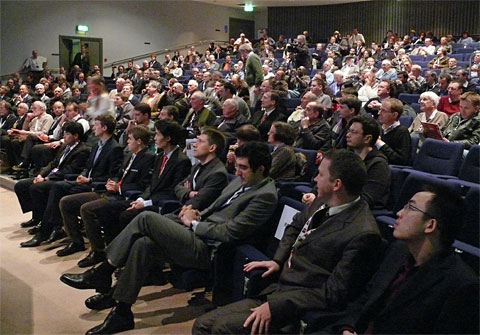
I took an afternoon off, yesterday, to visit the London Chess Classic, and the opening match between Vladimir Kramnik and the most exciting chess star around today, the young Magnus Carlsen. This was the first time I had actually seen these guys in the flesh, so in true geek style I was rather excited. In the picture below, in the front row, you can see, starting closest to the camera, Ni Hau, Nigel Short, Vlad Kramnik, Michael Adams, David Howell, Magnus Carlsen, Luke McShane, and Hikaru Nakamura.

Where's the Wally? (The receding hair line gives me away!)


(Photo by Frederic Friedel and Pascal Simon, on http://www.chessbase.com/newsdetail.asp?newsid=5972)

Saturday, December 05, 2009

Some unique Amazon Christmas gift ideas

Here you can buy what is called a 'Gentlemen's Ball Scratcher', which comes with two nice features:

  • Handheld Chrome effect Ball Scratcher, Presented in a deluxe metal case.
  • This quality silverware utensil is dishwasher safe, and has a stain resistant surface.

As one astute reviewer writes on the Amazon site: 'I've been using the ball scratcher for almost a day now, but have to say that it should be used with care. It seems to have upset several of the people whose balls I've tried to scratch with it. Maybe it's best kept for personal use.'

Yes, maybe a good idea.

Or here you can buy the 'Gentleman's Willy Care Kit', which comes complete with a Fluffing Brush, Styling Shear, Sprucing Mirror, and a Metal Bracelet all packed in a Fine Leatherette Box.

As one reviewer comments at Amazon: 'I used to be ashamed of my willy. People used to point and yell 'What an unkept willy!' I was bullied at school. But then I bought the Gentleman's Willy Care Kit, and now, instead, people yell 'What a fantastic willy!' and all my friends think I'm really cool'

A moving testimony.

By the way, if you were wondering: I happened across these items because I was looking for a head massager like this one. OK? I wasn't looking for anything else. Just so you know.

Wednesday, December 02, 2009

From Fundamentalist to ... what?

As is well known, many theologians who develop away from a conservative / fundamentalist Christian background tend to 'fall off of the horse the other side' by becoming some sort of atheist fundies.

Yet those of us who avoid this often end up in a haze of indecision, in a sort of theological 'no man's land' that I think can best be characterised as one which has lost its nerve. Of course, many of us have to journey through long periods of questioning and doubt, something I think intrinsic to healthy spirituality, but I for one don't want to live there on principle. Indeed, I am positive that there is a place of confidence, the other side of that healthy doubt through which many of us have had to mature. It is a confidence based not on foundationalist certainty, but informed gut instinct.

Links

There is a great discussion in the comments to the previous post. I am delighted that Doug Campbell (under the name of his wife, Rachel) and Michael Gorman are both involved in debate, all of which is really helping me in the process of digesting and weighing Doug's proposals.

Of course, Michael Gorman has shared his thoughts in a little more detail on his own webpage, but Sean Winter too has some reflections worth reading. I tend to be fairly cautious as an exegete, but this time I think I have a clear preference ... but I will share my thoughts later, after a little more meditation (I personally blame the OCD for this kind of dithering). The final decision certainly has concrete ramifications, not to mention a knock on effect for the rest of my theology.

On a slightly different note, only 21 days until Apple & Stone's debut album is released!

By the way, Anja and I got a 'Christmas reception' invite from Lambeth Palace today! We have officially arrived!

Finally, a question: can anyone tell me what the freaking heck all of this 2012 'end of world' stuff is about? One punter is even offering a free e-book on the subject, in which he confidently claims "On December 14, 2008, the First Trumpet of the Seventh Seal of the Book of Revelation sounded, which announced the beginning collapse of the economy of the United States and great destruction that will follow".

'Righty ho, then', as Ace Ventura says. While not getting into the spirit of it entirely, perhaps, I suppose this little inside prophetic tipoff means we can continue unabated in a veritable feast of sins, so long as we repent on the evening of the 13th December...

Tuesday, November 24, 2009

SBL highlights

For more than just a few of us, SBL is a real annual treat. Some of my highlights:

  1. the precious times of ruckus laughing while getting up to no good, especially with Jim West
  2. the meal with the Wipf & Stock crew, who kindly invited me to join their festivities last night. I don't think I have ever eaten so well. What a flippin great bunch of people they are. I got back to my room feeling like I had eaten half a cow (which wasn't far from the truth)
  3. time with Robin Parry, David Vinson, Max Turner, Doug Campbell, and other friends.
  4. the superb review session on Doug's extremely important book, The Deliverance of God. The formal responses from Douglas Moo, Michael Gorman and Alan Torrance were supplemented by short audience participation from Richard Hays, Tom Wright and Barry Matlock. Campbell handled the discussion masterfully and I don't think anyone provided a clear refutation of his exegetical claims – at least in the session. A private conversation with Richard Hays afterward gave me food for thought. But the strength of Doug's thesis surprised me; it is here to stay and needs more serious engagement in the future. Those who dismiss Campbell's work do so at their own peril. Are we seeing the changing of guard in Pauline scholarship, the bursting onto the scene of a new paradigm which will leave the former in many ways redundant?

Friday, November 20, 2009

Arrived in New Orleans

And had a great evening checking out Bourbon Street with Jim West. Bit shocking though. Let's just say that there weren't only chicken breasts in shop windows for all to taste and see. I.e. it is a bit of a mini-Amsterdam. We turning the street, after a lovely meal, and the culture changed 180 degrees. High culture shops and well dressed (well, just dressed) people, in complete contrast with the New Orleans just one street away. Variety is the spice of life, I suppose!

Tomorrow morning I'll head asap to the book hall over the road in Marriott. Perhaps see some of you there! Here are some of our pictures from tonight.

Thursday, November 19, 2009

Off to SBL

And I'm looking forward to getting up to no good.

I will land at Louis Armstrong International, New Orleans, 15:52 tomorrow. If anyone is around at that time and wants to catch a Taxi to Sheraton Hotel, perhaps we could go together.

To recognise me: I'll be the chap standing on chairs preaching in public, telling people to turn from the wickedness of Jazz to the righteousness of tamborines and popular Christian Rock.

Wednesday, November 18, 2009

Thursday, November 12, 2009

The Jesus and the Eyewitnesses thesis advances

In the Svenska Exegetiska Sällskapet 74 (Uppsala 2009), Richard Bauckham has published a new article, 'The Eyewitnesses in the Gospel of Mark', developing aspects of his groundbreaking Jesus and the Eyewitnesses thesis. One major part of that work, and one of its main innovative proposals, is that the Gospels are not only based on eyewitness testimony, but that the Gospels have ways of indicating their main eyewitnesses (see my two earlier posts on this matter here and here). His new article explores this proposal once again with special focus on Mark's Gospel. He responds particularly powerfully to Jerome Murphy-O'Connor's critique in RB 114 (2007).

'Given the stress that B. has laid on the preference of ancient historians for eyewitness testimony, one might have expected to find that it was they who directed his attention to the device of the eyewitness inclusio. In fact, he does not bring them into the argument at all…. For extra-biblical parallels B. has to go to Lucian's Alexander (C2 AD) and Porphyry's Life of Plotinus (C4 AD)' (p.626)

Murphy-O'Connor asserts that these parallels are not only irrelevant, because of their dates, but they also 'cannot be evidence for a literary convention in popular lives of such figures' (Bauckham's summary, 23). Bauckham's response seeks to offer the kind of evidence Murphy-O'Connor seeks, and to this end he examines Polybius and Plutarch. In both cases we read extremely compelling evidence that 'some of the personal names in the Gospel of Mark indicate the eyewitness sources of his narratives, especially in the cases of Peter, Simon of Cyrene and the three named women disciples' (37). In particular, material from Polybius shows that Bauckham's Markan eyewitness inclusio is highly plausible, and Plutarch's Life of Caesar presents evidence to affirmatively answer the question whether there are 'parallels in Greco-Roman history and biography to such a practice of indicating eyewitnesses without explicitly saying this about them' (33).

To be honest, I think Bauckham has hit a home run with this new evidence. His argument is very compelling.

Monday, November 09, 2009

Out from biblioblogging exile

With three posts of top theological class and erudition.

I thank you.

It's all in preparation for SBL, of course, and I'm looking forward to seeing some of you in a couple of weeks in New Orleans.

Forthcoming Magazine Teaser


America's Next Top Model Shock